From the archive: We present pivotal content from past decades of First Analysis research.
Internet investment strategy: The FAC 3E framework

The Internet is more than a fad — it is a new computing paradigm that is fundamentally changing the way people access, obtain, and use information. As the industry overcomes various obstacles and limitations, the Internet will realize its full potential. We believe companies with solid business models that slightly anticipate the Internet’s evolution, as measured by factors such as speed, security, and organization, will generate high returns.
In this report, we use the FAC 3E framework to lay the foundation for an Internet investment strategy.
TABLE OF CONTENTS
Introduction
Overview of the FAC 3E framework developed to understand the Internet’s evolution and evaluate investment opportunitiesThe FAC 3E framework: Enablers, Extenders, Embracers
Summary of three broad opportunity categories for the Internet: enablers, extenders, and embracersEnablers
Four sets of companies that provide the infrastructure, connectivity, basic software, and standards that allow the Internet to exist at a basic levelExtenders
Critical segment of companies that extend the capabilities of enablers by relieving bandwidth constraints, solving security problems, upgrading initial software platforms or organizing informationEmbracers
Pure-play Internet companies that entirely base their value propositions and business models on embracing the capabilities provided by the enablers and extendersGeneral implications for all businesses
Companies will need to embrace this new paradigm to remain competitive, using the Internet as a strategic weapon to lower costs, increase sales, build market awareness, and move closer to end-users.
Introduction
The Internet has received unparalleled media coverage during the past 12 months, and the spotlight intensifies with every passing day. From all this hype, one might believe 1997 will be the year shopping malls close, the postal service shuts down, and TV stations go bankrupt because all commerce, mail, and entertainment will be delivered via the Internet. While there is no question that Internet growth has been and continues to be staggering, it is just as clear that it will not replace traditional forms of commerce and entertainment overnight.
Investors, both in the public and private markets, are investing capital in Internet companies at astonishing rates. This frenzy of buying has pushed valuations to extremely high levels. But even after stripping the Internet of its hype, we still see compelling investment opportunities, and we believe fundamental research and analysis will help identify the most attractive opportunities. We expect the Internet to go through multiple life cycles, and we feel the best opportunities will come from companies targeting technologies and applications that are consistent with the Internet’s stages of evolution.
For example, the Internet’s user base, infrastructure, and design have made it an ideal forum for transferring text-based messages (i.e., e-mail). The evolution of the Internet is at a state that makes e-mail faster, cheaper, and more reliable than most non-digital alternatives. However, e-mail as an investment vehicle is at the end of its life cycle. In contrast, the Internet has not yet evolved to support video conferencing. Bandwidth, limitations of software platforms, and security concerns make this use of the Internet impractical today, placing video at the front-end of its life cycle. We believe there will be a time when such applications will be viable. However, the evolution that must take place is so complicated that it is impossible for anyone to predict the timing of such capabilities with any certainty. Therefore, it is speculative to invest in companies with very-early-life-cycle applications.
In summary, we believe timing of the multiple evolutions of the Internet will play an important role in determining which sectors and companies will outperform their peers. We have developed the FAC 3E framework to understand the Internet’s evolution and evaluate where the best investment opportunities lie at any given time. Our intent is to present this framework in a conceptual, nontechnical, and non-company-specific format that focuses attention on the fundamental market opportunities.
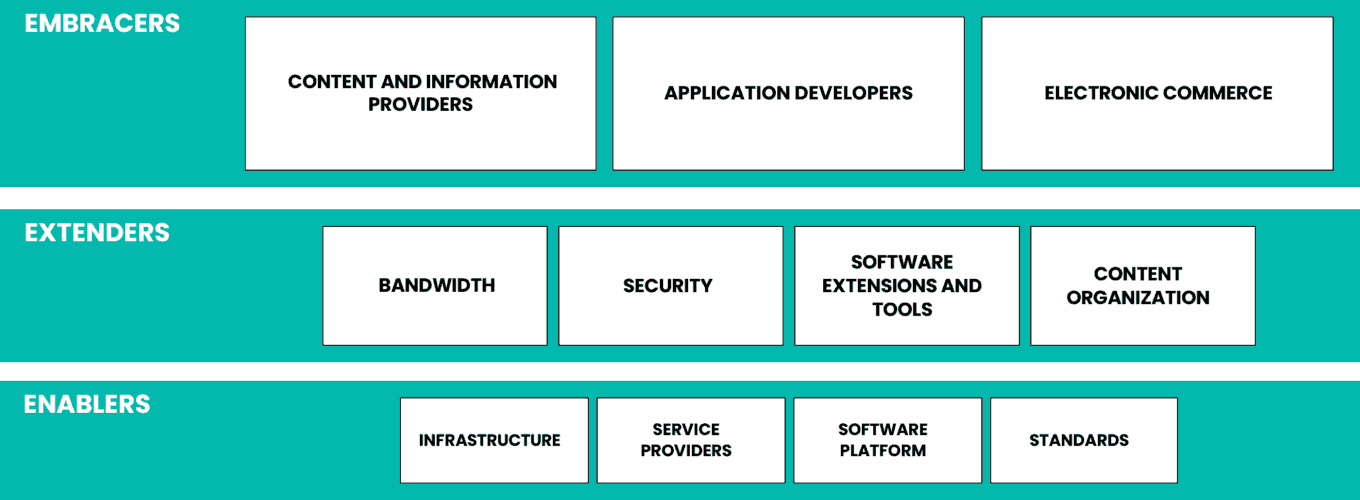
The First Analysis 3E Framework
Source: First Analysis.
The FAC 3E framework: Enablers, Extenders, Embracers
We have identified three broad opportunity categories for the Internet: enablers, extenders, and embracers. Products and services in the enablers group enable Internet use by providing basic infrastructure, connectivity, viewing capabilities, and widely-adopted standards. Products and services in the extenders category extend the enabling technology and propel the Internet into mainstream society by increasing bandwidth, solving inhibiting security issues, upgrading the software platform, and organizing masses of information. Products and services in the embracer category will embrace the capabilities improved upon by the extenders to create dynamic content and applications as well as enable true, widespread electronic commerce. We think this group will eventually become the largest because all businesses (not just information technology companies) will embrace Internet technology as a strategic weapon, incorporating it into their core processes to increase productivity, decrease costs, and move closer to customers.
I. Enablers
The enablers group has existed since the Internet began. It includes four sets of companies providing the infrastructure, connectivity, basic software, and standards that allow the Internet to exist at a basic level. Substantial deployment of enabling companies’ products and services in the four areas has fomented the substantial growth of the Internet during the past several years.
The companies in the four enabling categories share a key characteristic: Even though the enabling phase is still in its early stages, enablers are the most advanced in their development of all the Internet companies. Thus, this category contains many public investment opportunities. However, the four groups differ significantly in other respects.
Infrastructure
Though the Internet has existed for more than 25 years, the Internet infrastructure had to be expanded and upgraded to accommodate the millions of new users rushing online, and the need for further expansion and upgrades persists. Therefore, companies providing infrastructure have been excellent Internet investment plays. These companies provide the modems and the high-speed switching and routing equipment that make up the backbone of the Internet. We also include the existing telecommunications infrastructure providers, such as providers of fiber optic lines. However, due to the wide availability and the commodity nature of fiber capacity, we do not see telecommunications lines as a viable Internet investment opportunity at this time.
| REPRESENTATIVE KEY PLAYERS — INFRASTRUCTURE |
|---|
| Ascend Communications Inc. (ASND) |
| Bay Networks Inc. (BAY) |
| Cisco Systems Inc. (CSCO) |
| Sun Microsystems Inc. (SUNW) |
| 3Com Corp. (COMS) |
| U.S. Robotics Corp. (USRX) |
Two characteristics of the infrastructure business have made it appealing for investment. First, unlike many of the ideas being promoted for the Internet, infrastructure is here and now. The hardware backbone must be in place for all the other Internet businesses to thrive. Therefore, entities that depend on the backbone have been very willing to pay billions of dollars to build, maintain, improve, and expand this system.
Second, the infrastructure equipment sales generate immediate profit. Unlike most Internet businesses that promise revenue and profit after a period of market, business, and technology development, the infrastructure players receive 100% of their revenue at the time of sale. This greatly reduces risk for investors.
Remaining investment risk comes from two primary sources: the potential for technical obsolescence and the potential for slowed growth in sales. Certainly, there can be no guarantees that the publicly traded infrastructure players will maintain their technology lead. However, it stands to reason the major players, with their stock as currency and their strong distribution channels, will be able to buy new technologies as they are developed. A recent example is Cisco Systems Inc.’s announced intention to acquire StrataCom Inc. This is not to say small niche plays will not be available. In fact, they may make excellent investments simply for acquisition potential.
Regarding the potential for slowing growth, we believe the infrastructure build-out is still in its early stages. Demand for infrastructure is a function of two factors: number of users, which we expect to increase significantly, and intensity of use, which should also increase greatly with increases in the number and sophistication of Internet-based services.
Service providers
Just as the infrastructure for the Internet must be in place, so must a way to connect to this infrastructure. Providing this connectivity has been the business plan of literally hundreds of companies. Unlike infrastructure companies, which receive payment for their products immediately, most Internet service providers (ISPs) receive little or no revenue when a customer is initially connected. These companies rely on the promise of recurring revenue from an ever-growing customer base.
We evaluate ISPs in a manner similar to that used for traditional subscription businesses. Where barriers to entry or switching costs are low and service quality is roughly equal, users will migrate to the lowest-cost provider. Likewise, where barriers to entry and switching costs are high and ISPs are able to differentiate based on service quality or other features, there will be room for many niche ISPs that match service offerings with end user needs.
| REPRESENTATIVE KEY PLAYERS — SERVICE PROVIDERS |
|---|
| America Onlince Inc. (AMER) |
| BBN Corp (BBN) |
| CompuServe Inc. (CSRV) |
| Netcom On-Line Communications (NETC) |
| PSINet Inc. (PSIX) |
| Uunet Technologies Inc. (UUNT) |
| MFS Communications Co. (MFST ) |
In the residential market, barriers to entry are low as quality and references are not critical and ISPs’ hardware infrastructure capital requirements are manageable. In addition, we believe the costs of switching providers, the most important of which is a change of Internet address, are minimal for residential subscribers. We believe an appropriate analogy is long-distance telephone service, where individuals routinely switch carriers.
With both low barriers to entry and an inability to lock in customers, cost structure and marketing become key investment considerations. We are skeptical that any of the dedicated residential Internet access providers will have lower costs than companies that already have elaborate infrastructures (principally the established local and long-distance telephone companies, which have sophisticated billing and collection systems and the ability to bundle services). Furthermore, these companies have tremendous marketing power and name recognition. Despite offering lower prices, upstarts cannot compete with the marketing muscle of the three major residential long-distance telephone companies, AT&T Corp., MCI Communications Corp., and Sprint. We feel a similar scenario will emerge in the residential ISP market. Thus, we do not view it as an attractive opportunity.
In the business market, two factors, 1) quality of the network (users’ ability to connect to the Internet and achieve the speed of data flow promised for the level of service they have paid for) and 2) customer support are the key considerations in choosing a provider. In the general ISP market, many providers have poor service and customers are often locked out of the Internet due to inability to connect or inconsistent connections. Thus, business ISP customers demand account references and high-quality networks, as well as value-added services such as consulting and server co-location.
These dynamics of the business segment require providers to make significant capital outlays to credibly enter the market. Thus, we expect relatively higher barriers to entry for business ISPs. Also, there is a greater cost associated with switching ISPs for a business than a residential customer. These costs include researching the quality of a new provider, physically moving co-located servers, and losing productivity due to down time and inefficiencies associated with the new ISP having to learn the business’ needs.
For these reasons, we believe the business market offers intriguing opportunities for nimble ISPs focusing on fulfilling the needs of small- to mid-sized business clients who cannot command the attention of the large telecommunications companies. Again, the long-distance telecommunications market, which has spawned hundreds of profitable companies that compete for business customers, is analogous.
We note that the recently announced merger between MFS Communications Co. and Uunet Technologies Inc. will likely catalyze a consolidation of the business ISP market as large players, both inside and outside the industry, rush to lock up control of large corporate accounts.
Software platform
Arguably, the software platform, which enabled the creation of the World Wide Web, is responsible for the tremendous growth in Internet traffic. The software platform consists of two basic components: 1) browser software, such as Netscape Navigator, that allows users to view content on their monitors and 2) web server software, which allows companies and individuals to host published information that can be viewed with browser software.
Because this segment contained no public investment vehicles prior to 1995, it received little investor focus. However, Netscape Communications Corp. and Spyglass Inc. emerged to fill this void and were later joined by Microsoft Corp. Because these companies’ products enable viewing and hosting information on the Web, demand for these products is phenomenal. In addition, intranet demand may well exceed total demand for traditional Internet use. For example, some industry sources estimate that companies will likely purchase five to 10 web servers for use on their intranets for each web server they deploy for the public Internet.
| REPRESENTATIVE KEY PLAYERS — SOFTWARE PLATFORM |
|---|
| Microsoft Corp. (MSFT) |
| Netscape Communications Corp. (NSCP) |
| Spyglass Inc. (SPYG) |
While we recognize the awesome demand drivers for this segment, we still believe there are major investment risks in this area. First, pricing pressure is tremendous, literally driving competitors to give product away. Second, the business models for these companies are unproven. To date, the trend has been to give away browser software to gain mind and market share. After establishing brand names, these companies have tried to make the majority of their profit by selling server software and related products. This strategy seemed to be working initially, however competition again has put downward pricing pressure on server software, prompting these companies to compete in the higher-value-added products and services discussed in the extender section.
Standards
Standards, while typically not a business opportunity, are a key component of the enabler category. When the Internet began (as a redundant communications tool for national defense and education), its users had many types of computer hardware and operating software. Therefore, standards were created to allow disparate computer systems to speak the same language. These standards include Transmission Control Protocol/Internet Protocol (TCP/IP) and Hypertext Markup Language (HTML). As the Internet has gained popularity, standards have been added. For example, Visa and Mastercard recently agreed on standards for the transmission of credit card information via the Internet.
Standards, both existing and emerging, have been and continue to be critical to the Internet’s growth. They have created a truly open, independent platform transcending both hardware platforms and operating systems. They have also allowed software engineers to focus on developing higher-level applications.
At the same time, the standards needed to sustain an open system hamper its evolution. Because no single company controls the standards, the process of upgrading and changing the enabling software technology is at the mercy of standards committees that move notoriously slowly even in the midst of fast-changing industries. The slow evolution of the original standards has prompted companies to promote new, proprietary extensions. These new software efforts have created opportunities discussed in the extender section below.
II. Extenders
Extenders, which extend the capabilities of enablers, are problem solvers that can be divided into four groups.
- Relieve the current bandwidth constraints,
- Solve security problems,
- Upgrade the initial software platform, or
- Organize the endless information available to the user.
The extenders are the most critical segment because their success in addressing these Internet problems will determine if and when the Internet is embraced by a wide range of entities to reach its full potential. The success of each extender group should create a wave of opportunity for embracers, as not all embracers require all of the problems to be solved. For example, credit card transactions do not need greater bandwidth, and real-time video does not always require better security.
Because extenders are critical to unleashing significant business opportunities for embracers, we believe extenders as a group, more than enablers and embracers, have strong potential.
Bandwidth
This group of extenders focuses on increasing the speed of network communications. Currently, there are bottlenecks at virtually every point in the Internet, including the vast majority of user terminals that are still connected to the Internet via modems. In addition, many Internet service providers and most corporations use data transfer protocols that can not handle the speeds necessary to avoid substantial time delays in accessing information. These are just a few examples of the myriad bandwidth limitations throughout the Internet.
Of all the extender groups, this one has the greatest industry focus because all applications will improve with speed. Additionally, many applications will never succeed without increased speed. Finally, internal business networks using Internet protocols (so-called intranets) represent a potential market that could far exceed the Internet in the short term, further driving the need for bandwidth.
As a result of the latent demand for increased speeds, the market opportunity is tremendous. Furthermore, like the enabling infrastructure players, these companies have proven business models receiving payments for equipment. To the investor’s benefit, the bandwidth issue is so pervasive that several disparate technologies will be required to solve it. For example, modem speed increases will not significantly improve Internet bandwidth if the backbone infrastructure speed is not also increased through faster routers and protocols. Thus, several varied businesses in this market should generate strong returns.
| REPRESENTATIVE KEY PLAYERS — BANDWIDTH |
|---|
| Cascade Communications Corp. (CSCC) |
| Fore Systems Inc. (FORE) |
| NetStar Inc. (NTSR) |
| Optical Data Systems Inc. (ODSI) |
| PairGain Technologies Inc. (PAIR) |
| Shiva Corp. (SHVA) |
| StrataCom Inc. (STRM) (Cisco) |
| 3Com Corp. (COMS) |
| U.S. Robotics (USRX) |
| Xylan Corp. (XYLN) |
| Zenith Electronics Corp. (ZE) |
While the demand is enormous, selecting winners in this segment will be difficult because there are many solutions being offered for each bottleneck in the system and none of them provides the perfect solution. For example, consumers face the choice between waiting for high-speed cable modems and the necessary infrastructure development at the cable companies or using ISDN technology that currently is expensive and difficult to implement. In aggregate, their decision depends on how long they must wait for cable modems to achieve their promise and how quickly ISDN becomes cheaper and easier to install.
Additionally, new technologies, such as those that increase the transmission capability of copper phone wire, may render these other methodologies obsolete. How the bandwidth issues are ultimately resolved depends on the relative technological advancement of the competing technologies, which today is impossible to predict.
Security
One of the most publicized problems of the Internet is security. The inherent openness of the Internet creates a dichotomy. While the open environment is one of the primary drivers of the explosive growth of online computing, it creates an opportunity for anyone to intercept the information as it passes through the Net. In addition, as companies allow outside access to their computer systems by way of the World Wide Web, they create a potential entry point for hackers seeking access to a company’s entire computer network, putting critical data at risk of being shared or damaged. Also, devastating viruses can be transferred when programs are downloaded and subsequently executed at the local network level.
As a result, many companies are hesitant to allow employees to access the Internet from work or to establish websites. In addition, perceived fears that credit card information may be gleaned from the network and then used in a fraudulent manner are making consumers wary of engaging in electronic commerce.
Because security is an obstacle to so many applications, the security segment should be an exceptional market opportunity for existing businesses and new entrants. There is room for various levels of security based on the information businesses are trying to protect. Large businesses, with the risk of losing literally billions of dollars if their networks are compromised, will be willing to pay premium prices for excellent security. Other companies may have less demanding security needs, but every network operator will desire some level of security.
| REPRESENTATIVE KEY PLAYERS — SECURITY |
|---|
| Cylink Corp. (CYLK) |
| Raptor Systems Inc. (RAPT) |
| Security Dynamics (SDTI) |
| Vasco Corp. (VASC) |
There are also many different types of security that can be offered including access control, encryption, firewalls, and authentication. Each represents a large market, and many different companies are likely to provide these capabilities. This group of extenders already has spawned several high-profile public companies, such as Security Dynamics and Raptor Systems Inc.
To date, investors have been wary that standards will eliminate the need for multiple vendors offering similar solutions. We disagree for several reasons. First, there are enough different security threats that one standard will not address them all. Second, there are too many entrenched companies competing successfully in this market for the majority of them to agree on standards in the near term. Finally, and perhaps most importantly, a single standard for security might allow a single method of corrupting the security system. Multiple security methods, ideally changing and improving over time, provide greater security against hackers than a single static system. We expect many quality plays in this segment.
Software extensions and tools
Companies in the software category of extenders focus on two broad areas: extending the initial software platform and creating application development tools. Both are important to the future of the Internet because they lay the foundation for dynamic, multimedia applications that are critical to the success of many of the embracers. We address these subsegments separately because of their differing market dynamics and business models.
| REPRESENTATIVE KEY PLAYERS — SOFTWARE EXTENSIONS AND TOOLS |
|---|
| FTP Software Inc. (FTPS) |
| Isocor (ICOR) |
| Macromedia (MACR) |
| Microsoft Corp. (MSFT) |
| NetManage (NETM) |
| Quarterdeck Corp. (QDEK) |
| VocalTec Ltd. (VOCLF) |
Extension of initial platform
The market for extending initial software platforms, such as HTML and first-generation client and server software, is enormous. These platforms were not originally designed to accommodate the varied tasks users are demanding. The market is so eager to improve the existing software platform that it has already heralded Java, a new language that has not even shipped production-quality product yet, as having changed the paradigm of computing.
Despite the hype, this subsegment will likely be tough from an investment perspective. The main risk is unclear or unproven business models. Many companies give away these languages to foster related business opportunities. This reduces the attractiveness of the market and the ability for new companies to offer competing products.
If a company has established mind share with free or virtually free product, it typically tries to develop and sell enhanced versions or it attempts to swap the free use of its products for maintenance and service contracts. It is unclear if this business model will work in the long run.
However, most of the software companies targeting this segment are also releasing products that have higher value-added capabilities. Investors should watch this segment closely as the entrenched competitors (Netscape, Microsoft, and Spyglass) all try to extend their initial capabilities by focusing on higher level offerings such as workflow products, application development tools, etc.
Application development tools
The opportunity for web application development and maintenance software is clearer. This software allows developers to concentrate on the functionality of their applications, not on writing to standard protocols. By using intuitive, visual environments, application developers can create media-rich, database-centric applications without the need to program in lower-level languages such as C++. This speeds the adoption rate of web-based applications.
We believe this market is poised for immediate growth because, during computing paradigm shifts, the development community is typically the first to embrace the new phase change. These products are needed to create high-level applications, just like Visual Basic and PowerBuilder preceded and allowed for a slew of applications in the client/sever arena. In addition, the business model follows the proven high-value software model of selling seat licenses for the product in both individual and group configurations.
The companies that build the most robust development environments should make outstanding investment vehicles. However, there are currently low barriers to entry, so there will be literally hundreds of companies competing. We expect only a handful to be big winners: Developers tend to prefer one tool, remaining brand loyal once they find one that meets their needs because of the significant time spent to master using the products. Critical success factors include:
- Developing products in extremely short cycles,
- Incorporating cutting-edge technologies into the environment quickly and seamlessly,
- Building widespread distribution and usage, and
- Retaining the trust of the development community.
Content organization
While the web has exploded as a significant source for published data, the task of finding relevant, usable information has become extremely difficult. Therefore, many search engines, such as those offered by Yahoo! Inc., Excite Inc., AltaVista, and Lycos Inc., have emerged to help users navigate the sea of available information.
| REPRESENTATIVE KEY PLAYERS — CONTENT ORGANIZATION |
|---|
| Excite Inc. (XCIT) |
| Lycos Inc. (LCOS) |
| Verity Inc. (VRTY) |
| Yahoo! Inc. (YHOO) |
These technologies are well-received by users. Today, they receive more hits than practically any other sites on the web. In fact, so many search engines have recently emerged that a search engine for search engines, called search.com, has surfaced. Currently, these sites are free to users.
From an investment perspective, this segment is difficult to get comfortable with for several reasons. First, the business models are generally unproven. Current businesses are basing their revenue streams on advertising payments. The hope is that as advertisers convert spending from traditional media to cyberspace, these search engines will be in a position to capitalize on this spending because of the significant traffic that flows through their sites. In addition, it is unclear whether these search engines will, as they hope, be able to participate in transaction revenue that is produced as a result of navigation through their sites. Additionally, entry barriers are low, and many search engines are testing the market. The investment thesis may be interesting in the long run; however, it remains to be seen if the business model will become viable.
III. Embracers
The embracers consist of all companies that will use the capabilities provided by the enablers and extenders to build businesses. This group will ultimately consist of virtually all entities as they redesign their operations to incorporate the Internet to remain competitive. By using Internet technology, these companies can lower their cost structures, increase their productivity, and broaden their coverage.
We focus on a subsegment of this group: pure-play Internet companies that entirely base their value propositions and business models on embracing the capabilities provided by the enablers and extenders. These companies will generally become content providers, application developers, and electronic commerce enablers. An example would be a business providing an intranet application enabling an organization’s employees to track and change their 401k allocations at any time. This hypothetical application developer’s business model is based solely on the sale of software written for the Internet and intranet platform.
Content and information providers
Much of the excitement the Internet has generated, especially since the advent of the World Wide Web, surrounds the content providers. Content providers have one aim — to have people access their content and to derive revenue from this access. The revenue can be a direct charge for accessing the content. Premium cable TV channels such as HBO provide a non-Internet example of this business model. Indirect revenue can be generated through advertising if enough people access the content. Free TV is an example of this type of model in the non-Internet world. Finally, hybrid models similar to traditional newspaper businesses should appear.
| REPRESENTATIVE KEY PLAYERS — CONTENT AND INFORMATION PROVIDERS |
|---|
| America Online Inc. (AMER) |
| CompuServe Corp. (CSRV) |
The content provider market is very attractive in the long run. The number of online users is estimated to be roughly 30 million and is projected to grow to 200 million by 2000. Additionally, advertisers are expected to spend roughly $200 billion annually in traditional radio, television, print, and electronic media by 2000, with only roughly 1% projected for the electronic form.
Clearly, the opportunity is huge if advertisers allocate more of the budget to online advertising. Advertisers are quite likely to spend more once interactive advertisements are effective. Internet-based interactive advertisements, because of their point-to-point nature, are unusual to the advertising world because they can trigger immediate purchases by the viewer. Also, advertisements have a new feature on the Internet known as links, where an icon or small advertisement will link a user to another Internet site where larger advertisements or product promotions can be made.
However, content providers may underperform the market in the short run due to some inhibiting factors. First, content providers are hampered by bandwidth limitations. Therefore, they typically offer only static, text-based documents that are unlikely to attract the initial trial and repeat business that is fundamental to generating revenue whether advertising or usage based. The embracers are banking on the extenders to relieve the constraints of Internet communication that limit the potential of content-based models.
Until these issues are resolved, we believe investors should be skeptical of many of these companies, particularly companies relying on multimedia content requiring significant bandwidth. While there will be a time when these companies shine, we think it will likely be later than investors currently anticipate, rather than earlier.
Second, the prices companies will be able to charge advertisers or users is undetermined. We view investments based on specific pricing assumptions to be speculative. This is particularly true of direct-charge content, as many current Internet users are connected through schools or work and thus may be unwilling or unable to pay extra for content.
We also believe a group of companies will emerge that will emphasize information over content. These companies will attempt to use web sites to provide information to help customers make purchase decisions. This information is intended to shorten the sales cycle and to provide effective, efficient customer service. Most of these informational sites will be hosted by existing firms, such as Federal Express, which has a web page allowing customers to track packages. Thus, there will not likely be many pure play investment opportunities.
Application developers
Application developers are companies writing software applications based on the Internet platform. Many of these applications, so-called intranet applications, will be targeted to run entirely within one organization to improve various business functions. Intranets enable businesses to measurably increase productivity and decrease costs for several reasons. First, the communications costs of using the Internet are roughly 20% to 50% less than for using a proprietary wide area network. Second, expenses of connecting disparate platforms are reduced because Internet protocols are independent of hardware and software operating systems. As in all computing paradigms, the quality of the applications will drive usage of the Internet platform and will determine the extent of savings and productivity gains.
We expect businesses to rush to adopt quality web-centric applications just as they demanded applications from PeopleSoft Inc. and SAP AG in the client/server arena. For quality companies with top-notch products, this space will provide excellent returns. The business models are well defined and similar to those of earlier computing eras.
The main investment risk is a reliance on the extenders to solve the inhibiting problems of security and bandwidth. Many of the applications will be time-sensitive and mission-critical and will transport confidential data. Therefore, users will demand improvements to both security and transport speed before widely adopting these Internet-intranet applications.
Another risk will be determining which vendors provide the best price-value equation. It is likely that start-up companies designing software solely for the Internet architecture will be able to effectively challenge entrenched client/server vendors trying to target their earlier applications to the Internet because the upstart’s products optimize the Internet’s capabilities. Existing client/server vendors may also hesitate to fully embrace the Internet for fear of cannibalizing existing sales and distribution channels.
Electronic commerce
Electronic commerce is much more than just a new distribution channel, it is an entirely new industry. While home shopping on television represented a new medium for vendors to reach consumers and buyers, order-taking and processing were still handled traditionally. Electronic commerce provides point-to-point connections between the vendor and the consumer or buyer, allowing orders to be triggered and fulfilled electronically. Thus, order processing time and costs should decrease substantially.
| REPRESENTATIVE KEY PLAYERS — ELECTRONIC COMMERCE |
|---|
| CyberCash Inc. (CYCH) |
| Premenos Technology Corp. (PRMO) |
The electronic commerce market should be quite attractive. The market potential is enormous, and market growth should be rapid. In addition, vendors will embrace this medium as a way to trigger more transactions and lower their costs of selling and distribution. Consumers and buyers will ultimately shop electronically for many staple items because it saves time and money. (It is interesting to note that electronic commerce will likely reduce the role of the middleman. This change should significantly alter the traditional logistics industry.) Therefore, many companies will emerge to offer transaction processing engines that can be incorporated into existing web sites, advertisements, or as stand-alone applications.
However, there are still several hurdles to clear before electronic commerce is fully embraced (despite the fact that this already is a significant industry). First, the shopping experience is not yet equivalent to traditional forums. For example, many shoppers are still wary of purchasing goods they cannot see, touch, and ask questions about. Second, the technologies that have emerged to date typically concentrate on the transaction process at the expense of merchandising.
Emerging electronic commerce applications will be differentiated by how much they help the vendor sell (merchandising), while the transaction processing side will become an afterthought as long as it functions correctly. Third, shoppers have a hard time locating vendors on the Internet, a problem to be solved with improved locating and navigating tools from the extenders. Fourth, consumers and buyers are still nervous about secure transactions.
These hindrances, when considered in totality, have the potential to push widespread adoption of electronic commerce far enough into the future to make most companies specializing in this area speculative investments.
General implications for all businesses
The Internet and its implications transcend the information technology arena. All businesses, regardless of where and how they compete, must embrace this platform to remain competitive. The Internet will help companies significantly reduce their costs and increase productivity, and eventually it will become a critical component of almost all businesses’ core processes. High-performing businesses will use the Internet in many ways, including the following:
Intranets — To reduce costs and increase productivity by deploying enterprise-wide intranet applications.
Virtual private networks — To reduce costs by using the Internet as a communications platform instead of more costly private leased lines.
New sales, marketing, and advertising channel — To reach potential users in a new way with the ability to trigger real-time transactions.
Online customer support — To improve and lower costs of customer service by enabling companies to communicate answers to typically asked questions via the Web with text, image, video, etc. to lower response times and the associated costs of servicing customers.
Closer integration of the supply chain — To reduce distribution and fulfillment costs with electronic data interchange via the Internet, between vendors, suppliers, and shippers, decreasing costs and reducing cycle times.
Provide information — To shorten the sales cycle by providing customers with information needed to make purchase decisions.
Increase global awareness — To reduce costs of reaching a global marketplace.
Companies that embrace this new paradigm will position themselves to remain competitive in the marketplace, while stragglers may quickly find themselves at a significant disadvantage both in terms of cost and reaction time. In essence, nimble companies will use the Internet as a strategic weapon to lower costs, increase sales, grow market awareness, and move closer to their end-users.
A 3E Scenario for Market Growth
Source: First Analysis.
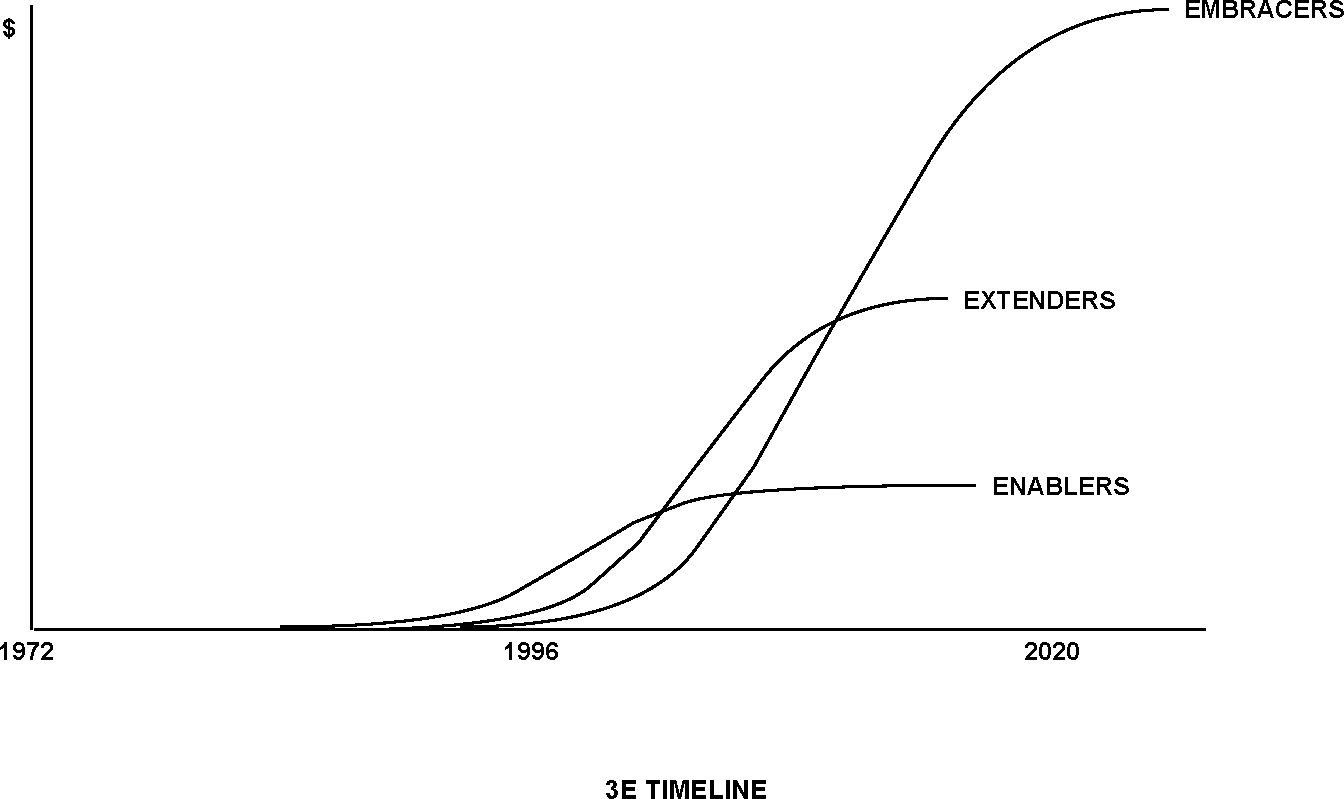
Each of the 3E market segments has the potential to generate attractive returns, but timing will play a critical role in determining success. While we believe Internet use will eventually become ubiquitous, many hurdles remain. Table 1 shows how we envision the market developing with respect to the 3E market segments and timing.
To demonstrate our point that the Internet is similar to other historical markets in terms of its evolution, we present an appendix on pages 10 and 11 featuring a comparative analysis of the Internet and the television industry using the 3E framework.
Conclusion
The Internet market is likely to be innovative and competitive to an extent rarely seen in other industries. Small, nimble businesses will emerge at a pace never seen before. However, it is critical not to lose sight of the ultimate investment goal. Mind share and market share are interesting metrics, but without a well-defined business model, they do not necessarily produce attractive earnings and shareholder value.
While our 3E framework should help identify interesting segments in the Internet market, evaluating investments by their market segment or technology is just a starting point. Successful companies will be led by strong management teams who will establish strong marketing and distribution channels as well as workable business models.
APPENDIX
Using TV as an analogy for the Internet market
It is quite likely that the development of the Internet and its functionality will follow a path similar to that taken by the television industry. While the television industry continues to evolve, it is helpful to study it as a proxy for what is likely to occur in the Internet industry. The comparative analysis shown in Table 1 below underscores the similarities in each of the 3E stages.
It is interesting to note how similar these industries become as they enter the embracer stage. In fact, we believe these industries will become seamless to the user. For example, content will most likely be delivered over the same pipe, the cable modem. In addition, the long-awaited phenomenon of interactive television will likely become a reality when high-bandwidth Internet access is commonplace for all consumers.
The first key difference between these industries will be the time for the maturation process. The Internet has a significant advantage over the television industry (and therefore will develop much more quickly) because much of the technology — for example, the delivery mechanism (cable and satellite) and the viewing devices (screen technologies) — was refined during the television revolution. In addition, consumer lifestyles have evolved around gathering and accepting information presented via a monitor. As a result, the Internet development cycle, from enabler to embracer, should take much less time than did the television development cycle. The second key difference is in scope of audience address. Because the Internet is based on point-to-point communications, information can be targeted at individuals, helping achieve marketing nirvana: one-to-one marketing.
TABLE 1: Comparison of the Internet to Television
| Television industry | Internet industry |
|---|
| ENABLERS | ||
|---|---|---|
| Content choices (bandwidth) | Limited to three networks | Unlimited |
| Content display | Black-and-white and primitive animation, graphics | Static, text-based, slow graphics |
| User interaction | None | Extremely limited |
| Revenue model | Advertising | Advertising |
| EXTENDERS | ||
|---|---|---|
| Content choices (bandwidth) | Expansion of choices with the emergence of cable programming | Unlimited, but search engines help user organize content |
| Content display | Color and the improvement of computer based ani-mation, graphics, and special effects | Emergence of multimedia content with the advent of Java and VRML technologies |
| User interaction | No direct influence but more choices | Limited interaction but more choices |
| Revenue model | Split between focused advertising on market segments plus the emergence of a subscription model for basic service and pay-per-view for premium content. In addition, the introduction of home shopping as a new retail channel (despite lack of point-to-point access to consumer). | Split between focused advertising on market segments plus the emergence of a subscription model for premium content. In addition, the introduction of electronic commerce as a new retail channel (despite hesitation due to security concerns). |
| EMBRACERS | ||
|---|---|---|
| Content choices (bandwidth) | Introduction of satellite service providers capable of increasing content by roughly 10 times | Emergence of consumer presence on the Web (in addition to business) with individual home pages. Smart agents help organize content |
| Content display | HDTV | Virtual-reality guided experience through full multi-media content |
| User interaction | Emerging with the ability to conduct transactions (especially at hotels) | High interaction that has become proactive rather than reactive with the adoption of agent technology |
| Revenue model | Primarily a subscription model (cable and satellite) plus a transaction component from the increased use of interactive shopping and commerce | Primarily a subscription model (cable and satellite) plus a transaction component from the increased use of interactive shopping and commerce |
Source: First Analysis.