
From the archive: IoT/M2M platform software
Overview of an essential and increasingly appreciated ecosystem layer
The ability to help manage the inherently complex IoT/M2M networking environment as well as automate related tasks at scale has pushed platform software to the fore, sparking significant investor and M&A interest and making an in-depth look at this market a timely undertaking.
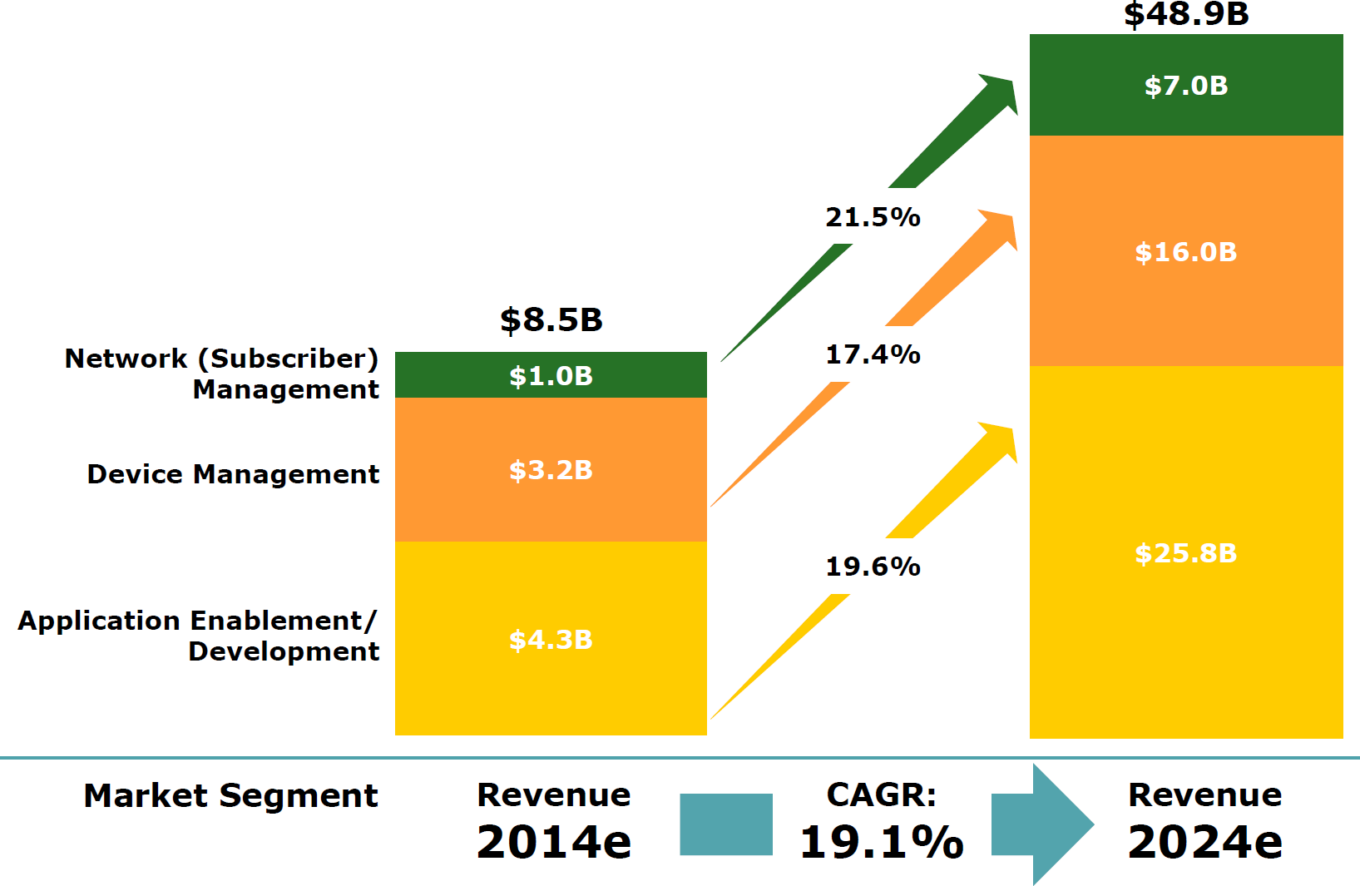
We estimate the wide-area wireless infrastructure software market, consisting of device and network (subscriber) management as well as application enablement/development platforms, will reach $49B by 2024, up from $8.5B in 2014, and representing 19% CAGR; however, the vast majority of this market is either in-house or bundled as a captive part of a broader offering, leaving only about 15% of the market as standalone third-party software.
Despite the relatively small percentage of the market that is standalone, there are hundreds of generally very small private players; in addition, hardware, network, and full-solutions vendors are increasingly bundling platform software into their core offerings, making this a dynamic and often confusing ecosystem.
Because few entities deploying IoT/M2M solutions begin their journey with the selection of a platform supplier, we believe partnering for distribution will be a key success driver for standalone platform companies along with more traditional success drivers such as breadth of offering, customer support capabilities, and vertical market expertise.
TABLE OF CONTENTS
- IoT/M2M Platforms: A basic description
- The IoT/M2M ecosystem and where platforms reside
- Platform types
- Benefits – primarily around cost, time savings
- Segmenting the market
- Pricing
- Sizing the platform software market opportunity
- Adoption drivers
- Competition – highly fragmented market, players still emerging
- Success drivers
- Trends and observations
- Conclusions
- Public and private infrastructure software company profiles
Includes discussion of 2lemetry (Amazon.com, AMZN), Aeris Communications, Ayla Networks, Bosch S/W Innov (Bosch, BOSCHLTD.NS), Bright Wolf, B-Scada Inc. (SCDA), Bug Labs, CalAmp Corp. (CAMP), Carriots S.L., CloudOne Corp., Cradlepoint Inc., Digi International Inc. (DGII), EVRYTHNG, Grove Streams, IBM Corp. (IBM), Jasper Technologies Inc., M2M DataSmart Inc., M2Mi, MachineShop, Novatel Wireless Inc. (MIFI), Orbcomm Inc. (ORBC), PTC Inc. (PTC), SeeControl, Sense Tecnic Systems Inc., Sierra Wireless Inc. (SWIR), Stream Technologies, Telit Communications (TTCNF), WebNMS (Zoho Corp.), Wireless Glue Networks Inc. and Xively (LogMeIn Inc., LOGM).
IoT/M2M Platforms: A basic description
This report offers a high-level overview of the infrastructure software market beginning with a basic description of a platform and the three general platform types. We then describe the benefits of using a platform, discuss ways to segment the market, size the global opportunity, highlight adoption drivers and trends, and offer some high-level conclusions. After our overview, we profile 30 public and private players.
At a high level, a platform represents the support software IoT/M2M solutions use to help connect (integrate) core ecosystem components (i.e., hardware, network, application software, other infrastructure software, systems), ensuring data can be passed between monitored/controlled assets and end-user applications; this software also handles ongoing management tasks and facilitates data visualization.
Platforms essentially play the role of intermediary: Assets and solution components can send data in a broad range of formats using different communication protocols, but an abstraction mechanism, which the platform provides, is required to translate it into common formats so it is usable elsewhere in the value chain. This software has been typically created internally by companies needing to support a proprietary application, often at great cost and requiring much time/effort. However, third-party or outsourced platforms are starting to become more popular. They are able to provide much of the underlying support functions, which tend to be common across verticals, leveraging infrastructure built to be agnostic to devices, networks, and other components.
It’s not uncommon for IoT/M2M platforms to be referred to as middleware solutions, infrastructure software, frameworks, plumbing, and even glue – terms basically describing similar concepts that we use interchangeably in this report.
The IoT/M2M ecosystem and where platforms reside
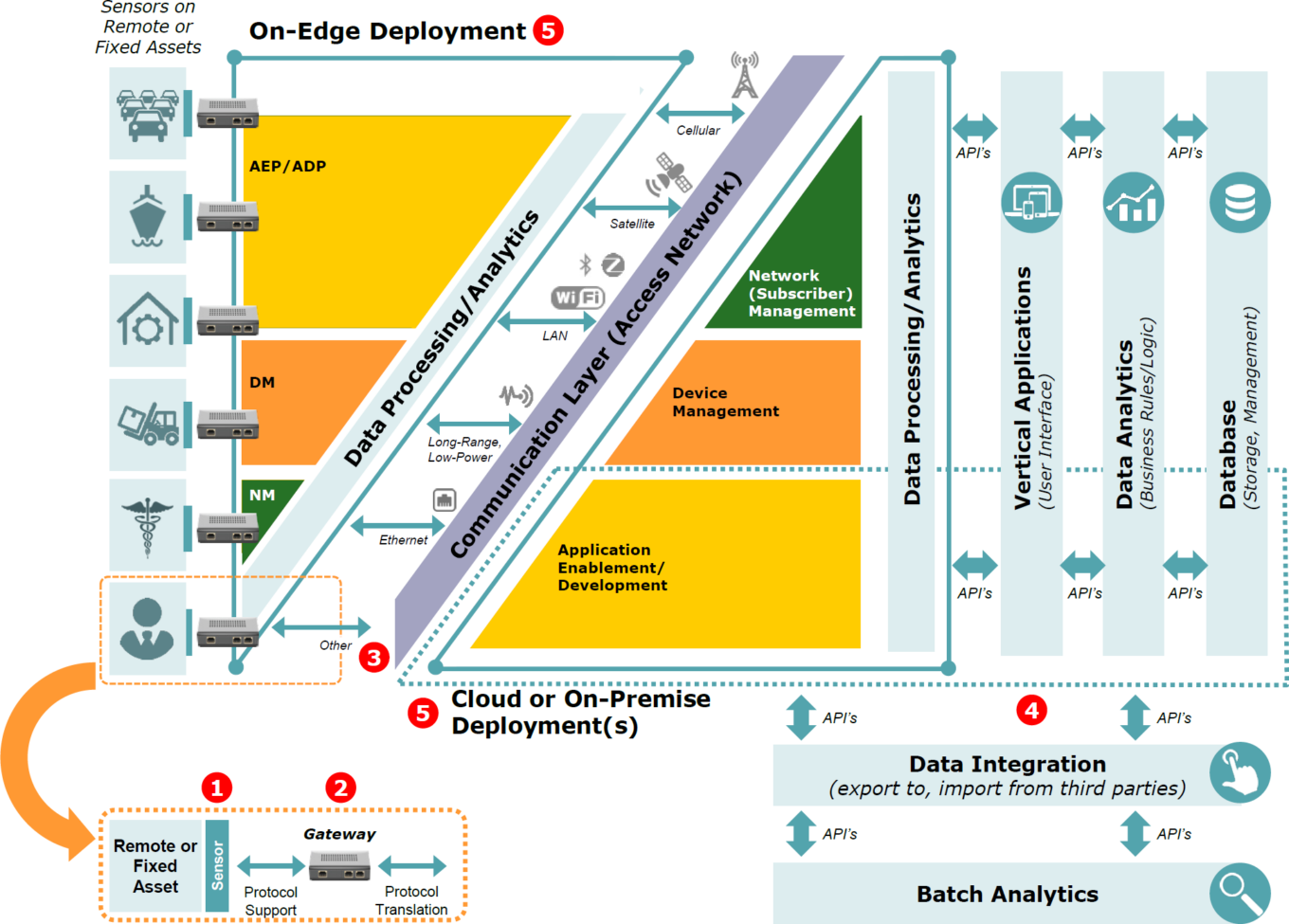
The Internet of Things (IoT)/Machine-to-Machine (M2M) can be defined as the exchange of data between two devices, using a network, for the primary purpose of monitoring or controlling remotely deployed or fixed assets. An IoT/M2M solution generally features a handful of distinct components (illustrated in Table 1), often provided by multiple vendors. These include: 1) sensors to capture asset status or event data, 2) a device (e.g., a gateway) to aggregate and transmit captured data, 3) a communications network over which the data can be sent, 4) software systems and applications for analyzing and translating data, and 5) infrastructure platform(s) to support the other components.
TABLE 1: Software platform as part of the IoT/M2M value chain
Source: First Analysis.
Notes: Numbers correspond to definitions in the text.
Devices represent the physical interface between assets and the network and are designed to not only capture and transmit data, but also receive information (instructions, updates) from the software system/applications. Such units contain some software (firmware) to enable basic functions, but more sophisticated software can be embedded for greater capabilities. The network involved can be wireless (short or long range), wired line, or a combination of two or more communication types (hybrid). The data is ultimately received by a back-end system embedded with vertical-specific application software to be translated into meaningful information and then acted upon by another machine or human. Underlying and helping to connect the above solution components (leveraging protocol libraries, APIs, and other connectors) and enabling ongoing management is platform software, which can be deployed (embedded) on the devices themselves, next to back-end systems/applications, or using both methods.
Platform types
Infrastructure software platforms vary greatly, but generally fall into one of three categories: device management (DM), network (subscriber) management (NM), and application development/enablement (ADP/AEP). We provide a basic description of each below followed by a detailed list of available functionalities. While these platforms can be found as distinct standalone offerings, it is becoming increasingly common (as our company profiles section illustrates) to find vendors that combine two or all three types in a single offering. Some consider analytics to be a fourth platform type, separate and distinct from the others, but we think of it more as a functionality since it is applicable and has value within each of the above categories.
Device management (DM)
DM is software that enables customers to remotely configure and adjust embedded device settings, monitor device status, and troubleshoot issues, among other administrative tasks. This fairly basic software is typically provided by hardware vendors, whether charging for it directly or not, to support their products. Because this functionality is essential in many customers’ hardware purchase decisions (though some will use another dedicated or integrated DM platform), we expect the vast majority of hardware companies to possess it at some point, if they don’t already.
Network/data (subscriber) management (NM)
NM is administrative software integrated into or with wireless carrier networks to facilitate the provisioning of data services for devices/subscribers in addition to handling plan activation (de-activation) and billing, network usage and performance monitoring, and data plan changes, among other things. Sellers/resellers of airtime, specifically carriers and network aggregators (mobile network operators, or MNOs, mobile virtual network operators, or MVNOs), typically provide customers access to this type of software as part of the monthly data subscription. Similar to device management, customers generally expect this type of platform software to be available upon signing up for service, but some will likewise procure this functionality from another dedicated or integrated NM platform.
Application enablement/development (AEP/ADP)
AEP/ADP is an environment that provides customers the software tools and/or templates to create (with minimal or no coding) the actual end-user applications used to turn captured data into actionable information. Such platforms typically handle data processing and management and include basic visualization tools (displays, graphing, reporting) and sometimes more advanced analytics (business knowledge or rules, algorithms). In addition, this term may include the platform’s or even the entire IoT/M2M solution’s application hosting, data storage/querying, security, and integration with third-party software and/or systems. Relative to the prior platform types, this software and related functionality is much more complex and the range of sophistication varies greatly across providers.
Functionality/capabilities
We provide a fairly detailed list of functionalities seen in the market for each platform type in Table 2. The actual feature set offered by a vendor will generally vary from category peers due to differences in strategy and/or sophistication. However, some capabilities are typically held in common across all vendors in a category and are what we consider basic (or “table stakes”). For this reason, we organize features from base level to more advanced, making it clear where variability can be expected.
TABLE 2: Functionalities, features and components by platform type
| Device management (DM) | Network management (NM) | Application enablement/dev (AEP/ADP) |
|---|---|---|
| Basic, fairly standard* | ||
Dashboard/user interface Libraries (device drivers, protocols, adapters) Device profiling (“birth certificate,” assign units to customer, device-to-asset/assoc./application/network association) Messaging (bi-directional) Device provisioning, activation, configuration Remote device decommissioning Bulk functions, actions Alerts, notifications Reporting (automated; standard or customized) History Device status check (on/off, sleeping, utilization) Location tracking/awareness (associations, neighbors), mapping Firmware check, version tracking Over-the-air (OTA) firmware and software updates, admin (scheduled/automatic, manual) Hierarchy control (by device, user, geography, technology) Search Security (settings; authentication, registration, role-based permissions, encryption, audit) User account mgmt, privileges enablement APIs/third-party s/w integration (incl. platforms) |
Dashboard/user interface Profile creation Provisioning, configuration Rate plan selection, plan changes Plan activation, de-activation, renewal Connection, subscription agreements Subscription, communication status Coverage map view with diagnostics Bulk functions, actions Alerts, notifications Reporting (automated, standard or customized) History (airtime usage metering, admin changes), auditing Hierarchy control (by device, user, network, geography) Search, database queries APIs/third-party software integration Message/data brokerage (support) Security (settings; authentication, registration, role-based permissions, encryption, audit, reporting) User/role administration, management SIM order (inventory) management IP routing check Network monitoring/performance analysis (signal strength) Connection audit (analyze, test, diagnostics) Hardware testing (remote reset, device properties overview) Troubleshooting tools Traffic routing, limiting (intelligent connection selection, optimization) Roaming network control, selection tool |
Dashboard/user interface Libraries (device drivers, protocols, adapters), abstraction layer Messaging (bi-directional) Data collection/capture/aggregation Data publishing to applications Data visualization (charts, graphs, gauges) Mobile apps Application hosting Runtime, rule, event processes engine(s) Technical support (built-in resources, tools) Alerts/notifications (text, email, platform messages) Reporting (automated, standard or customized) Data storage (history), database, backup APIs (open, RESTful); integration frameworks Software development kits (SDKs) Developer tools (incl. drag-and-drop data, widgets) Application management (supporting updates/changes) Security (authentication, authorization, access control) Hierarchy control (range of dimensions) User/role administration, management Edge application logic Supports integration/data sharing (outgoing) with third-party applications (via APIs) Data integration (incoming) with third-party sources (incl. enterprise systems), “mashups” with structured/unstructured data Solution templates Forms |
| More advanced, not standard* | ||
Dynamic asset grouping Inventory management, deployment workflow Remote diagnostics/device health Troubleshooting tools, debugging Multi-network communication support Automatic check-in with device, auto config Jamming detection Third-party device support Predictive maintenance, performance analysis Analytics |
Billing, rating, etc. Risk/demand management Automation rules (for life-cycle mgmt, incident resolution) Multi-network communication support, legacy protocol support Analytics |
Turnkey applications Dashboard replication Collaboration Sandbox, prototyping and app testing Compliance (monitoring, analyzing access security logs; auditing) Multi-network communication support, legacy protocol support Quality of service (QoS) validation Cloud-to-cloud integration (ERP, MRP, MES, SCADA) Analytics (data processing, filtering, mining, querying) |
Source: First Analysis, vendor/industry literature.
Notes: Arranged from most to least commonly encountered
Benefits – primarily around cost, time savings
Infrastructure software platforms can be beneficial to customers in a variety of ways – some of the more common benefits are highlighted in Table 3. Because the platform type involved influences the benefits available, we indicate which platform type is most likely to yield a particular benefit. From a high level, the benefits recognized typically revolve around cost and time savings but extend to greater solution reliability and ability to manage scale, particularly around data handling (i.e., analytics and sharing).
TABLE 3: A sampling of the potential benefits from leveraging an IoT/M2M platform
| Resource savings, efficiencies |
|---|
Labor cost and time savings from eliminating need to recreate redundant infrastructure and horizontal features (1,2,3) Lower upfront capex from minimized infrastructure or need to replace legacy assets (1,2,3) Centralized administration and processes reduce labor costs associated with ongoing deployment management (1,2,3) Reduces dependency on software developers/engineers – a resource in tight supply (3) Improved resource allocation, reallocation of developers to more value-added tasks (e.g., application creation vs. building infrastructure) (3) Reduced labor costs associated with incorporating modifications/fixes and new features, launching large deployments (1,2,3) Greater reliability, reduction in support and issue resolution costs (1,2,3) Lower costs make it possible to service micro vertical markets (3) |
| Automating operational tasks, bulk handling |
Higher productivity (1,2,3) Reduced labor costs, support needs (1,2,3) More effective lifecycle management (1,3) Reduction in risk, improve solution reliability (1,2,3) |
| Increased visibility |
Real-time insight into status, performance, issues (1,2,3) Improved decision-making (1,2,3) Understand coverage limitations, ability to optimize data usage (2) |
| Security |
Access to features designed specifically for IoT/M2M (1,2,3) Fine-grained access mgmt for people, roles, devices, apps, third-party systems (1,2,3) |
| Revenue enhancements, preservation |
Easier to adjust offerings to incorporate new features, correct issues (3) Faster concept to revenue by eliminating recreation of commodity infrastructure (3) Greater reliability and reduction in service outages (1,2,3) Enables the monetization of IoT/M2M data, augmented with other data sets for greater actionable intelligence (3) |
| Integration, interoperability |
Enables heterogeneous devices and systems to communicate with each other (1,2,3) Ability to integrate with legacy end points, avoiding replacement (1,3) Facilitates the support of offerings from other providers (1,2,3) Greater actionable insights, value creation from integrating IoT/M2M data with other system data sets; increased access to and use of siloed or hard-to-reach information (1,2,3) |
| Technology |
Massive scalability to support the expected number of IoT/M2M connections and quantity of data (1,2,3) Supports the Big Data/analytics opportunity of IoT/M2M and the new integrated world (3) |
| Leverageable expertise |
Gain from best practices in solution development and deployment proven to work, continuously augmented over time (1,2,3) Access to relevant/trusted partner ecosystem where utility has been proven (1,2,3) |
Source: First Analysis, industry reports, vendor literature.
Notes: (1) Device management platform. (2) Network (subscriber) management platform. (3) Application enablement/development platform.
Segmenting the market
Identifying differences between IoT/M2M platforms is a challenge when comparing vendor literature. To gain insights into what matters, one generally has to dig deeply into the nuances and approaches of the many vendors. We highlight several ways to segment the market that are either the most common or useful in analyzing companies and identifying distinguishing value, noting our list is not meant to be comprehensive.
Business purpose, customer focus
A platform can be classified as third-party, captive, or in-house based on its business purpose or customer focus. Third-party typically signifies the platform represents a separately sold, standalone product of a vendor. Captive platforms are those that support a vendor’s core products or services (e.g., device management for a hardware product line or network management for airtime services) and are generally not accessible unless those specific items are purchased. These platforms are sometimes called bundled since the customer is paying for multiple deliverables, including the platform software, under a single invoice, with the standalone platform price unobservable. In-house platforms represent software developed by a company exclusively for internal use that is not intended to be made commercially available or accessible either on a standalone basis or in connection with the purchase of one of the vendor’s other products or services. While a few hundred third-party and captive platforms can be readily identified, we note much of the IoT/M2M market is reliant on in-house infrastructure.
Platform type
Players can be classified by the type of platform they provide: device management, network (subscriber) management, and application enablement/development. However, because vendors can be increasingly found offering the capabilities of more than one platform type, a single classification is obviously not a good fit; we thus label multi-purpose platforms “comprehensive.” We think the value in the space is going to accrue to application and comprehensive platforms given more advanced and evolving functionality that can be reasonably differentiated.
Functionality/capabilities
The functionality offered tends to vary across platform vendors. Some provide only basic features to meet general requirements while others target one or more advanced capabilities in hopes of building a reputation or establishing differentiation. The advanced feature(s) may have been a focus since inception, leveraging proprietary technology or expertise, or a more recent addition to meet an underserved market need. Examples include platforms placing an elevated focus on security features to authenticate users and ensure appropriate data sharing, deep protocol libraries to safeguard connectivity to legacy hardware, and embedded device software clients to process data on the edge and limit the amount of data put on the network.
Deployment model
Three general deployment models exist for putting an infrastructure software platform into service:
- On-device (on-edge). This model, sometimes called “fog computing,” features software and resources pushed out to the enabling edge devices (sensors, modems, gateways) of IoT/M2M applications for the purpose of aggregating and storing as well as processing/analyzing captured data, with only the relevant data sent on to the application/back-end system.
- In the cloud (Software, platform, Infrastructure as a Service). Software and resources are virtualized in various data centers, with all the raw data captured being transferred first to the application/back-end system before the data is acted upon in any way.
- On-premise. Such models feature software located within the physical confines of the company run on existing computers.
We provide a sampling of some of the pros and cons associated with each model in Table 4. On-device and cloud deployment models are currently the most common, with both encountered with roughly equal frequency. However, we note vendors able to deploy platform software under two or more models can be found without much difficulty as well. Longer term, with on-device and cloud offering clear advantages for certain environments, we envision most vendors featuring both models and needing to be good on both ends to facilitate competitive end-to-end solutions.
TABLE 4: Deployment models – some of the pros and cons
| On-device (edge) | Cloud (SaaS/PaaS/IaaS) | On-premise |
|---|---|---|
| Pros | ||
Eliminates need to develop custom data collection/communications firmware Lower cost of bandwidth from reduction in data sent over network With computer processing power, possible to run analytics on the edge Improved ecosystem security Ideal for assets with high, unpredictable latency |
Extensible capabilities, greater scalability Processing power virtually unlimited Easy integration with other clouds, data sources More agnostic to technical developments (i.e., software evolution) All changes handled in backend, making it easy Lower upfront, ongoing costs |
Lots of data processing power Behind corp. firewall = perceived better security, more customizable Generally lower long-term cost Much higher degree of customer control |
| Cons | ||
Requires endpoint capable of supporting S/W S/W changes can require material and expensive updates to S/W agents to maintain operability Can increase device, in-person support costs Processing power inferior relative to cloud, on-premise Greater processing requires more energy, not ideal for battery-powered assets Limited endpoint storage capacity |
Can be very expensive at large data volumes Fewer security options, tend to rely on vendors Limited edge processing options May not be as customizable as needed |
Requires upfront capex Other components must be purchased/managed (e.g., database, app server, hosting) Often long deployment/implementation times More expensive to run, maintain, extend Slower cycle time for release of updates Can get dramatically out of sync with current version of vendor S/W |
Source: First Analysis, industry and vendor literature.
Supported communication networks
IoT/M2M solutions can leverage one or more communication networks to transmit captured data. Platform players can similarly be found supporting just a single type (e.g., cellular, which is fairly common) or a broader collection. The methods supported typically depend on anticipated adoption rates associated with a connection type and an understanding of the nuances of the network. Providers with a multi-network approach and the ability to add networks as demand materializes (e.g., long-range, low-power) should be better positioned for success given the number of total connections expected in the long term, which we don’t think will be dominated by a particular network type.
TABLE 5: Sampling of communication networks IoT platforms support
| Wireless | |
|---|---|
| Cellular | Wi-Fi |
| Satellite | Zigbee |
| RF | Bluetooth |
| Long-range, low-power | RFID |
| Wired line | |
| Ethernet | Telephone network |
| Fiber-optic | Power-line comm. |
Source: First Analysis.
End-market focus: horizontal or vertical-specific
Infrastructure software is horizontal by nature, possessing generic functionality that can be leveraged to support virtually any vertical. Most vendors go to market horizontally because of this, at least initially. However, some target specific markets due to historical market experience or specific expectations of which vertical markets will see compelling growth. In addition, some horizontal vendors have gravitated to a vertical strategy, dictated by early successes or ongoing traction. We expect the market to maintain a healthy mix of horizontal and vertical-specific vendors, with each approach producing winning vendors.
Pricing
The platform market features a diversity of pricing methodologies underlying various business strategies; Table 6 summarizes options observed among vendors, segmented by platform type. We think the range of options, particularly among application platforms, speaks to the market’s early stage, with most participants still experimenting with different pricing models in hope of finding one effective at both spurring demand and helping revenue scale. Subscription pricing (monthly fee per device or connection; “pay-as-you-grow”) appears to be the most widespread based on our observations. But we are seeing an increasing incidence of “free” or bundled models where platform access is granted to customers when they purchase other products or services (e.g., hardware unit, data subscription) or commit to trial use (up to a certain number of assets) in addition to “a la carte” or “modular” models.
TABLE 6: Observed pricing models by platform type
| Device management (DM) |
|---|
Free with unit purchase, often bundled with other services Per device per month |
| Network management (NM) |
Free as part of monthly data subscription, often bundled Per device per month Monthly fee for messaging services |
| Application enablement/development (AEP/ADP) |
Free (pilot/trial, introductory offer, connections < threshold) Free (if dashboard accessible by public) Monthly fee (for a set number of devices, connections, data streams, dashboards) Monthly application hosting fee Flat fee (up to a certain level of devices, connections, bandwidth, storage) Per transaction, notification (SMS, email, web-based); tiered Per user (subscriber) data access fee Base fee for initial app creation, followed by per device monthly fee Monthly base fee for core platform functions, modules (a la carte) extra 1x license fee plus maintenance Revenue share, royalty Bundled with other services (pricing unobservable) |
Source: First Analysis, industry/vendor literature.
Sizing the platform software market opportunity
The IoT/M2M platform software market is relatively challenging to size since the majority of the market is supplied by captive vendors and in-house as opposed to third-party providers, who provide visible metrics essential to formulating pricing estimates. Because of this, we imputed prices, allocating portions of bundled pricing to supporting platforms and extrapolating from observed pricing for standalone third-party offerings. This process yields an aggregate platform market focused on cellular and satellite solutions of $8.5B in revenue globally in 2014 and the expectation of it reaching $49B in 2024 (19.1% CAGR; see Table 7 and 8). We note our estimate does not include platform revenue associated with IoT/M2M solutions leveraging short-range (e.g., Wi-Fi, ZigBee, Bluetooth), long-range/low-power, or wired-line communications, which would be additive to the above estimate.
TABLE 7: Estimated size of the wide-area-wireless IoT/M2M platform software market (2014, 2024)
Source: First Analysis estimates.
In sizing the market, we apply our estimates and proxies for pricing to the number of wireless IoT/M2M connections. A connection, based on our definition, consists of four components: 1) hardware to capture and transmit data, 2) a wireless network (cellular, satellite) over which the data is transmitted, 3) software for data processing, visualization, and analytics, and 4) a customer paying for the service to a solution. We estimate about 220M global connections existed in 2014, which combines standalone IoT/M2M cellular and satellite connections with multi-purpose smartphone connections. Because smartphones are used for many applications other than IoT/M2M, we have to use equivalent units, which is the number of smartphone connections believed to be associated with an IoT/M2M application (~2% globally in 2014). To arrive at our estimate of 2.4B connections by 2024 (27% CAGR), we apply an expected annual volume growth rate of wireless modules (the core component enabling wireless connectivity) to our base cellular and satellite connections numbers (19% and 20% CAGR, respectively) and add to it equivalent smartphone connections (which assumes about 10% CAGR in global smartphone connections, with over 25% of smartphones being associated with an IoT/M2M application by 2024).
The stronger growth in aggregate connections relative to platform revenue stems from smartphone attach rates to IoT/M2M applications and overall platform pricing: We expect increasing numbers of these smartphones to be used for IoT/M2M as well as a rising percentage of daily activity for such applications (on a small base) but anticipate steady declines in ARPUs across the board from competition and customers leveraging increasing scale.
TABLE 8: Estimated size of the cellular, satellite, smart device wide-area-wireless IoT/M2M infrastructure software platform market
| Cellular | Satellite | Smart devices used for IoT/M2M | Total WAW platform market | |||||||||||||
|---|---|---|---|---|---|---|---|---|---|---|---|---|---|---|---|---|
| 2014e | 2019e | 2024e | CAGR | 2014e | 2019e | 2024e | CAGR | 2014e | 2019e | 2024e | CAGR | 2014e | 2019e | 2024e | CAGR | |
| # of M2M connections (M) | 183.0 | 464.9 | 1,054.4 | 19.1% | 5.3 | 13.1 | 32.6 | 20.0% | 32.3 | 451.5 | 1,298.5 | 44.7% | 220.6 | 929.5 | 2,385.5 | 26.9% |
| Annualized price per connection for: | ||||||||||||||||
| Network (sub) mgmt. software | $5.40 | $4.40 | $3.40 | $18.00 | $14.66 | $11.34 | $0.95 | $2.30 | $2.78 | $5.05 | $3.52 | $3.17 | ||||
| Device mgmt. software | $18.00 | $14.66 | $11.34 | $18.00 | $14.66 | $11.34 | $6.00 | $4.89 | $3.78 | $16.24 | $9.91 | $7.23 | ||||
| AEP/ADP software | $24.00 | $21.25 | $18.25 | $24.00 | $21.25 | $18.25 | $9.14 | $7.58 | $6.08 | $21.82 | $14.61 | $11.62 | ||||
| Revenue by platform type ($M) | ||||||||||||||||
| Network (subscriber) mgmt.1 | $899 | $1,878 | $3,341 | 14.0% | $87 | $176 | $339 | 14.6% | $20 | $905 | $3,358 | 66.6% | $1,006 | $2,959 | $7,039 | 21.5% |
| Device mgmt.2 | $2,997 | $6,260 | $11,136 | 14.0% | $87 | $176 | $339 | 14.6% | $129 | $1,921 | $4,563 | 42.9% | $3,212 | $8,357 | $16,039 | 17.4% |
| App. enablement/dev.3 | $3,996 | $9,072 | $17,911 | 16.2% | $116 | $255 | $546 | 16.8% | $196 | $2,982 | $7,337 | 43.7% | $4,308 | $12,309 | $25,793 | 19.6% |
| Total platform opportunity | $7,892 | $17,209 | $32,388 | 15.2% | $290 | $608 | $1,224 | 15.5% | $345 | $5,808 | $15,258 | 46.1% | $8,527 | $23,625 | $48,871 | 19.1% |
Source: First Analysis estimates.
Notes: (1) Cellular & satellite revenue determined by multiplying the per connection airtime fee (factoring in price degradation of 5%/year) by the average number of IoT/M2M connections and then taking 15% of this total (the fee portion assumed to be associated with network management software). For smart devices, we multiply the average number of devices estimated to be used solely or partially for IoT/M2M (equivalent units) by the annual smart device data plan fee and an assumed percentage for data used in that IoT/M2M application. We then multiply this total by 15% (the fee portion assumed to be associated with network management software). (2) Determined by multiplying the annual fee for device management (factoring in price degradation of 5%/year) by the average number of IoT/M2M connections. For smart devices, we estimated the number of connections being used solely or partially for IoT/M2M, multiplying it by the assumed annual fee (again factoring in 5%/year price degradation) for device management. (3) Determined by multiplying an annual application platform subscription fee (factoring in price degradation of 3%/year) by the average number of cellular and satellite IoT/M2M connections. For smart devices, we multiply the annual application subscription fee by the average number of smart devices estimated to be used solely or partially for IoT/M2M (equivalent units) and then take 20% of this total (the portion of the subscription fee assumed to be associated with an application platform).
Network (subscriber) management (NM)
We think network management platforms will represent a $7.0B opportunity in 2024 (21.5% CAGR), rising from 2014’s estimated $1B. To size this market, we apply an annualized price to average number of IoT/M2M connections each year to compensate the network vendor for providing platform services. The platform prices associated with cellular and satellite connections are assumed to be equivalent to 15% of their respective airtime bills – a proxy supported by our conversations with network connectivity resellers. We thus start with $5.40 for cellular and $18.00 for satellite – 15% of the $36 and $120/year average prices observed in the market, respectively; we assume prices degrade 5% annually due to competition, customers leveraging growing scale, and an increasing mix of lower-priced connections from lower bandwidth needs. These prices on our cellular and satellite connections yield $3.7B in revenue by 2024, up from $1B in 2014. Added to this is the platform revenue from supporting smartphone-associated IoT/M2M applications, which we expect to reach $3.4B (66.6% CAGR) in 2024 off a small 2014 base. Here, we multiply average smartphone connections (in equivalent units) each year by the percentage of data plan activity estimated to be associated with IoT/M2M (about 15% in 2024, up from ~2% in 2014). We then multiply this number by an annualized data plan rate before taking 15% of the result – again seeing this as a reasonable proxy for network management platform pricing.
Device management (DM)
We expect device management platforms to be a $16B revenue opportunity in 2024 (17.4% CAGR), up from $3.2B in 2014. Our initial assumption is an annual charge of $18.00/connection for both cellular and satellite connections to be in line with the average pricing seen from pure-play device management platform vendors. We assume pricing declines by 5% each year due to competition and customers leveraging scale. Applying the annualized charges to the average number of cellular and satellite connections each year yields a combined market size of $11.5B in 2024, up from 2014’s $3.1B. For smartphones, we assume an initial annual charge of $6.00/connection (also declining by 5% a year for the reasons mentioned above) due to the associated applications typically being less pricey relative to cellular or satellite applications and our belief that smartphone support costs would be held in similar proportion to the annual application prices as those connection types. Applying these annualized prices to the average number of smartphones (in equivalent units) each year yields a market size of $4.6B in 2024, up from $0.1B in 2014.
Application enablement and development (AEP/ADP)
We think application platforms represent about half (51%) of the current infrastructure opportunity and expect this to be the case in 10 years (53%); we model AEP/ADP platforms reaching $25.8B in revenue in 2024 (19.6% CAGR), up from $4.3B in 2014. To size this market, we start with an annual price of $24/connection for both cellular and satellite platforms to be in line with the average pricing seen from pure-play AEP/ADP vendors. Because the average end-user application is believed to be priced at $120/connection in the market, factoring in all vertical applications, this implies 20% of what is collected from a customer (if focusing on bundled pricing) for access to the end-user application software is associated with compensating the vendor for the platform. We model ongoing price degradation (3% annually) as a result of competition and scale effects, which is less relative to the other platform types due to a greater ability to sell ARPU-enhancing add-on functionality.
These assumptions along with our standalone connection estimates yield a combined cellular and satellite AEP/ADP platform market of $18.5B by 2024, up from 2014’s $4.1B. We add an estimate for smartphone-oriented IoT/M2M application platform revenue to this, which assumes the above relationship seen in cellular and satellite holds: 20% of overall end-user application revenue, if focusing on bundled pricing, is associated with the underlying software platform. To calculate application revenue, we take the average number of IoT/M2M smartphone connections (in equivalent units) by geography for each year, multiplying it by the annualized application ARPU seen in each region (which also assumes 3% annual degradation). Summing up the regional totals, we arrive at an estimate for global smartphone IoT/M2M application revenue; taking 20% of this total yields a smartphone application platform market size of $7.3B by 2024, up from $0.2B in 2014.
Adoption drivers
We feel two general factors are driving customer adoption of infrastructure software platforms.
Ecosystem complexity
IoT/M2M requires the communication of data between heterogeneous devices and software programs, with the interacting points having to handle and understand messages in different formats and/or languages. Selecting the right components and making them interoperable is inherently difficult and often underappreciated. A company needs employees with an understanding of the nuances of each ecosystem component (hardware, network connectivity, software, systems) as well as programming and other skills to put together a solution internally and effectively maintain it as technology evolves. Many companies do not possess sufficient talent in all the necessary areas and, in particular, lack programmers with experience in connected systems. An IoT platform’s core function is to remove complexity through pre-built or custom integrations. We view this as an ongoing platform adoption driver that has become more visible in the market, which has a growing understanding and appreciation of this capability.
Scalability, need for automation
Many IoT/M2M applications are supported by captive infrastructure software platforms. These platforms generally possess adequate functionality but have been known to run into performance difficulties (slow response times, accessibility issues, etc.) as the number of connections and/or the volume of data handled grows. When this problem occurs, companies can solve it by deploying additional resources (around systems, the network, or processes) or building a new platform, both of which can be expensive, as well as outsourcing platform needs to a dedicated provider. We believe third-party platform vendors have experienced steady demand because of this dynamic, with many having made scalability a high priority when designing/architecting their current-generation platforms. Broad industry connection growth should cause more companies to run into the scalability problem, spurring what we think will be ongoing interest in outsourced platforms.
Closely related to scalability is the need for automation. Ecosystem participants, in our view, broadly realize that handling the deployment, integration, and ongoing management of solutions using manual processes can be both a time-consuming and expensive proposition, especially at scale. We believe this has led to a growing interest in infrastructure software that can automate tasks, thereby preserving resources for other initiatives. We think such automation is essential to support the billions of device connections projected for the next decade, which should lead to steady adoption of IoT/M2M platforms.
Competition – highly fragmented market, players still emerging
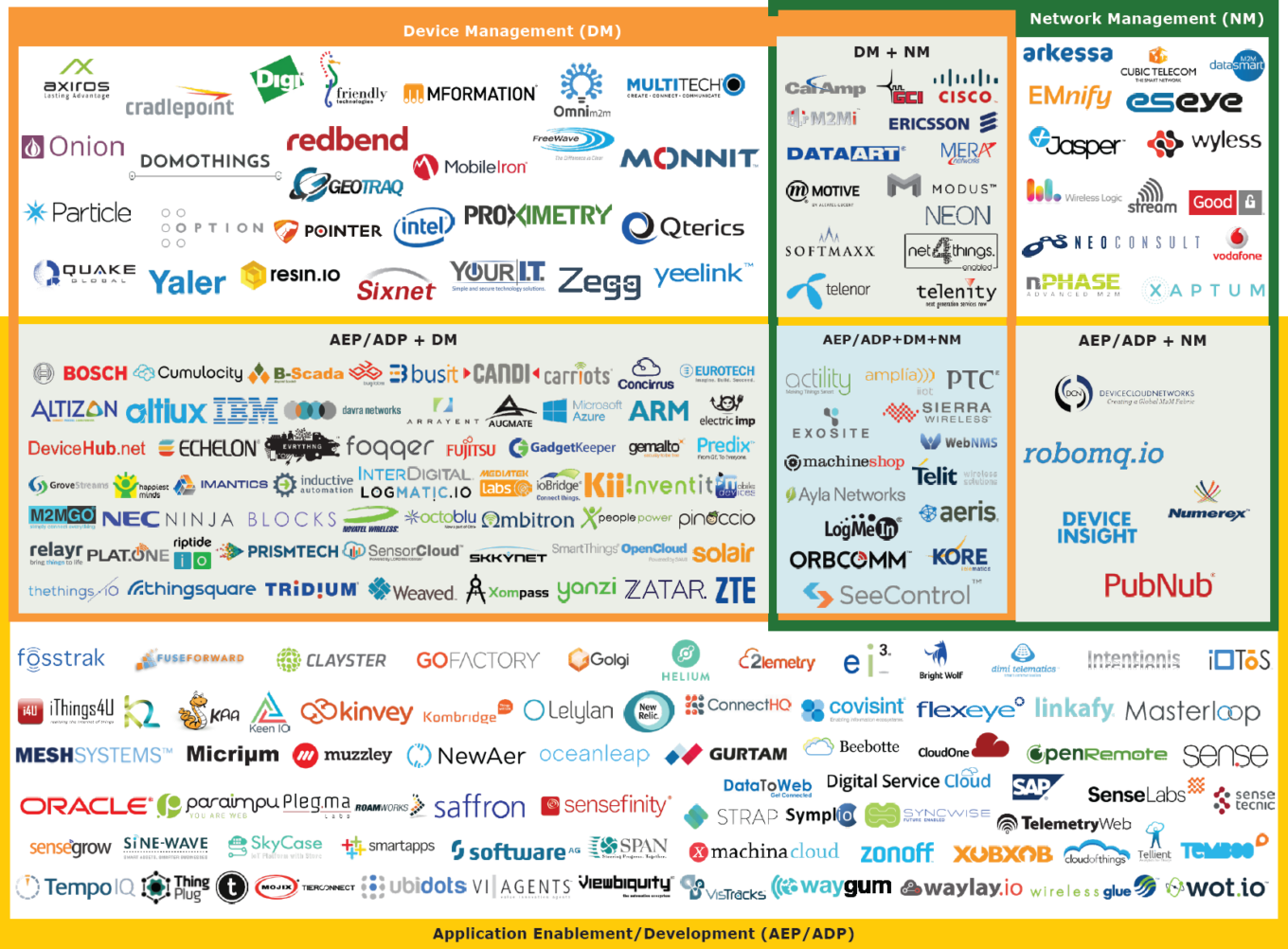
We’ve counted over 100 pure-play platform companies serving the IoT/M2M market but think between 200-300 more players exist globally, with many being recent start-ups or freshly emerged from stealth mode. These numbers would be substantially larger if we included companies whose ownership of a platform is incidental to serving a different, more-core offering (e.g., hardware, network vendors, professional services companies), leveraging internally created (captive) platforms, and large players with a reputation in different businesses possessing IoT platforms (e.g., IBM, Google). In Tables 9-10, we provide a list of some of the company types we have observed offering IoT/M2M platforms and map out the specific players we have run across, including both pure and non-pure-plays, grouped by platform type.
TABLE 9: Providers of infrastructure software platforms

Source: First Analysis, industry literature.
It is important to underscore how common it is in the IoT/M2M industry to find captive and in-house platforms instead of sourcing from a dedicated third-party platform provider. These are a major source of competition for the pure-play platform companies, particularly on the application enablement/development side. This may partially explain why so many of the third-party vendors are sub-scale with minimal revenue in an overall market that is seeing strong connection growth. However, a meaningful in-house presence, while currently a competitive challenge, implies a future opportunity for third-party vendors should the companies supporting internal platforms shift to an outsourced model – something we think should happen given the many benefits or advantages highlighted above.
Near term, we expect the number of platforms supporting IoT/M2M to expand further. While we believe each type will experience increases, we think third-party application platforms or platforms bringing multiple platform types together will see the greatest expansion; we anticipate less standalone device and network management platform expansion due to the high proportion of hardware and network vendors already possessing this functionality. We think application and comprehensive platform expansion will be driven by the large perceived (still-greenfield) opportunity IoT/M2M represents, the noticeable absence of platform players in leadership roles or having reached critical mass, interest in the space as evidenced by PE investment and lofty takeout multiples paid in recent M&A transactions, and generally low entry barriers for basic feature sets.
TABLE 10: Mapping the IoT/M2M platform software market: A venn diagram
Source: First Analysis, vendor literature.
Success drivers
We think the overall platform market will experience steady adoption and interest given the platform’s utility in making diverse ecosystem components interoperable and supporting the massive number of expected IoT/M2M connections. Obviously, only a handful of the hundreds of players competing in the platform market can break away from the pack and establish leadership positions. We discuss some of the key attributes or strengths below that we think will allow this to happen. In terms of the other vendors, we expect many to be consolidated into players attempting to put together a comprehensive offering or be acquired by companies looking to move up the IoT/M2M value chain, with the balance stagnating before quietly going out of business.
Distribution – building a strong partner network
The platform space differs from other parts of the IoT/M2M value chain in that customers interested in initiating an IoT/M2M strategy are often unfamiliar with connected solutions and don’t typically enter the ecosystem at the platform level. It is more common for customers to learn about and explore connected solutions through the more-accessible hardware, network, and application software providers, finding them via basic searches or by referrals, and ultimately enter the IoT/M2M space at one of these points.
This dynamic makes partnering with hardware, network, and application software providers a valuable channel to access potential customers. Partnerships with companies that have competent technology, brand awareness, traction/scale, a broad distribution footprint, and deep partnerships themselves are the most coveted. They lend credibility to partner offerings and likely result in the most referrals, but they can be difficult to establish and gain mindshare. We highlight Jasper Technologies as a prime example of the results that can accrue from partnering well, with Jasper achieving material scale by leveraging distribution relationships with global Tier 1 mobile network providers.
Quality support – self-service tools not yet sufficient
Many customers are in pilots with nominal units attached and therefore contribute only modest revenue to platform companies. This is a losing proposition for a vendor if it has to provide significant service and support, which can be expensive. We note it is possible for a single support call to wipe out the monthly revenue from a customer. To circumvent this issue, many platform companies are adopting a self-service approach, providing an environment with tools and other capabilities so the customer can quickly develop, deploy, and support applications without calling in for help. We acknowledge self-service technologies continue to improve but note, even with better tools, building an application that fulfills a customer’s unique requirements while connecting all the necessary ecosystem components still remains a complex and challenging task. This invariably means human-based service and support is going to be needed at some point during the development and/or deployment process.
We think this creates an opportunity for platform players with solid and efficient engineering/support capabilities to differentiate themselves. This should not only help win initial business but also create sticky relationships. We note players with a comprehensive offering (bundling the three platform types) sometimes have to handle support calls for components (device, network, application) even if they don’t provide them, meaning putting together a solid support offering around a broader ecosystem could be an important differentiator.
Opportunity providing vertical market expertise
Application platforms generally run data through a few processes (business rules, analytics) before presenting it in a dashboard. The processes tend to be generic, built without an in-depth understanding of the critical aspects of the vertical market involved or the nuances that matter to customers, and are commonly leveraged across multiple verticals with minimal variation. One can argue the resulting insights are thus limited, failing to maximize the value from deploying a solution. In order to produce the most relevant insights, the platform vendor needs to know exactly what data to use (among IoT/M2M, integrated internal, or third-party data sets) and the specific processes (customized business rules and analytics) to run – items they often need to get from the customer.
We think this creates an opportunity for vendors that can pursue a vertically focused strategy, leveraging existing or even acquired domain expertise from a few markets, to differentiate a platform offering and be successful relative to horizontal peers. Such a focus would make the vendor less dependent on the customer and allow for faster deployments, facilitate quicker innovation leveraging practical experience and customer input, allow for better customer service/support, and make for stronger sales pitches that speak directly to the customer’s needs relative to competitive offerings.
Taking a targeted customer approach
We believe a platform vendor, regardless of type, could increase its probability of success through disciplined customer targeting. In general, the ideal customer for a platform vendor is one that has many connectable assets and requires minimal service/support. Leveraging prior experience and other data sources (e.g., partners), a platform company can estimate how fast the customer’s connections will ramp, assign a probability to the customer’s ability to reach material scale, and even approximate the incidence and magnitude of service/support costs. By doing so, the platform vendor can handicap the attractiveness of an opportunity, turning down or avoiding those where the likelihood of the customer reaching scale is low and/or the anticipated support costs could overwhelm the revenue opportunity (or otherwise adjust its pricing accordingly). We think this approach favors those vendors with vertical expertise and a strong partner ecosystem from which to gather the data relevant to evaluating the individual customer opportunities.
Flexibility, architected for change
We think platforms built to accommodate technological changes are theoretically best positioned for success. Such platforms are often described as “future-proof” and are designed to support both legacy versions of ecosystem components and incorporate new ones as they appear. This kind of flexibility makes sense in light of the material investments made for the various solution components and expected longevity of connected deployments. Of course, no system is guaranteed to evolve with all future technology, but we think platforms that feature an open systems architecture to integrate with any device or software system as needed, are extensible to support different communication networks as demand materializes, and incorporate data security to protect the vast quantities of data IoT/M2M is expected to generate and share across systems will have a leg up in the market.
Trends and observations
From our conversations with over 30 platform providers, a handful of themes and general observations emerge. Because we think many could have implications for existing players, we highlight and discuss them below.
Many moving up toward comprehensive functionality
A number of platform vendors are extending their offerings to be more comprehensive (defined as containing all three platform types, potentially with analytics). Such moves are driven by a host of factors, including a desire to be more of a one-stop shop and increase wallet share with a customer, exert greater control over the customer relationship and become stickier, add a recurring revenue component to a core business operating under a different model, and support the sale of ancillary and/or tangential products and services.
Related to this is the entering of new partnerships and integration with other software providers to increase functionality while enabling support of customers outside the anchor services provided by the company. We think this will be an ongoing trend due to the above factors, with commoditization fears around lower-level functionality (device, network management) also influencing moves up the technology stack.
Migration up the value chain to turnkey applications
Some application platforms are providing turnkey applications or templates, often internally developed, alongside enablement/development capabilities. The applications offered are typically ones the vendor has helped create multiple times before (e.g., fleet and asset tracking) for different customers. The thought among vendors is a turnkey version or a template that allows for nominal customization – and can be white-labeled – is a natural response to regular demand. By offering them, the platform vendor can speed up routine end-to-end solution creation and deployment, as well as achieve a higher monthly subscription fee and improve margin by going beyond hosting, application management, and other basic enabling services.
The number of platform vendors currently doing this is modest, but a number of players we have spoken with have indicated plans to move in this direction. Such a strategy positions the vendor to compete directly with existing customers, particularly solutions providers supporting a similar application on the vendor’s platform, making it potentially risky and requiring careful management. Channel conflict aside, we think it will be a challenge for most platform players to excel in two distinct parts of the value chain simultaneously, making us believe many will end up choosing one over the other eventually.
Data visualization sufficient today, but expect shift to more advanced analytics
Application platforms typically possess data visualization capabilities, or the ability to present data from connected assets in a graphical format within a dashboard. Despite basic visualization creating some standalone value, many agree that greater value can be achieved from running deep analytics on historic and real-time machine data combined with other internal and third-party data sets to enable deeper actionable intelligence. However, the IoT/M2M market has not yet moved significantly toward big data and analytics to unlock this value. We think this is a function of current IoT/M2M penetration rates and the more pressing need of getting assets connected in the first place.
A number of players are beginning to enhance analytics and data mining capabilities, leveraging some combination of internal development, acquisition, and/or integration with third-party tools. We think such moves prudent given our belief that harnessing the data will one day take on much greater importance among enterprises. In addition, we think it important for players to have business intelligence and analytics on the offering roadmap as we expect some customers to select platform providers based on having such capabilities, although they may not be planning to use it/pay for it until later.
Horizontal offerings, vertical ambitions
A number of vendors have indicated their desire to be vertical specialists – bypassing the broader opportunity afforded by their horizontal capabilities – in hopes of achieving faster-than-market revenue growth. This approach, however, does not align with IoT/M2M’s early stage as it is not yet clear which verticals will experience strong adoption and when. Because of this, most vendors have started horizontally, marketing themselves as vertical agnostic. The thought is some will shift to a vertical approach once sufficient platform adoption/traction is seen in one or more specific verticals, such that vendors can bill themselves as specialists in those areas.
We generally like focused approaches due to the potential to outperform relative to diversified strategies. However, we wonder whether platform traction in specific verticals will be random or driven by actual expertise in those markets. If vertical specialists solve issues for customers, their expertise can be a differentiator, generating value and stickier relationships.
Large, non-traditionally IoT/M2M companies entering, emphasizing platforms
A dynamic too early to gauge but important to monitor is the influx of large companies into the infrastructure software space that have not traditionally focused on IoT/M2M. These companies are leveraging resources generated in other markets to acquire and/or develop platforms as well as extend existing capabilities to form an offering. Notable examples include Amazon (acquiring 2lemetry), Bosch Software Innovations (acquiring ProCyst among others plus internal development), and IBM (bundling, enhancing existing capabilities). For some, we believe entry represents an experiment to gauge customer interest, size the opportunity, learn about the industry (perhaps to avoid having to play catch up later), and be part of the IoT/M2M conversation, while for the others it represents a more strategic and longer-term commitment.
We think the revenue generated by these initiatives is small relative to core businesses but could become material. In any case, we expect the trend of large players entering to continue. This raises questions we hope to answer in time: 1) How aggressive will these entities be leveraging deeper resources (capital, distribution, branding)? 2) Will they disrupt the competitive positions of existing platform players? 3) Will they drive more adoption of IoT/M2M in general, helping incumbents in the process?
Increasing M&A activity evidences interest in platforms
Both platform deal volume and valuations have ticked up the last few years (see Tables 11 and 12), evidencing the market’s growing interest in these capabilities. This activity is primarily being driven by non-platform companies, which are making acquisitions for various reasons. Some are gaining access to specific capabilities (e.g., Telit) or the IoT/M2M market in general (e.g., LogMeIn, Amazon). Others are completing an end-to-end solutions offering (e.g., Orbcomm) or moving up market to get stickier with existing companies and add recurring revenue streams (e.g., CalAmp, Sierra Wireless). Notably, only a modest number of recent transactions represent market consolidation (e.g., KORE’s acquisition of Raco, PTC’s acquisitions of Axeda and ColdLight).
TABLE 11: Pure-play and asset-motivated IoT platform transactions since 2011
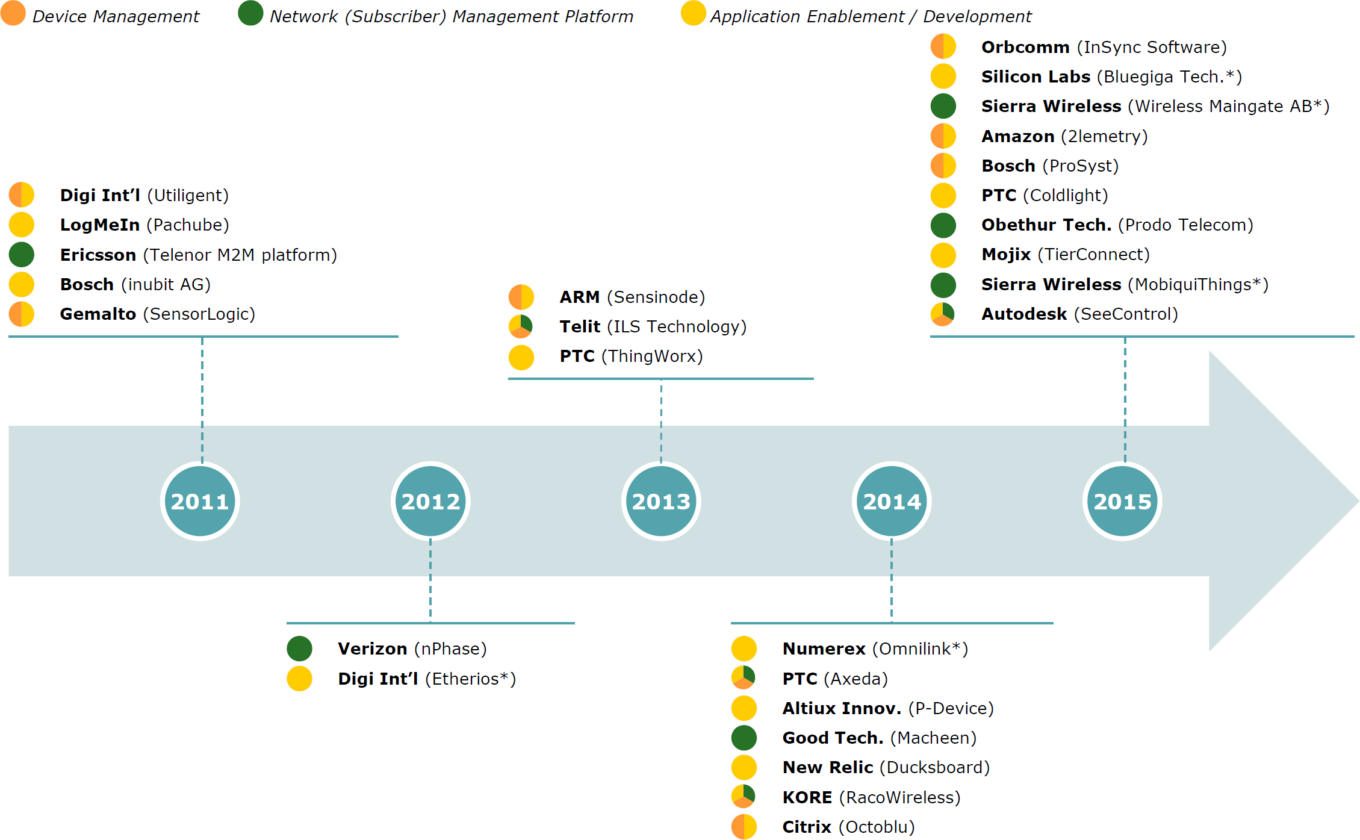
Source: First Analysis, Bloomberg, company reports.
Notes: Companies acquired in parentheses; * Transaction included notable platform software assets.
We think platform M&A will remain strong near term with activity continuing to be driven by the above factors and getting a lift from consolidation, which we anticipate increasing as players look to have more comprehensive platforms to become more of a one-stop shop and control the customer relationship. In terms of valuations, some platforms have realized lofty takeout multiples, and we have heard the current asking prices for IoT platforms generally start at 10X TTM revenue – although we note both takeout multiples and asking prices tend to be on relatively modest revenue bases and thus partially reflect a need to compensate the seller for the time and costs incurred to build the asset.
We think valuations will remain high given our expectations for strong M&A activity near term, helped by greater consolidation. Because of this, we would not be surprised to see companies giving greater consideration to building desired capabilities vs. buying them in addition to companies in the market for these assets becoming more creative, pursuing underappreciated properties (e.g., SCADA software) that can be acquired cheaply and repurposed to the target market.
TABLE 12: Pure-play platform transactions or transactions motivated by a company’s platform assets
| Target | Acquirer (ticker) | Date | Amount ($MM)1 |
Rev mult1 | Platform type/capabilities | |||
|---|---|---|---|---|---|---|---|---|
| Device | Network | App | Analytics | |||||
| Utiligent | Digi International (DGII) | 2011 | – | – | X | X | ||
| Pachube | LogMeIn (LOGM) | July 2011 | $15 | – | X | |||
| Telenor M2M platform | Ericsson (ERIC) | Aug 2011 | – | – | X | |||
| inubit AG | Bosch (BOSCHLTD.NS) | Oct 2011 | – | – | X | |||
| SensorLogic | Gemalto (GTO.AS) | Dec 2011 | – | – | X | X | ||
| nPhase | Verizon (VZ) | Jan 2012 | – | – | X | |||
| Etherios* | Digi International (DGII) | Nov 2012 | $20.5 | – | X | |||
| Sensinode | ARM Holdings (ARMH) | Aug 2013 | – | – | X | X | ||
| ILS Technology | Telit Comm (TCM.L) | Sep 2013 | $8.5 | – | X | X | X | |
| ThingWorx | PTC (PTC) | Dec 2013 | $130 | 21.7x | X | X | ||
| Omnilink* | Numerex (NMRX) | Apr 2014 | $37.5 | ~3x | X | |||
| Axeda | PTC (PTC) | July 2014 | $176 | – | X | X | X | |
| P-Device Systems | Altiux Innovations | Aug 2014 | – | – | X | |||
| Macheen | Good Technology | Oct 2014 | $8.3 | – | X | |||
| Ducksboard | New Relic (NEWR) | Oct 2014 | – | – | X | |||
| RacoWireless | KORE Telematics | Nov 2014 | – | – | X | X | X | |
| Octoblu | Citrix (CTXS) | Dec 2014 | – | – | X | X | ||
| InSync Software | Orbcomm (ORBC) | Jan 2015 | $16 | 3.2x | X | X | ||
| Bluegiga Technologies Oy* | Silicon Labs (SLAB) | Feb 2015 | $60.8 | – | X | |||
| Wireless Maingate AB* | Sierra Wireless (SWIR) | Feb 2015 | $90 | 4.7x | X | |||
| 2lemetry | Amazon (AMZN) | Mar 2015 | – | – | X | X | ||
| ProSyst | Bosch (BOSCHLTD.NS) | Apr 2015 | – | – | X | X | ||
| Coldlight | PTC (PTC) | May 2015 | $105 | 13.1x | X | |||
| Prodo Telecom | Obethur Technologies | Jun 2015 | – | – | X | |||
| TierConnect | Mojix | Jun 2015 | – | – | X | |||
| MobiquiThings* | Sierra Wireless (SWIR) | Jun 2015 | €14 | 4.7x | X | |||
| SeeControl | Autodesk Inc. (ADSK) | Oct 2015 | – | – | X | X | X | X |
Source: First Analysis, Bloomberg, company/industry reports.
Notes: Transaction included some notable platform software assets. (1) Factors in potential earn-outs from hitting performance-based milestones, when known.
Conclusions
Below we summarize some of the key takeaways from our review of the IoT/M2M platform software market.
Increasingly relevant ecosystem component
The complexity of IoT/M2M environments in terms of hardware, networks, and integrated software systems combined with the growth in large-scale deployments makes platform functionality an increasingly relevant component of the IoT/M2M ecosystem.
Distribution/ecosystem partnerships key
We believe solid distribution is essential to achieving success in the platform software market because this layer is not the typical starting point for companies interested in pursuing an IoT/M2M initiative/strategy. It is more common for potential customers to learn about and enter the market through hardware, application software, and even network providers. Therefore, it is important for platform vendors to align with the more natural starting points of customers in order to be brought into opportunities and gain validation by association. An important component of partnering that should not be understated is mindshare, which comes with effectively working with desired partners over time and is necessary because these ecosystem players have many existing partners that need to be bypassed to gain access to the opportunity.
Justification for growing interest and high valuations
The market’s ongoing interest in IoT/M2M platforms is evidenced by the growing volume of M&A transactions, high valuations (takeouts or asking prices), entry of large enterprises, and internal initiatives. Even though most platforms are currently not producing much revenue in and of themselves, we believe the market views platform functionality as the key to unlocking or adding other revenue streams. This is being seen among hardware vendors looking to add recurring services revenue to traditionally one-time sales models, application providers desiring to be flexible and facilitate expansion to new or tangential markets, network service providers wanting to be able to support non-traditional connection types as demand appears, and even large enterprises looking for ways to monetize siloed data sets. Platform functionality brings the above players closer to having end-to-end capabilities, which facilitates stickier customer relationships and allows for greater control of the customer – items that should positively impact revenue. We expect this interest to persist for several years.
Likely a difficult standalone segment of the market longer term
We think the pure-play infrastructure platforms will play an important role near term in helping to deploy and manage the massive quantity of IoT/M2M connections, driving solid financial results for this segment. However, given the entry of large enterprises with significant resources and our belief other portions of the value chain (e.g., hardware, application software providers) will move to own such platform capabilities to create new revenue opportunities and stickier relationships, we think only a handful of significant standalone platform players will remain over the longer term. We do expect a few big winners, driven by some combination of strong distribution/partnering, vertical expertise, technical capabilities, and/or business model.
Public and private infrastructure software company profiles
In the following pages, we highlight 30 public and private players offering at least one of the previously discussed platform types. Our sample is just a portion of the 100 companies in the market we track, itself a subset of hundreds of players that compete in the market, and mirrors the industry’s complexion with most players being private and weighted toward application enablement/development capabilities.
We believe our sample is weighted toward companies with significant market relevance and impact, excelling in one or more of the areas of proprietary capabilities, partnerships, brand recognition or mindshare, customers/wins, and other unique factors. For each player, we provide detail on platform features/components, pricing model, key vertical and customer focuses, commonly seen competitors, differentiators, and near-term strategy.
2lemetry (part of Amazon.com)
Founded: 2011
Headquarters: Denver, Colo.
Funding: Public/part of Amazon.com Inc. (AMZN)
Company size: < 50 employees
Overall offering: Infrastructure software platform; professional services
Platform type: Application enablement/development platform, device management
Platform features: Dashboard/user interface, data visualization, rules engine, analytics, bi-directional messaging, data storage and brokerage, third-party software integration, APIs, location tracking, security, QoS validation, device auto-provisioning
Platform pricing: $0.15-$0.50 per device per month (depending on # of devices); free for 5 devices or less
Vertical segments: HVAC, industrial (manufacturing, mining), oil & gas, transportation (fleet), wearables
Primary regions: North America
Customer focus: Enterprise, SMB, consumer
Customers: Avyzo, Demeter Power Group, First Mile, Honeywell, Peoplenet, Rak, SafetyCare, Sendum
Competitors: Axeda (PTC), Exosite, ILS Technology (Telit), ThingWorx (PTC)
Partners: IBM, Salesforce (software); Freescale, Intel, Qualcomm, Texas Instruments (hardware); AT&T, Device Cloud Networks, Sprint, Verizon (network connectivity); Accenture, LogicPD (professional services)
Company overview
2lemetry, acquired by Amazon in March, offers an application enablement platform that is distinguished by its ability to connect heterogeneous devices, scalability, and low-cost service. The platform, called ThingFabric, leverages extensive protocol libraries (turnkey and custom-coded) to translate device data into an appropriate format so it can be brought into the solution irrespective of source (even if running legacy or proprietary protocols), facilitating bi-directional communication with back-end systems. Its ability to support so many devices generates value to customers in multiple ways: faster solution deployment, greater choice of hardware vendors, leverage of legacy systems and avoidance of capex for hardware upgrades, enabling current units to remain supported even as technology evolves, and handling mixed vendor deployments. Beyond connecting devices and enabling messaging, 2lemetry creates value in handling massive quantities of data with features such as real-time filtering and processing, brokering alerts, and other insights based on user-defined rules.
We note that prior to acquisition, 2lemetry was already using low-cost Amazon Web Services to facilitate its low-price strategy and ensure it could scale to handle the connection growth its pricing and hardware-agnostic approach are expected to drive. It is unclear how 2lemetry will be positioned alongside Amazon’s broader offering, particularly since Amazon’s IoT/M2M strategy has yet to be articulated; Amazon’s (June) small investment in Mojio, a connected car solution provider with development platform capabilities, provides few additional clues. It will be interesting to see if Amazon acquires additional IoT platform capabilities to form a more comprehensive offering or steps up S&M to build awareness and more effectively monetize 2lemetry. We think Amazon’s ownership of 2lemetry represents a low-cost paradigm (vs. value generation), which most platform competitors should at least monitor.
B-Scada Inc. (SCDA)
Founded: 2003
Headquarters: Crystal River, Fla.
Funding: Public/OTC
Company size: < 50 employees

Overall offering: Infrastructure software platform; h/w; professional services
Platform type: Application enablement/development, device management
Platform features: Dashboard/user interface, data visualization, graphic design tools (drag&drop), infor. modeling, analytics, data aggregation, storage, alerts/notifications, history, reporting, hierarchy capabilities, APIs/connectors, forms, workflow autom., 3rd-party s/w integ., templates, security
Platform pricing: License or subscription
Vertical segments: Agriculture, building automation, government, industrial (manufacturing, mining), oil & gas, power transmission & distribution, transportation & logistics, water/waste water
Primary regions: North America, EMEA, Asia-Pacific
Customer focus: Enterprise, SMBs, government, resellers, SIs
Customers: Alstom, BrassCraft, Emerson, Far Systems, General Dynamics, Honeywell, InterLink, Invensys, Rockwell Automation, Trane
Competitors: Carriots, Inductive Automation, Invensys, Skkynet, ThingWorx
Partners: Ocean Data Sys (software); B+B SmartWorx, Monnit (hardware)
Company overview
B-Scada (Beyond Supervisory Control and Data Acquisition) is approaching the wireless IoT/M2M platform market from a non-typical starting point, wireline industrial applications, leveraging its legacy platform capabilities and technical knowledge. The wireless push, started in early 2015, stems from expectations for robust connection growth and B-Scada’s realization it could support wireless without making material investments to upgrade its software.
Its newest product, the VoT (Virtualization of Things) platform, enables customers to create and run wireless applications; it essentially facilitates data capture, organizing and processing it in real time (sometimes enriching it with third-party data), before visualizing it in a dashboard so it is actionable. It features a drag-and-drop (no-coding) environment for quick builds, but allows developers to extend and customize applications/interfaces via some programming. An intriguing feature is that interfaces can be replicated numerous times and then individually customized, further accelerating deployments.
B-Scada feels it is differentiated by its ability to pull data into the platform regardless of asset type or data source (using turnkey connectors or custom ones, written as needed), comprehensive and easy-to-use data visualization tools, deep professional services and support, and its reselling hardware to make it more of a full solutions player. Ease of data integration explains its presence in non-traditional verticals such as recreation/consumer (e.g., monitoring swimming pools) and importantly, suggests its ability to support small-to-mid- market companies in underserved (micro) industries – potentially a large opportunity in aggregate. To help attract these types of customers, typically unable to handle large upfront fees, the company is now offering its software under a subscription option beside its traditional license model.
The company acknowledges lacking visibility in the marketplace, explaining its current emphasis on boosting awareness through elevated S&M investment. Despite this, for a platform provider, B-Scada is generating decent revenue from long-term relationships with large companies (although it suffers from concentration risk; 69% of 2014 revenue came from three customers) and is generally profitable and cash flow positive; these reference accounts, in our view, lend validation to its capabilities. Given these items, combined with the market interest in IoT/M2M platforms and the high valuations achieved in recent transactions, we would not be surprised if B-Scada was considered for acquisition, particularly under a build-vs.-buy scenario.
Bosch Software Innovations
Founded: 1997 (Software Innovations)
Headquarters: Berlin, Germany
Funding: Public/part of Bosch Ltd. (BOSCHLTD.NS)
Company size: < 700 employees

Overall offering: Infrastructure software platform; professional services
Platform type: Application enablement/development platform, device management
Platform features: Dashboard/user interface, data visualization, analytics (mining, transformation), rules engine, alerts, reporting, security, hierarchy capabilities, device management (provisioning), application design tools and models, APIs, third-party software integration, application management
Platform pricing: Per-device subscription or license (on-premise)
Vertical segments: Automotive, energy/utilities, financial services, government, healthcare, industrial (manufacturing), IT, retail, smart city, telecomm, transportation & logistics (fleet, supply chain)
Primary regions: Europe, Asia, United States
Customer focus: Enterprise, government
Customers: Deutsch Telekom, DHL, John Deere, Minnesota Dept. of Revenue, Siemens, ThyssenKrupp, U.S. Navy
Competitors: Axeda (PTC), ILS Technology (Telit), ThingWorx (PTC)
Partners: Escrypt, Knime AG, MongoDB, Oracle (software); Vodafone (network connectivity); Infosys, Tata (professional services)
Company overview
Bosch, known for automotive components among its many other business lines, has built a robust software platform over the last decade via acquisitions and internal development in its quest to become the leader in connected products. Branded the Bosch IoT Suite, it features a modular design with components consumable individually or as an integrated service.
The base Device Management product enables the connection and control of Bosch and third-party devices, leveraging device connectors and information models to abstract messaging protocols into formats usable by applications. It has been used in notable customer offerings, such as AT&T’s Digital Life and GE’s Predix platform, lending validation to its capabilities. Bosch added its rules and process management software to form an app enablement/development layer.
The Business Rules Management (BRM) product features user-friendly drag-and-drop tools for visualizing data and setting the business logic (alerts, thresholds, parameters) that affect how data is processed and managed. Using the Business Process Management (BPM) product, captured data can be integrated with third-party systems (e.g., CRM, ERP). These products feed the Big Data Processing (BDP) module for advanced data mining and analytics, integrating sensor data with internal and external data sets for deeper insights.
While the IoT Suite is horizontal, most deployments to date have been in the telematics, smart city, and manufacturing verticals; traction in telematics is unsurprising given Bosch’s roots and expertise in the controller area network (CAN bus) vehicle messaging protocol it created. Besides its advantage in automotive, the company sees its 400+ person engineering team as a key differentiator few platforms can match; the team enables Bosch to develop and add new functionality, adapting to change quickly. However, management feels a lack of market awareness for its platform relative to peers is a weakness. Management’s near-term focus is thus on marketing to build a stronger presence.
We think Bosch Software Innovations’ existing functionality and focus on innovation combined with its access to the deep resources of its parent for S&M and even M&A make it one of the key platform players to monitor. Its lack of visibility, in our view, is a short-term obstacle, and its brand and balance sheet should give it an advantage surviving the procurement process for enterprise accounts relative to most of the competitive field.
CalAmp Corp. (CAMP)
Founded: 1981
Headquarters: Oxnard, Calif.
Funding: Public/Nasdaq
Company size: < 450 employees
Subscribers: 495K solutions subscribers (as of 5/31/15); 5M MRM devices in service with access to device management platform capabilities

Overall offering: Hardware; infrastructure software platform; apps/end-to- end solutions; network connectivity; professional services
Platform type: Device and network management; minor app enablement
Platform features: Dashboard/user interface, provisioning, 3rd-party device support, OTA updates (firmware), monitoring (health, status, location), hierarchy capabilities, security, user/ account mgmt, billing, network KPIs, alerts, reporting, history, data storage, query and sharing, processing, analytics, airtime mgmt (plan changes, usage monitoring), troubleshooting, APIs, app store
Platform pricing: Typically no charge for basic device management; more extensive platform capabilities paid for as part of a bundle
Vertical segments: Energy/utilities, govt/public safety, heavy equip, industrial (construction, rail, mining), oil/gas, transp/logistics (fleet, asset tracking), insurance, vehicle finance
Primary regions: North America, Latin America, EMEA, Asia-Pacific
Customer focus: Enterprise, OEMs, full-solution & app providers, SIs, VARs
Customers: Caterpillar, Directed Electronics, Fleetmatics, Masternaut, Pepco Holdings, Rio Tinto, Sascar, Spireon, Toyota, ZTR
Competitors: Digi, FreeWave, GenX, Multi-Tech, Option, Sierra, Xirgo
Partners: Axeda (PTC), Telit, Jasper (s/w); Gemalto, Sierra, Telit (h/w); AT&T, KORE, Sprint, Verizon, Vodafone (airtime)
Company overview
CalAmp has long featured infrastructure software alongside its core hardware offering, differentiated by integration capabilities and a proven ability to scale. Its platform offering is comprehensive, comprised of device and network (subscriber) management as well as application enablement capabilities.
The device management component, PULS (Programming/Provisioning, Update, and Logistical System), is upper tier relative to those offered by other hardware vendors and goes beyond typical functions. It enables users to reconfigure (repurpose) units for different apps and provides “smart” device check-in (leveraging distinct firmware) to the platform for auto-configuration, updates, and identifying health issues. It is free with device purchase, seen as “table stakes” for which most customers don’t expect to pay, but adding a layer of value that helps hardware demand; PULS supports 5M+ MRM devices. An enterprise version with greater capabilities around automation, reporting, security, and integration (e.g., to ERP, CRM) is available for a fee.
The other platform component, COLT (CalAmp On-Line Telemetric platform), contains both the network management and application functions. It’s important to note COLT is not a fully-fledged application platform: It was designed to support certain aspects of development and deployment, containing interfaces/tools to connect wireless devices to applications over networks; it essentially deals with the many device/network complexities (protocols, interoperability testing) normally handled by developers or engineers. Scalable into the millions, 500K subscribers currently sit on COLT; it can support additional (internally created, acquired, third-party) apps.
Completing the platform’s app capabilities (i.e., a coding environment for developing end-user interfaces, visualizations, and analytics or no-coding drag-and-drop tools) is on the roadmap, although timing is uncertain. CalAmp can build these horizontal functions internally but is likely to continue partnering for them, focusing instead on solving vertical-specific problems it thinks captures more value and drives demand. However, $184M on its balance sheet positions it to acquire various assets, including application platforms. Because of potential channel conflict with hardware customers – something management is highly cognizant of – combined with the lofty market valuations for such assets, we don’t expect CalAmp to buy this capability, opting for turnkey apps it can support instead.
Digi International Inc. (DGII)
Founded: 1985
Headquarters: Minnetonka, Minn.
Funding: Public/Nasdaq
Company size: < 700 employees

Overall offering: Hardware; infrastructure s/w platform; prof. services
Platform type: Device management platform
Platform features: Dashboard/user interface, remote configuration, device performance/health monitoring, location awareness, connection performance monitoring, alerts/notifications, reporting, history, (bulk) firmware updates, hierarchy capabilities, security, APIs
Platform pricing: $2.50/device/month; 1-5 year contracts available
Vertical segments: Energy/utilities, government, healthcare, industrial, retail, smart city, transportation
Primary regions: Global
Customer focus: Original equipment manufacturers (OEMs), distributors, systems integrators (SIs), value-added resellers (VARs), full-solutions providers
Customers: BSM Wireless, Comverge, EnerNoc, New Boundary Technologies, Honeywell, Libelium, Siemens, Silversphere, Telogis, TXU Energy, WaterTrac, ZTR
Competitors: CalAmp, Cradlepoint, DGI Technologies, FreeWave, GE- MDS, Multi-Tech Systems, Quake Global, Sierra Wireless, Sixnet
Partners: Microsoft, Salesforce, ThingWorx, VMware, Wind River (software); Freescale, Intel, Itron, Qualcomm, Schneider Electric (hardware); AT&T, Iridium, Orbcomm, Rogers, Sprint, Telus, Verizon (network connectivity); PGA M2M (systems integrators)
Company overview
As part of Digi’s turnaround, management is intent on establishing a clearer identity for the company in terms of products, targeted verticals, and marketing message. These efforts are already being seen on the platform side, which was previously highlighted as a key source of customer confusion due to multiple re-brandings and the inclusion of Etherios’ Salesforce integration capabilities. Digi thus simplified its platform effort, focusing on device management capabilities that mesh well with its hardware roots and a more straightforward branding while de-emphasizing the Etherios platform functions.
The main platform product for Digi is now Remote Manager, which as the name suggests, enables users to remotely monitor (e.g., device health, utilization, connections), update and control (e.g., firmware), and manage (alert thresholds, access) devices. Device Cloud, a higher-tier version, includes all Remote Manager features but possesses advanced data access/ integration capabilities. Digi also adjusted its marketing, emphasizing the ROI potential from using its platform for bulk deployments or hard-to-reach assets – an approach we have not observed from other hardware vendors with platforms
Device platform offerings are not known for uniqueness, but Digi feels it is differentiated in device health stemming from its years building devices and working with network carriers, giving it expertise in spotting and rectifying problems – a skill set built into the platform. Digi also sees its security capabilities as distinctive but potentially underappreciated. Near term, Digi is not planning to add material functionality, feeling it has filled outstanding platform gaps, but may make minor enhancements to various components; longer term, Digi acknowledges the potential to add application platform functions.
We don’t think Digi generates material revenue from its platform and don’t expect it to in the future, as we anticipate such functionality to be essentially given away, incidental to a hardware sale. Its platform could still drive incremental hardware demand and customer stickiness for those not wanting to contend with mixed deployments and multiple interfaces. That said, we think it a good cornerstone for a comprehensive offering should Digi elect to spend some of its $101M in cash on platform acquisitions.
IBM Corp. (IBM)
Founded: 1910
Headquarters: Armonk, N.Y.
Funding: Public/NYSE
Company size: > 375,000 employees
Overall offering: Hardware; software (applications, infrastructure platforms); professional services
Platform type: Application enablement/development platform, device management
Platform features: Dashboard/user interface, data visualization, bi-directional messaging, data storage and query, device management (registration, monitoring, software updates). location awareness, application development tools, business rules, analytics, security, user/account management, APIs, SDKs, third-party software integration (incl. cloud- to-cloud), diagnostics, troubleshooting, application management
Platform pricing: Based on devices connected, data exchanged, and data stored; 20 devices, 1MB of data traffic; 1GB storage are free per month
Vertical segments: Retail, smart city, telematics, transportation & logistics
Primary regions: Global
Customer focus: Enterprise, SMBs, start-ups, hobbyists
Customers: Cummins, SilverHook Powerboats, United Technologies
Competitors: Bosch Software Innovations (Bosch), Predix (GE)
Partners: Twillo (software); ARM, B+B Electronics, Intel, Multi-Tech Systems, Texas Instruments, u-blox (hardware)
Company overview
IBM is aggressively targeting IoT/M2M, having recently announced its plan to invest $3B over four years to establish a dedicated business unit. A key piece of this initiative is a software platform offering to help customers connect devices to the Web and leverage data to generate actionable insights. To create this platform, rather than undertaking a massive development effort, IBM has been consolidating some of its existing products that already possess the prerequisite capabilities, such as the Internet of Things Foundation, Bluemix, and analytics, to form a unified IoT service offering.
The Internet of Things Foundation is a platform product that facilitates the connection of devices to the cloud using standard messaging protocols, initial device set-up, and ongoing device management via a single interface in addition to data storage. It ensures that real-time and historic data can reach IBM-created or third-party apps for interpretation. Bluemix is a cloud-based platform customers can use to build, manage, and run applications; it contains both a programming environment as well as no-coding drag- and-drop widgets. IBM’s broad analytics package is being incorporated as well to interpret sensor and integrated data with the goal of making decisions more proactive rather than reactive.
Besides packaging existing pieces, IBM’s planned investment will also be used for adding new or upgrading existing components. Recently updated Product Line Engineering (PLE) software is an example; it enables IoT engineers to keep better track of design work so it can be easily replicated up to a certain stage with adjustments then made to form new or custom offerings – speeding up overall development efforts. IBM is also looking to amass strategic partnerships with companies (e.g., The Weather Channel) with access to high-value data streams it can integrate into its platform and make available to customer solutions.
Overall, we think IBM has already bundled compelling functionality to target IoT/M2M, noting it can certainly build or buy any components it needs to round out its offering. To be successful, IBM needs to attract developers with material numbers of assets to connect, leveraging a well-crafted message around a seamless offering, both of which we view as still in the works. That said, its focus on analytics to maximize value creation represents IoT/M2M’s end game and is a good positioning to be establishing.
Novatel Wireless Inc. (MIFI)
Founded: 1996
Headquarters: San Diego
Funding: Public/Nasdaq
Company size: < 400 employees
Subscribers: ~250,000 (on FW’s management platform)
Overall offering: Hardware; infrastructure s/w platform; professional svcs
Platform type: Device mgmt, app enablement/development platform
Platform features: Dashboard/user interface, device configuration, over- the-air updates (firmware), device monitoring (status, health, location), search/filters, hierarchy capabilities, alerts, reporting, history, security (user accounts, device privileges), network quality/usage/trends, capacity/ coverage, APIs, application framework (drag-and-drop app widgets), data visualization, analytics
Platform pricing: DM offered under per-device license + annual maintenance fee
Vertical segments: Connected car, connected home, digital signage, energy/ utilities, gvmt, healthcare, industrial (construction), oil & gas, retail/POS, security, smart city, transportation (cold chain, fleet, intermodal), usage-based insurance, vehicle finance, wearables
Primary regions: Global
Customer focus: Enterprise, SMBs, gvmt, solutions providers, value-added resellers (VARs), systems integrators (SIs), retail consumer
Customers: Fleetmatics, Modus, NexTraq, Quindell, Telogis, Telular
Competitors: CalAmp, Cradlepoint, Gemalto, Franklin Wireless, GenX Mobile, Huawei, Sierra Wireless, Telit, Xirgo
Partners: Agnik, Google, SeeControl, ThingWorx (software); Digi, Foxconn, Systech (hardware); AT&T, Bell, KORE, Numerex, Orange, Rogers, Sprint, Telefonica, Verizon, Vodafone (network connectivity); Novotech (professional services)
Company overview
As part of its aggressive IoT/M2M acquisition strategy, Novatel bought (in March) Feeney Wireless (FW), a systems integrator and professional services provider with infrastructure software capabilities. Novatel saw FW as advancing its strategy to compile an integrated suite of technologies and services that drives value to customers through simplifying solution deployment and management. Prior to FW, Novatel’s software offering consisted of a device management portal with generic capabilities such as remote configuration and firmware updates, monitoring (health, status), and troubleshooting. FW’s Remote Monitoring System (RMS) upgrades Novatel’s N4A Device Manager with more sophisticated diagnostics (with benchmarking) and troubleshooting tools in addition to performance analytics/intelligence around connectivity (signal strength/quality, coverage gaps). RMS’s ability to handle devices from several mainstream hardware providers in a single interface, leveraging FW’s role as a reseller, positions Novatel to service mixed vendor deployments.
A product that adds a layer to Novatel’s software stack that we think intriguing, but underappreciated, is FW’s application (framework) platform Crossroads. Crossroads features a no-coding environment with drag-and-drop visualization tools (FWidgets) that customers can use to integrate (via APIs) and aggregate data from multiple sources, abstracting and mashing it, before finally presenting it in a format that could expose actionable trends; Avalon, a framework used with Crossroads, contains more formal graphical presentation tools in addition to alerting and notification capabilities. Introduced early in 2015, Crossroads has been adopted by 400 customers already.
The acquisition of solutions provider DigiCore, in our view, confirms Novatel’s moving further up the value chain to end-user applications. Because of this, we think Crossroads could turn out to be the gem among FW’s assets, enabling customer-created applications and even turnkey ones built internally – putting Novatel on a path to potentially greater recurring revenue. That said, we think it worth watching to see how much effort will be put into marketing Crossroads and if its functionality will be augmented (analytics appear limited), given the company’s other focuses.
Orbcomm Inc. (ORBC)
Founded: 1993
Headquarters: Rochelle Park, N.J.
Funding: Public/Nasdaq
Company size: < 500 employees
Subscribers: 1.3M (aggregate; comprised of network and application subs)

Overall offering: End-to-end solutions; app s/w; infrastructure s/w platform; network connectivity; hardware; professional services
Platform type: Device/network mgmt, app enablement/development
Platform features: Dashboard/user interface, provisioning, data visualization, device/network monitoring (health, usage, status), alerts, reporting, history, analytics, hierarchy capabilities, OTA firmware & s/w updates, data translation/normalization, ntwrk coverage maps, billing, acct/user/device/data plan mgmt, inventory mgmt, security, troubleshooting, APIs, templates, dev. environment, app tools, prototyping/testing
Platform pricing: Device/network mgmt platform not sold standalone, included network connectivity, solution subscriptions
Vertical segments: Govt/military, healthcare, heavy equip, industrial (mfg), maritime, oil/gas, supply chain, transp/dist (cold chain, intermodal, trailer)
Primary regions: Global
Customer focus: Enterprise, OEMs, VARs, SIs, government
Customers: Boeing, Caterpillar, C.R. England, Doosan, Hub, Iron Mountain, Komatsu, Maersk, Ryder, Swift, Target, Wal- Mart, Union Pacific
Competitors: KORE Telematics, Wyless
Partners: McLeod, Savi, TMW (s/w); Cisco, Flextronics, GainSpan, Morey, Quake, Qualcomm, u-blox (h/w); AT&T, Globalstar, Inmarsat, Rogers, Telefonica, Telenor, T-Mobile, Verizon, Vodafone (ntwrk connectivity); Capgemini, ClearConnex, Connected Development, HP (professional services)
Company overview
The (Jan) acquisition of InSync Software, an application platform, fills a gap in Orbcomm’s offering and, more importantly, supports its ongoing transformation to end-to-end solutions from wholesale connectivity. Orbcomm already offers a few turnkey end-user applications (i.e., reefer, intermodal, heavy equipment tracking) gained primarily via acquisitions. InSync essentially positions Orbcomm for additional solution subscriptions by giving customers the ability to create new end-user applications that Orbcomm could support (host), potentially bundled with its hardware and airtime services.
InSync’s product suite contains a development environment where customers can adjust templates to form custom applications or use other building blocks/tools (e.g., drag-and-drop modeling/menus), eliminating or minimizing the need to program or write code. While InSync’s platform was built for applications using short-range wireless (i.e., RFID, Wi-Fi), it is currently being expanded to support long-range (satellite, cellular) to align with Orbcomm’s technology and expertise.
Orbcomm is also working to better productize InSync’s capabilities and add more self-service functions. Aside from InSync, Orbcomm has a device and network management platform, branded Subscriber Management Portal (SMP). Despite a generic name, it is fairly robust, enabling customers to provision/configure devices and network connections, monitor status (health, usage), segregate and manage items (by device, user, role), set alert thresholds, make updates (firmware, data plans), and integrate into other systems.
On the network side, Orbcomm is deeply integrated into partner networks (two satellite, six Tier 1 cellular carriers), facilitating a single, comprehensive view for users/resellers. We view Orbcomm’s platform software positively since it now has exposure to the application portion of the market, which we expect to drive the most value and not suffer commoditization. We also like InSync’s alignment with Orbcomm’s full-solution strategy, recognizing its platform tools and built-up knowledge is usable not only by customers, but by Orbcomm’s internal staff to help build targeted turnkey vertical applications the company has long been looking to develop and market.
PTC Inc. (PTC)
Founded: 1985
Headquarters: Needham, Mass.
Funding: Public/Nasdaq
Company size: > 6,000 employees; IoT is about 7% of PTC’s overall revenue

Overall offering: Software (applications, infrastructure platforms); prof. srvc
Platform type: Device/network management, app enablement/dev
Platform features: Dashboard/user interface, data visualization, s/w agents/ libraries, analytics, machine learning, alerts, reporting, data storage, security, APIs, 3-party s/w integration, device mgmt (provisioning, configuration, OTA updates, diagnostics, troubleshooting), app development tools, modeling
Platform pricing: Subs-based assets connected or account accesses
Vertical segments: Agriculture, automotive, energy/utilities, financial services, gvmt, healthcare, industrial (manufacturing, mining), oil & gas, retail, security, smart city, transportation & logistics
Primary regions: Global
Customer focus: Enterprise, OEMs, SMBs, govt, solutions prvds, VARs, SIs
Customers: Diebold, Dirt Road Data, Joy Global, Leica, OnFarm Systems, Orbotech, Sysmex Int’l, Varian, Ventana Medical
Competitors: 2lemetry (Amazon), Ayla Networks, Telit, MachineShop, SeeControl, Sense Technic, Xively (LogMeIn)
Partners: IBM, Oracle, Salesforce, SAP, Splunk (software); ARM, CalAmp, Cisco, Digi, Intel, Qualcomm (hardware); Aeris, AT&T, Jasper, KORE, Sigfox, Stream, Verizon (airtime)
Company overview
PTC, known for its design and product lifecycle management software used by manufacturers, has put together a comprehensive IoT/M2M platform through high-profile acquisitions. The platform’s first component is ThingWorx (acq. 2013), an application development environment that helps customers connect assets to the Web and create dashboards without coding via drag-and-drop widgets, which combine and manage data feeds from various sources. ThingWorx identifies and incorporates data patterns in constructing the initial application, but its apps evolve over time as new relationships are discovered and prior data sets update.
PTC accentuated ThingWorx’s capabilities and filled in some platform gaps with the purchase of Axeda (2014), a more robust platform with a greater focus on enablement. Core capabilities gained included software agents and toolkits to establish connections between devices and the platform regardless of device type or data format, data management software (for processing, handling, storage), integration frameworks to facilitate connections to enterprise systems, and device management software (for provisioning, diagnostics, troubleshooting, software updates).
The most recent piece added to PTC’s platform is analytics through the purchase of ColdLight (May 2015). ColdLight, a big data and predictive analytics platform, is to be combined with ThingWorx, automating the analysis of machine data. Its addition moves PTC beyond simple data visualization through integrating external data sets, modeling correlations, continuously updating data sources, validating predictive models, etc.; at a minimum, PTC sees these capabilities as enabling it to predict product failures, prescribe remedies, and prioritize recommendations against cost constraints in its core markets, particularly manufacturing. PTC also plans to offer ColdLight as a standalone product to customers with in-house or third-party platforms since many lack compelling analytics functionality.
We think PTC has assembled a deep platform portfolio to handle the market’s current visualization stage and the eventual shift to analytics as needs evolve. While its portfolio could be extended with the purchase of network management software or turnkey/template applications, among other components, we don’t believe material additions are necessary for PTC to be successful. The company’s focus on tangible value creation, in our view, is the right approach to drive adoption and achieve greater scale.
Sierra Wireless Inc. (SWIR)
Founded: 1993
Headquarters: Richmond, British Columbia
Funding: Public/Toronto Stock Exchange, Nasdaq
Company size: 950+ employees

Overall offering: Hardware; infrastructure software platform; network connectivity; professional services
Platform type: Device and network mgmt, app enablement platform
Platform features: Dashboard/user interface, config. & mgmt, data acq/ storage, location tracking, analytics, rules engine, alerts, reporting, data visualization, firmware updates, diagnostics/ prevent. maint., SIM mgmt (activate, suspend, change plans), traffic routing/limiting, billing, connectivity status (strength), security, APIs, troubleshooting tools, frameworks
Platform pricing: Per device/connection; flat fee and usage-based monthly plans available with add-ons
Vertical segments: Automotive/connected car, energy, healthcare, industrial, networking, retail/sales & payment, security, transp.
Primary regions: Global; customers in 130+ countries
Customer focus: OEMs, VARs, SIs, solutions providers
Customers: CBS Outdoor, GE, Nespresso, Schneider Electric, Veolia
Competitors: Aeris, Axeda (PTC), Digi Int’l, Telit, ThingWorx (PTC), WebNMS
Partners: Amazon, Microsoft, Red Bend (software); AT&T, Orange, Sprint, Rogers, T-Mobile, Telenor, Telus, Verizon, Vodafone (airtime)
Company overview
Sierra is augmenting its AirVantage software with network management capabilities through the acquisitions of Wireless Maingate (Jan.) and MobiquiThings (Aug.), MVNOs that have platforms to help deliver data services. The additions align with management’s one-stop-shop strategy to capture more of the value chain, integrating hardware, platform services, and airtime. Despite respectable traction, AirVantage contributes immaterial revenue, but management emphasizes the platform is more geared toward differentiating its hardware products to increase customer stickiness.
The device management component contains the expected features, enabling customers to remotely configure settings (e.g., security, routing, alerts), monitor device parameters (health, location), and update software (firmware, applications) for single devices or bulk deployments. The enablement component is robust, comprised of open frameworks (libraries, operating systems, APIs) and development environments (tools, language support) for creating on-device applications; these apps connect to the cloud for data processing, storage, and analytics beyond what can be handled on the device. However, app capabilities stop at data visualization with customers responsible for building the user-facing portal; Sierra notes customers typically do this anyway to control the user experience.
Among application platforms, it is uncommon to find vendors not closing the loop to provide the end-user portal when at the visualization stage and having the appropriate data connectors. We think Sierra is avoiding hardened apps because of potential channel conflict with its solutions-provider hardware customers. In similar fashion, Sierra is keeping MVNO services confined to Europe, which has the side effect of limiting customer access to full network platform capabilities (provisioning, subscription management, performance monitoring) unless a Maingate/MobiquiThings subscriber.
Overall, while we think Sierra’s one-stop-shop approach is sensible given the difficulty in putting ecosystem components together, the absence of hardened interfaces and global airtime services – requiring customers to use additional partners – naturally caps its value. We believe Sierra recognizes this, and we thus expect it to weigh the benefits of adding more pieces to its platform against channel ramifications. In addition, because we expect more data processing to occur at the edge, we think Sierra’s embedded platform capabilities position it around an interesting trend.
Telit Communications (TCM.L)
Founded: 1986
Headquarters: London, U.K.
Funding: Public/London Stock Exchange
Company size: > 800 employees; IoT Platform as a Service (PaaS) $21.9M in TTM revenue (7% of overall rev.)

Overall offering: Hardware; infrastructure s/w platform; airtime; prof srvcs
Platform type: Device and network mgmt, app enablement/development
Platform features: Dashboard/user interface, visualization, data storage, device config. & mgmt, diagnostics, inventory mgmt, troubleshooting, OTA firmware updates, SIM mgmt (provisioning, metering, usage, diagnostics, plan changes), network performance analytics, billing/rating, user/account mgmt, security, 3rd-party s/w integ, APIs, location, app dev tools, analytics, prototyping, alerts, reporting, messaging
Platform pricing: Monthly subscription based on number of devices/ connections, data usage (pay-as-you grow); revenue share
Vertical segments: Agriculture, automotive, energy, food & bev., healthcare, industrial, retail, security, smart city, transp., wearables
Primary regions: Global (80+ countries)
Customer focus: Entrp., OEMs, SIs, solutions providers, network operators
Customers: > 5,000 customers
Competitors: Axeda (PTC), Cumulocity, ThingWorx (PTC)
Partners: Amazon, Google, IBM, Oracle, SAP (s/w); CalAmp, Cradlepoint, Multi-Tech, Option (h/w); AT&T, KORE, Sprint, Verizon (airtime)
Company overview
Telit, known for its portfolio of hardware modules, has assembled one of the more comprehensive software platforms through acquisitions and internal development to support its one-stop-shop approach for building, deploying, and managing end-to-end solutions. Its platform includes app enablement/development and device and network management capabilities, marketed as part of its m2mAIR business unit. Much of this offering stems from Telit’s acquisition of ILS Technology (2013) and its deviseWISE platform.
deviseWISE features typical device management capabilities such as provisioning, monitoring, and remote updates. It goes beyond this with deep libraries of device agents enabling it to connect many devices, support many communication types, and provide carrier-grade reliability/scalability. On the app side, it offers data visualization and business rules for basic dashboards in addition to developer tools to construct more complex apps.
Differentiators at this layer include on-edge intelligence for data processing and its ability to integrate deeply with enterprise systems, leveraging embedded drivers vs. APIs, which only require rules configuration with drag-and-drop tools. ILS being a part of IBM’s factory automation division before being spun off explains the origins of some of the above. The deviseWISE platform can be deployed on-device (embedded on Telit modules and/or partner devices), on-premise (back-end enterprise IT integration), or on a cloud (APIs, cloud-to-cloud integration) – making it one of the few platforms with all three models.
Telit’s near-term focus is on layering in more features and enhancing existing functionality and is open to building, buying, or partnering; Telit also intends to unify its branding, phasing out the ILS name. We think Telit is in a strong position to monetize its platform due to its customer focus and distribution model. Many competitors target vertical apps with questionable ROIs or hobbyist developers with few connectable assets. Telit purposely goes after applications offering an ROI to drive adoption, particularly from enterprise accounts that appreciate strong use cases and have significant quantities of connectable assets, which could help Telit scale quickly. Telit’s embedding the platform on its modules – it anticipates shipping 100M over the next 5 years – is a strong distribution model that could lead to material connection growth even if actual attachment is a fraction of this number – a distribution advantage most competitive platforms do not possess.
Xively (part of LogMeIn; LOGM)
Founded: 2007 (as Pachube)
Headquarters: Boston
Funding: Public/part of LogMeIn (LOGM)
Company size: ~$2-3M in revenue (2014)

Overall offering: Infrastructure software platform; professional services
Platform type: Application enablement platform with analytics, device and network management functionality
Platform features: Dashboards, visualization, analytics, data normalization & storage/retrieval, prototyping & testing, alerts/reporting, provisioning/activation, device mgmt/control, language libraries, directory, messaging/routing, security, APIs, 3rd integrations
Platform pricing: Flat rate up to a certain number of devices, level of bandwidth/storage; above that, variable
Vertical segments: Connected home, consumer, education, healthcare & life sciences, industrial (construction, manufacturing, mining
Primary regions: Global
Customer focus: OEMs, enterprise (B2B, B2B2C), SMBs, retail consumers
Customers: 160,000+ active users
Competitors: Arrayent, Axeda (PTC), Ayla Networks
Partners: Salesforce, Temboo, TierConnect, (software); ARM, Atmel, Electric Imp, Marvell, Texas Instruments (hardware); Sigfox (network connectivity); ExtensionEngine (services)
Company overview
LogMeIn, recognized for its remote access management and customer support software, is placing significant emphasis on IoT/M2M through Xively, its infrastructure platform, which it expects to be a major contributor to overall revenue growth longer term. Acquired in 2011, Xively (then Pachube) has become one of the industry’s more comprehensive offerings, featuring device and network management as well as application and analytics functions.
It possesses a deep library of software adaptors/agents embedded on partner devices or easily portable to unsupported ones, enabling various products to connect and pass data in common formats to the LogMeIn cloud. Communication is bi-directional, supporting the monitoring/management of devices and network settings. Data sent to the cloud is organized and processed before being pushed to platform-created applications, proprietary customer apps, Xively’s analytics engines, or enterprise systems. Xively presents the ultimate data insights in a single interface, helping customers identify & solve connected product issues, find cross/upsell opportunities, etc. The most recent (Apr) release is notable as it materially upgrades Xively’s speed, security, and scalability.
From a strategic perspective, LogMeIn is focused on adding customers and, to that end, is investing heavily in S&M promoting Xively. The company generally takes all comers, explaining why the majority of the platform’s active users are hobbyist developers spread horizontally. The goal is to shift the mix to OEMs in a handful of verticals with more substantial numbers of connectable assets to scale revenue; Xively is seeing some traction in target markets (e.g., lighting) with companies with material potential (e.g., Philips, Lutron). LogMeIn is also working to enhance Xively’s predictive analytics, machine learning, and business applications capabilities. However, management notes acquiring platform assets is unlikely given the high multiples observed in the space; IoT/M2M transactions may instead resemble its prior acquisition of a systems integrator for the purpose of driving connections to Xively and adding value through support.
We think Xively possesses many attributes that increase its probability of success, including strong technical capabilities (comprehensive, built to scale, support of multiple connection types, embedded and cloud deployment model), expertise from 10+ years in the platform space, deep partner ecosystem, and an understanding of the need for service and support. Being part of a high-profile parent, both interested in IoT/M2M and with the resources to aggressively invest in S&M and R&D, puts it in an enviable position relative to peers.
Private company profiles
Aeris Communications
Founded: 1992
Headquarters: Santa Clara, Calif.
Funding: Private/management-backed
Company size: < 200 employees
Subscribers: > 4M

Overall offering: Network connectivity; infrastructure software platform
Platform type: Device and network management functionality, application enablement platform with analytics
Platform features: Device management (provision, activate, suspend), device and network performance analysis, traffic management, billing, adjust rate plans, alarms/alerts, reports, batch controls, security, data storage, analytics, APIs for data integration/sharing
Platform pricing: Pay-as-you-grow: per device or connection per month, with volume-based discounting
Vertical segments: Asset tracking/monitoring, connected car, healthcare, retail/point-of-sale, transportation (fleet), utilities
Primary regions: Global
Customer focus: Enterprise, OEMs, SIs
Customers: Hyundai, Honda, Chrysler, Fiat, GTX Corp., SimplyHome, Leica, PeopleNet, Novariant
Competitors: Axeda (PTC), Ericsson, Jasper Technologies, Stream Technologies, ThingWorx (PTC), Vodafone (platform); KORE Telematics, Wyless, AT&T, Verizon (network connectivity)
Partners: CalAmp, Sierra Wireless, u-blox, Novatel, Multi-Tech, Telit (hardware); Sprint (network); LSR, Tech Mahindra (professional services); GetWireless, DH Wireless, Novotech (distribution)
Company overview
To support its main business of reselling wireless connectivity services, mobile network operator (MNO) Aeris provides a comprehensive software platform it feels is differentiated by its structural design. As an MNO, Aeris owns and operates a core network, enabling it to handle things like message routing and authentication. Its core network differs from traditional carriers as it features a proprietary architecture purpose-built for the data volumes and nuances of IoT/M2M.
The company believes its design allows greater real-time visibility into and control of data communications and explains its market success (achieving 4M+ data subscribers). The software platform, which plugs into the Aeris core network, is made up of two main components, AerPort and AerCloud. AerPort, the end-user-facing component, is a network (subscriber) management portal that allows users to handle provisioning, activation, billing, run performance analytics, etc. Because AerPort is viewed as a service enabler, it is provided to data subscribers for free.
Aeris launched AerCloud, an application enablement/development platform, to move up the value chain. Its tools help customers speed up end-user app creation, ultimately facilitating data collection, management/storage, sharing, and analytics; customers are charged a monthly hosting fee for platform-created apps and separately for analytics. Having recently launched a separate analytics product and believing its infrastructure offering is complete, Aeris desires to provide higher-margin/ARPU standard vertical applications (templates) that can be monetized repeatedly; it is open to either building or buying them.
We think Aeris has solid platform capabilities that create customer stickiness around its core offering, which is essentially a commodity. In our view, not charging for AerPort makes sense as it’s a basic feature set expected by customers and likely to be commoditized, but we see AerCloud as potentially generating sustainable revenue given the value it creates. We think offering standard apps could be a viable strategy for Aeris and platform competitors alike, assuming channel conflict isn’t a big issue; we think white-labeling platform-created applications could circumvent this problem.
Ayla Networks
Founded: 2010
Headquarters: Sunnyvale, Calif.
Funding: Private/PE backed
Company size: < 200 employees

Overall offering: Infrastructure software platform; professional services
Platform type: Application enablement platform with analytics, device and network management functionality
Platform features: Analytics/BI, dashboards, virtualization engine, data visualization tools, data storage, rules engine, activity scheduling, alerts and messaging, management tools (device, network/data), device diagnostics, security, audit logging, policy management, third-party software integration, APIs
Platform pricing: Flexible; subscription or license for core, some a la carte offerings
Vertical segments: Asset tracking, connected home, industrial, personal monitoring, pet, smart cities, wearables
Primary regions: Global; emphasis on U.S., Europe
Customer focus: Original equipment manufacturers (OEMs), retail consumers
Customers: Devotion, Johnson Controls, Kidde Fire Safety, LockState, Owlet
Competitors: Arrayent, Axeda (PTC), ThingWorx (PTC), Xively (LogMeIn)
Partners: Amazon, Clickatell, mnubo (Software); Broadcom, Flextronics, Marvell, NXP Semiconductors, (Hardware); CardinalPeak, Innominds, iTexico, Room 5 (professional services)
Company overview
Ayla is one of the few infrastructure software players deeply focused on the consumer vertical, a market it feels has a significant number of connectable assets but is underserved. It sees the consumer vertical as giving it an opportunity to scale quickly due to shorter customer pilots and less reliability requirements relative to commercial verticals in addition to a tendency for repeat business. The company is targeting manufacturers (of home appliances such as refrigerators, thermostats, lighting systems, electric outlets) wishing to add connectivity to products so end consumers can remotely monitor/control them via smartphones – without substantial design changes.
To go after this market, it developed a platform with end-to-end functionality (i.e., device/network management, application enablement), believing the ability to solve all customer problems will be “table stakes” for middleware players. The platform is made up of: 1) Embedded Agents (EA), 2) Cloud Services (CS), and 3) Application Libraries (AL). EA is firmware pre-loaded on the chips/modules that can be built into most OEM products to facilitate connection to Ayla’s CS. CS is a secure environment supporting scalable device/network management, data collection, and analytics. In the developer portal, customers have access to AL, which is a collection of tools/APIs for creating end-user applications that interact with the cloud. While the platform was architected to make OEMs self-sufficient in adding connectivity to products, it offers professional services for those customers needing design, development, and management help.
Near term, Ayla is focused on adding customers and hardware partners, increasing R&D capacity, and enhancing platform functionality. Management noted coming up short in winning deals previously because of its size, but it is now starting to gain traction with some reference wins that it believes is de-risking the company. Overall, we like Ayla’s focused vertical approach as we think it fosters domain expertise that should positively impact the probability of success. We also think while recent wins increase its visibility, a greater ramp in S&M – as opposed to its heavy R&D investment in 2015 – is required to reach material scale.
Bright Wolf
Founded: 2008
Headquarters: Wake Forest, N.C.
Funding: Private/founder backed
Company size: < 50 employees

Overall offering: Infrastructure software platform; professional services; application hosting and support
Platform type: Application development & enablement platform
Platform features: Dashboards/interface, alerts, reporting, analytics, data storage and query, management, security, APIs, multi- lingual/translations,
Platform pricing: Monthly per device or endpoint
Vertical segments: Healthcare, industrial (rail, mining, construction), logistics, motorcycle, oil & gas, tank, transportation (fleet, trailer), waste management
Primary regions: North America
Customer focus: OEMs, ODMs, systems integrators (SIs)
Customers: 50+ in production
Competitors: Axeda (PTC), ILS Technology (Telit), ThingWorx (PTC), Xively (LogMeIn)
Partners: Amazon, Clickatell, mnubo (Software); Broadcom, Flextronics, Marvell, NXP Semiconductors, (Hardware); CardinalPeak, Innominds, iTexico, Room 5 (professional services)
Company overview
Bright Wolf (BW), drawing on a deep skill set honed from many years building connected systems, created a horizontal application development/deployment platform (Arbor) to augment its professional services business. At the center of this platform is a somewhat unusual longevity-oriented approach: It was specifically designed and equipped to handle inevitable change and features characteristics that make it highly flexible (e.g., modular design, standards-based, programming/OS agnostic, APIs), so functionality is reasonably assured as the market evolves.
The platform software can be deployed in one of three ways (on edge device, on premise, cloud) depending on specific device capabilities, application requirements, and client needs, giving BW additional flexibility and further separating it from most peers. The company supports cellular as well as satellite, long-range/low-power, Wi-Fi, mesh, and wired deployments – expanding its potential appeal to market participants.
Beyond the above, BW points to services expertise starting at the hardware level and extending up through enterprise software as a key differentiator relative to competitors; as such, it offers comprehensive services including development, training, and ongoing support. Management’s near-term focus is to add customers and grow recurring revenue; revenue being predominantly recurring within a few years is its goal.
We think BW’s platform being closely tied to professional services makes it compelling given our belief most customers need some help building apps even if possessing software tools. Its support of multiple networks makes sense given the expected evolution of the platform market; we aren’t surprised BW supports long-range, low-power given the belief most of IoT/M2M will be on such networks. The company’s multi-year relationship with Caterpillar is notable, offering some validation of its offering and market visibility, but we think investment in S&M is needed to make BW a top-of-mind platform player.
Bug Labs
Founded: 2006
Headquarters: New York City
Funding: Private/venture backed
Company size: < 50 employees

Overall offering: Infrastructure software platform; professional services (incl. hardware design)
Platform type: Application enablement/development platform, device management
Platform features: Data visualization, dashboards/control panels, tools/ widgets, messaging, alerts, data publishing and subscription, security, APIs
Platform pricing: Free if data is public/shared, fee if made private ($12-$100/ month)
Vertical segments: Agriculture, connected car, consumer, retail (vending), smart cities
Primary regions: North/South America, Europe, Australia
Customer focus: SMBs, enterprise, retail consumers
Customers: Comcast, Ford, Pitney Bowes, P&G, Renesas, United Technologies, Verizon
Competitors: 2lemetry (Amazon), Beebotte, Ducksboard (New Relic) Exosite, ThingWorx (PTC), Xively (LogMeIn)
Partners: NXP Semiconductors, Texas Instruments (hardware); Orange, Verizon (network connectivity); Arrow (distribution)
Company overview
Bug Labs is working to build a reputation in the platform software market, having transitioned its offering completely away from its original incarnation as an open-source (modular) hardware provider. Despite the shift, the company’s mission remains the same: give customers the tools to rapidly create and enable unique applications. Its newest platform is made up of two components, dweet and freeboard. dweet is essentially a messaging tool that allows users to easily publish cellular device data to the Web after inputting some basic scripts; it is similar to Twitter, but meant for devices instead of humans.
Freeboard pulls the data published by dweet (and/or other sources) into a dashboard and visualizes it for the user in real time; other functionality (e.g., alerts, reporting, control panels) can be added using plug-ins (widgets) from drop-down menus and APIs to create custom apps. Both components are free to users if their data feeds and dashboards remain public, otherwise a nominal charge applies.
The company is working on a Professional version, marrying the above components with better device management functions, in hopes of selling it to developers and converting a portion of its free base to recurring revenue. The new offering incorporates the lessons learned from running Bug Labs’ prior platform offering, addressing its “ease of use” issues so as to re-align with the company’s original mantra while increasing application software features. Despite horizontal capabilities, Bug Labs tends to focus on novel applications (e.g., humidor monitoring, air-quality indexing, distillery monitoring, and diagnostics) within a handful of verticals, seeing a lot of connectable assets where it is costly to serve with other approaches – making them underserved.
We think Bug Labs could see solid traction in these long-tailed areas not only because it is relatively inexpensive, but it enables applications that are easy to set up and simple to use. It doesn’t have deep analytical functions, but we don’t see this as a hindrance since most of the market is not yet at a stage to require them; its visualization software is sufficient for most applications. We expect Bug Labs to offer analytics as its customers start demanding it.
Carriots S.L.
Founded: 2011
Headquarters: Madrid
Funding: Private/employees, private equity
Company size: < 25 employees

Overall offering: Infrastructure software platform; professional services
Platform type: Application enablement/development, device management platform
Platform features: Dashboard/control panel, data collection/storage, device management, rules engine, security, APIs, hosting, software development kits, hierarchy capabilities, debug tools
Platform pricing: Charge per month per device; free plan for 10 or less devices
Vertical segments: Agriculture, consumer, energy, financial services, logistics, oil & gas, retail, smart city/buildings
Primary regions: Europe; some exposure to Asia-Pacific, South America, United States
Customer focus: Enterprise, SMBs, developers
Customers: 50+ corporate customers, including 6 from Fortune 500
Competitors: Axeda (PTC), Bosch, Software Innovations, Cumulocity, GE
Partners: Arsys, Ducksboard (New Relic), IBM, Microsoft (software); Cisco, Electric Imp, Mobile Devices, Nethix, Option (hardware); Sigfox (network connectivity); Uniware, Wairbut (professional services)
Company overview
Carriots, spun out of development/engineering services firm Wairbut, is a Spain-based application development platform that has become more visible on the competitive landscape, particularly in the U.S. In 18 months of commercial activity, it accumulated 50+ corporate clients (incl. six Fortune 500) and more than 50K developers have tried the platform; over 100K connections are associated with trial accounts. This traction, according to management, stems from deployment flexibility (cloud, on-premise), a simple pricing model, and an emphasis on support.
Management also sees its go-to-market strategy, where it offers free accounts to developers (for up to 10 devices) for prototyping and testing applications, as a driver since it removes an adoption barrier and generates referrals; its model partly relies on monetizing these trial relationships, assuming some completed solutions see demand and ramp. The customer typically brings the vertical-specific expertise, programming the desired business logic, but uses the platform’s software tools (e.g., APIs) to form the applications Carriots then hosts; Carriots essentially provides 90% of the software backend, helping firms get apps built and fine-tuned in a few months vs. the typical 18-24 months by eliminating customer need to replicate commodity infrastructure. To use Carriots, programming experience is required, making it less user-friendly relative to peers providing self-service interfaces that enable application creation with little to no coding. However, Carriots is working to add this capability, recognizing its growing demand.
Carriots is also focused near-term on geographic expansion in Germany and India, adding new products, particularly turnkey end-user applications (modules) that leverage existing expertise in the industrial and smart city verticals, and partnering with analytics providers to increase platform depth. While we think free accounts and a simple pricing model could result in solid lead generation, we feel for Carriots to land more of the enterprise accounts it covets, it is going to have to invest aggressively in S&M – something it has not done in the past but should be able to in the future given its recent investment round. We also like its move to add turnkey apps and analytics since it can increase recurring revenue.
CloudOne Corp.
Founded: 2009
Headquarters: Indianapolis, Ind.
Funding: Private/PE backed
Company size: < 100 employees

Overall offering: Infrastructure software platform; professional services; managed services
Platform type: Application enablement/development
Platform features: Messaging, third-party software integration, security (secure virtual private clouds), licensing management and visualization, operations management
Platform pricing: Per-user license fee
Vertical segments: Automotive, connected home, food & beverage, government, healthcare, heavy equipment, industrial (manufacturing), military, retail, services, transportation & logistics
Primary regions: U.S., Europe
Customer focus: Enterprise, OEMs, government
Customers: BlueCross BlueShield, Cummins, Harmon, Lenovo, MTA Transit Authority, Panasonic, U.S. Army, Whirlpool
Competitors: Bosch Software Innovations, IBM, PTC
Partners: IBM (software); National Instruments (hardware)
Company overview
CloudOne, a provider of application enablement services, emphasizes its ability to leverage a customer’s existing software and systems to empower the desired IoT/M2M application. The company’s approach is built on the realization that legacy deployments, which required significant capital investment and are likely to be supported many years into the future, already capture much of the data needed by an application and can create value if allowed to contribute this information in a usable way. It thus has integrated with a broad range of enterprise systems and developed connectors to facilitate data messaging to its centralized and secure cloud-based repository (Virtual Private Cloud). The data transferred from a customer’s disparate systems is aggregated, processed, and refined in the cloud and can also be stored and analyzed.
The company built additional capabilities that enable management and monitoring of the various enterprise systems plugged into its private cloud and the unique security programs attached to each, all within a standalone interface (“single pane of glass”). The company monetizes it with a managed and professional services model and has seen solid traction to date within its core verticals of automotive, heavy equipment, healthcare, and retail.
Near term, the company is focused on adding new customers and further penetrating existing ones characterized by siloed business units. In addition, it is integrating more software packages and systems it currently does not support (e.g., Product Lifecycle Management) in anticipation of demand and potential vertical extension.
We like CloudOne’s data-centric approach of bringing together various sources to unlock greater actionable intelligence as opposed to a focus on data visualization, which is a capability prevalent among many current application platforms but one CloudOne leaves to partners. We also think its tendency to focus only on verticals where it has expertise and notable reference accounts increases the probability of company success. While our bias is for subscription-based models, we think CloudOne can scale a nice business with solid margins under its current managed services model if it continues to execute.
Cradlepoint Inc.
Founded: 2005
Headquarters: Boise, Idaho
Funding: Private/PE backed
Company size: < 500 employees

Overall offering: Hardware; infrastructure software platform; professional services
Platform type: Device and network management
Platform features: Dashboard/user interface, device configuration, firmware updates, remote diagnostics, alerts, reporting, history, network monitoring/data usage, intelligent network selection/optimization, troubleshooting, analytics, security, user access management, hierarchy capabilities, APIs, data storage, location services
Platform pricing: Per device, annual subscription; applications (add-on service modules) part of a bundled subscription or a la carte
Vertical segments: Financial services, government, healthcare, industrial (manufacturing), retail (SFDE, POS, kiosk), transportation
Primary regions: U.S., EMEA, Asia-Pacific
Customer focus: Enterprise, government
Customers: American Apparel, Healthsense, Pandora Jewelry, United Oil
Competitors: CalAmp, Cisco/Meraki, Digi Int’l, Option, Sierra Wireless
Partners: Trend Micro, Zscaler (software); Sierra, Telit (hardware); AT&T, Sprint, T-Mobile, Verizon (network connectivity)
Company overview
Cradlepoint’s (CP) infrastructure platform, Enterprise Cloud Manager (ECM), contains all the device management features expected of a hardware vendor, such as remote configuration/updates (firmware), monitoring (status, health), troubleshooting tools, and hierarchy capabilities (for users, devices). It goes beyond device management with network management software, enabling analytics (on data usage, cost, network performance) and intelligent network selection/optimization.
CP recently enhanced its platform offering, updating its database architecture with a shift to a fully virtualized model (i.e., using cloud- based services instead of CP buying and maintaining its own data infrastructure), making the platform more scalable and easier to support. Management believes this an underappreciated differentiator since it reduces the time and costs associated with increasing capacity and makes international expansion easier. CP intends to grow the platform (i.e., recurring) portion of its revenue, augmenting its 1x hardware sales, by attaching the platform to more initial hardware products and by offering a suite of (add-on) service modules, such as advanced security (PCI compliance, VPN; via third-party partners) and location services.
We hear CP’s hybrid approach to security, leveraging the combination of on-device and cloud processing, is generating interest among enterprises, given the data processing and cost benefits. CP does have some application enablement tools (e.g., SDKs, APIs) but tends to partner with other platforms for end-user portal creation, visualizations, and analytics. While CP believes it already possesses solid platform capabilities, it plans to continue adding functionality via internal development or tuck-in acquisitions.
Management desires to add more high-margin recurring revenue streams, which we think a purchase on the application platform side aligns well with, particularly in the following areas: turnkey applications, templates, development environment (coding or no-coding), and analytics. However, similar to other hardware vendors, providing software presents challenges, including potential channel conflict, which we think will make it interesting to watch how CP moves forward in this area, if at all.
EVRYTHNG
Founded: 2011
Headquarters: London, U.K.
Funding: Private/founder and PE backed
Company size: < 50 employees

Overall offering: Infrastructure software platform; professional services
Platform type: Application development & enablement, device management platform
Platform features: Dashboard/user interface, data visualization, analytics, business logic/rules engine, alerts, reporting, data storage, security, protocol translator & broker, APIs, 3rd-party s/w integration (incl. cloud-to-cloud), developer toolkits, prototyping, hierarchy capabilities, dynamic object profiles (digital identities)
Platform pricing: Monthly subscription for core platform plus a monthly fee per active device
Vertical segments: Consumerables (packaged goods), industrial (components), retail, smart home (appliances, electronics), supply chain
Primary regions: Western Europe, U.S.
Customer focus: Enterprise, original equipment manufacturers (OEMs)
Customers: Diageo, GE, GlaxoSmithKline, Gooee, Louis Vuitton, Mondelez Int’l, Red Bull, SDI Technologies, Unilever
Competitors: Arrayent, Ayla Networks, IBM, Xively (LogMeIn)
Partners: IBM, Trueffect (software); ARM, Marvell, Thinfilm (hardware); T-Mobile (network connectivity)
Company overview
EVRYTHNG’s IoT Smart Product Platform helps manufacturers connect products and packaged goods to the Web for tracking, data management, and end-customer engagement. It supports a range of device messaging protocols, enabling most consumer products (e.g., household appliances, electronics, thermostats) to relay captured data to an EVRYTHNG or a third-party application for visualization and analytics.
The platform includes standard templates in addition to toolkits (libraries, SDKs) for developers to quickly build custom applications and interfaces that draw on a robust business logic/rules engine. It also features sophisticated identification capabilities (Active Digital Identity) for associating new and evolving information to products, helping with data management, storage in a database built for massive scale, and queries; we note this database is designed for not only fostering versatile data management but integrating captured information with other data sets from the ecosystem to drive additional insights about products and how consumers use them.
EVRYTHNG extended its platform beyond long- life products to short-duration consumables (e.g., beverages, make-up, medicines) that pass data via other communication methodologies or types (such as barcodes, QR codes, RFID, or NFC tags to smartphones), essentially using the same core capabilities to increase supply chain visibility and understanding of customer-product interactions. Besides strong identification capabilities and a dynamic/scalable data environment, the company sees its ability to handle the less-common communication types mentioned above, interconnect with third-party systems, and provide fine-grained access control as differentiators.
Management’s focus near term is on increasing awareness of EVRYTHNG outside the U.K., particularly in North America, entering new partnerships to improve distribution, and enhancing its cloud-to-cloud integration capabilities. We view EVRYTHNG as one of the more interesting platforms due to its consumer goods focus, comprehensive capabilities, and extension to connect disposable goods – a niche part of the consumer market we think offers a wealth of useful data. Its emphasis on third-party data integrations theoretically positions EVRYTHNG for better demand and stickiness longer term relative to generic platforms. We also think EVRYTHNG’s elevating S&M investment to boost awareness and widen distribution, with its capabilities already hardened, is appropriate given the crowded platform backdrop.
Grove Streams
Founded: 2011
Headquarters: Maple Grove, Minn.
Funding: Private/founder backed
Company size: < 10 employees

Overall offering: Infrastructure software platform
Platform type: Application enablement/development, analytics platform; device management platform
Platform features: Notifications/alerts, analytics, dashboard, data processing and storage, visualization tools, templates, management, hierarchical capabilities, security, third-party software and data integrations, APIs, test environment
Platform pricing: By transaction if above a set threshold
Vertical segments: Agriculture, energy/utilities, healthcare, industrial, security, service, smart cities, smart home, transportation
Primary regions: North America
Customer focus: SMBs, enterprise, government, retail consumers, developers
Customers: HVACSP
Competitors: Carriots, Exosite, Xively (LogMeIn), 2lemetry (Amazon)
Partners: thing system (software); Arduino, Digi, Electric Imp (hardware); Energy Resource Projects, Paladin Engineering (prof. services)
Company overview
Grove Streams, leveraging deep expertise in big data and business intelligence, provides the software building blocks and tools to customers that enable the creation, testing, and deployment of applications for virtually any vertical. Its founders began under the realization that traditional systems were not made to handle connected device proliferation and the growing volume of IoT/M2M data. Its Data Analytics Platform was thus designed from the outset to be scalable – able to handle a million devices as easily as one.
With this platform and APIs, customers can collect a data stream from devices or systems, visualize it in templates or custom dashboards (mashed up with internal/external data), put it through analytics processes, and share it – creating actionable intelligence; the platform also has device management features. The platform is available as a suite or a la carte; customers are billed only if data streams, transactions, or notifications exceed a threshold.
The company sees its analytics suite, which allows it to act in near real time on massive amounts of data, as a differentiator. Dashboard capabilities (i.e., visualization tools, alerts, integrations), once a weak point, were recently upgraded to be more competitive. Near term, Grove Streams is focused on gaining customers, growing revenue, and filling out minor IT holes such as role-based security.
We think Grove Streams has a solid platform that could see significant traction with more S&M effort. Its improved visualization tools should satisfy the current functionality needs of the market while its analytics offering provides a migration path when the industry evolves to higher functionality.
Jasper Technologies Inc.
Founded: 2004
Headquarters: Santa Clara, Calif.
Funding: Private/PE backed
Company size: > 400 employees

Overall offering: Infrastructure software platform
Platform type: Network (subscriber) management platform
Platform features: Provisioning srvcs, policy mapping, usage permissions, rate plan selection/changes, ntwk performance & optimization, diagnostics, troubleshooting, connection mgr, billing/rating, buss. automation, rules engine, analytics, APIs
Platform pricing: Revenue share arrangement with mobile operator partners
Vertical segments: Advertising, agr., automotive, connected home, energy, financial services, food/beverage, healthcare, industrial, oil & gas, retail, security, telecom, transp., wearables
Primary regions: Global; 100+ countries
Customer focus: Enterprise, SMBs, solutions providers, SIs; via mobile operators
Customers: 2,000+
Competitors: Aeris Comm, KORE, Stream Technologies, Wyless
Partners: IBM, Microsoft, Salesforce, SAP (software); AT&T, EE, O2, Rogers, Singtel, Telefonica, Telenor, TIM (network connectivity); Accenture, Deloitte, Wipro (services)
Company overview
Jasper, leveraging robust capabilities and strong distribution, is one of a handful of wireless IoT platform providers to reach significant revenue scale. Its cloud-based platform, Control Center, is geared solely for the network services layer of the IoT ecosystem with a mission to give customers confidence the desired data reaches the back-end application (and vice versa) as efficiently, reliably, and cost effectively as possible.
As one would expect, Control Center offers the basic network management functionality around deploying a connected solution, such as rate plan selection, service provisioning, and setting usage policies. But deployment is just one aspect, as Jasper built other layers to satisfy its vision of Control Center being a services lifecycle tool. One added layer automates network performance monitoring and optimization, diagnoses and troubleshoots issues, and manages connections. The other layer is meant for facilitating global services expansion and adjusting rate plans in real time, using a rules engine and analytics, to ensure devices are running at the lowest airtime cost.
We note Jasper has a particularly strong reputation for its (split) billing and rating capabilities in addition to scalability (it processes 7B+ events/month). While Jasper only supports cellular, its platform can be extended to include other communication types (e.g., satellite); such extension is on the roadmap for when demand becomes material. Jasper typically goes to market through Tier 1 mobile operator partners (25 operator groups representing 100+ network affiliates), which promote and give customers access to Control Center, billing them and passing a portion to Jasper under a revenue share arrangement. This gives Jasper one of the more impressive distribution networks we have seen in IoT/M2M, let alone the platform space.
Jasper is deeply integrated into each partner’s network, enabling advanced capabilities; customers benefit from only having to integrate Control Center once and can quickly add services in regions where Jasper has operator partners as needed, managed in a single interface. Jasper, in our view, shows how a highly focused strategy can succeed, implying that building or acquiring other components to become more comprehensive – an apparent trend in the industry – may not be necessary. We believe its success has as much to do with its go- to-market strategy as its technical capabilities. However, its dependency on operators that have the direct relationships with the end customers creates concern about tension over revenue and profit sharing with distributors long term.
M2M DataSmart Inc.
Founded: 2009
Headquarters: Del Mar, Calif.
Funding: Private/founder backed
Company size: < 10 employees
Subscribers: 20,000-30,000
Overall offering: Network connectivity; data management portal (platform software); professional services
Platform type: Connectivity management platform
Platform features: Graphical usage interface, data plan activation, customer hierarchy setup, adjustable usage alerts, flexible reporting, coverage analysis, outage notification, developer tools, account suspension/enable, plan selection, billing
Platform pricing: Free to data subscribers
Vertical segments: Asset tracking, healthcare, retail (kiosk, vending, ATM, POS), tank, telecom, transportation (fleet), utilities
Primary regions: North America
Customer focus: SMBs, OEMs, SIs, solutions providers
Customers: MedicPen AB
Partners: Sprint (network connectivity); GenX Mobile (hardware)
Company overview
M2M DataSmart is a traditional mobile virtual network operator (MVNO), a company that purchases data in bulk at wholesale rates from large national carriers for resale. It resells Sprint, leveraging direct access to the carrier’s network through deep software integration that allows M2M DataSmart to do its own device/plan activations, set rate plans without involving Sprint, and access granular network performance data.
M2M DataSmart developed a proprietary infrastructure software management platform to help customers group end users (into hierarchies), set network usage alerts, run reports, suspend devices and change rate plans, graph usage, and study network coverage. It doesn’t charge customers for the platform, feeling it’s a basic requirement that must be satisfied for customers to consider M2M DataSmart among alternative vendors.
Recently, the company started offering a white-label version of its platform (MVNO-as-a-Service), complete with front and back-end access, to IoT companies (hardware vendors, solutions providers, integrators, etc.). Having recently updated its Sprint integration and platform, M2M DataSmart has turned its attention to monetizing Developers Lab, its team of technical engineers who can help customers with solution design (hardware selection, design review) and network certification (carrier interface support, firmware updates, antenna performance testing).
Over the last four years, M2M DataSmart has posted 100% customer retention. In our view, this is due to strong customer support combined with platform capabilities, which create stickiness around commodity network services. Ultimately, we think MVNOs like M2M DataSmart with solid platforms will increasingly be targeted for acquisition by hardware vendors looking to move up the value chain and platform/solutions providers interested in filling out capabilities or having a more complete offering.
Machine-to-Machine Intelligence
Founded: 2006
Headquarters: Moffett Field, Calif.
Funding: Private/founder backed
Company size: < 50 employees
Overall offering: Infrastructure software platform; network connectivity; professional services
Platform type: Device and network management platform
Platform features: Dashboard/interface, data visualization, security, data provenance, APIs, analytics, alerts, reporting, data sharing, device profiles, device location tracking/mapping, hierarchy capabilities, firmware updates, device health monitoring, remote testing and troubleshooting, SIM management (provisioning, activation/deactivation, metering, usage, diagnostics, plan changes), protocol support, connection testing, communication re-routing, data filtering/ normalization, billing
Platform pricing: Monthly subscription based on number of connections, modules used, and data consumed
Vertical segments: Agriculture, connected car, energy, industrial (manufacturing), oil & gas, smart city
Primary regions: North America
Customer focus: Enterprise
Customers: Ericsson, IBM, Intel, Oracle, Siemens
Competitors: Axeda (PTC), Jasper Technologies
Partners: IBM, Oracle (software); Cisco, Intel (hardware); Vodafone (network connectivity)
Company overview
M2Mi (Machine-to-Machine Intelligence Corp.) provides a device and network management platform that it differentiates from the basic offerings of peers through advanced security and data handling capabilities. The platform’s main feature is Lockbox, distributed security barriers residing between each of the components in a connected ecosystem (e.g., assets, devices, networks, software systems, users) that prevent data access or sharing unless the correct (encryption) keys are presented. Lockbox goes a step further with contextual awareness: customer-defined policies that allow authorized users/resources access to data only when certain conditions are met (e.g., time of day, device type/location, IP address).
Aside from security, M2Mi focuses on improving the data to be consumed by applications and analytics, with the platform providing various functions (e.g., aggregation, filtering, conversion, normalization) at different layers (on device at the edge, cloud). The company’s other modules extending platform functionality include In-Stream Analytics for basic data visualization and real-time alerts and Business Center for detailed metrics to improve productivity/efficiency. Customers can write full end-user applications themselves on top of these capabilities and modules, which form a robust infrastructure, or plug M2Mi software into an existing platform (proprietary or third-party) to augment its functions.
Because of significant pipeline growth, M2Mi is focused near-term on adding headcount, but it is also looking to enter additional partnerships to increase market reach, gain traction in new/fledgling verticals, and continue adding capabilities (modules) or enhancing existing ones (analytics, Lockbox). Besides its proprietary capabilities, we think M2Mi is seeing good traction because of previously supporting Oracle’s public cloud (before Oracle opted for an internal solution) – giving it some credibility in handling data and security at the enterprise level.
While we don’t believe the IoT/M2M industry is overly focused on security, we anticipate this changing over time. This should position companies like M2Mi well, in our view, because security can be complex and expensive to handle internally. We also note M2Mi resells airtime, giving it not only deep integration/expertise with carrier networks but a recurring revenue stream it can use to support development and go-to-market efforts.
MachineShop
Founded: 2012
Headquarters: Boston
Funding: Private/founder, customer, partner backed
Company size: < 50 employees

Overall offering: Infrastructure software platform
Platform type: Application enablement/development platform; data/ network management
Platform features: Protocol translation, real-time data processing & analytics, rule management and control, network/data management, data storage and search, alerting & notification services, API connectors, API management, authentication/security
Platform pricing: Cloud product: transaction based; edge product: unit based or 1x license plus maintenance
Vertical segments: Energy/utilities, healthcare, smart cities, transportation/ logistics
Primary regions: U.S., Europe, Asia-Pacific
Customer focus: Enterprises, OEMs, solutions providers, IoT/M2M platform providers
Customers: CSR, Diebold
Competitors: Axeda (PTC), ThingWorx (PTC), WebNMS, Xively (LogMeIn)
Partners: Amazon, mongoDB, SmartBear, Splunk (software); Cisco (hardware); Intech, Ribera, Xchanging (professional services)
Company overview
MachineShop provides a software platform to simplify application development and integration of systems, leveraging an architecture where APIs are used exclusively to extract, manage, analyze, and share data. The platform, called the Connected Services Platform (CSP), incorporates hundreds of out-of-the-box APIs, augmented by ones created or brought by customers, that can be consumed individually or in various combinations.
This approach addresses the interoperability issues typically encountered in IoT/M2M when forming solutions from diverse ecosystem components, which pass data in various, often incompatible, formats. Regardless of the direction the data flows (e.g., device to application or app back down to device), CSP’s APIs translate the data into formats usable by the solution’s other components or those of third parties. Customers can deploy CSP in the cloud, on premise, or in a hybrid blend; it also offers a version with limited memory and processing capabilities for edge devices.
From a strategic perspective, the company intends to build out its channel partner ecosystem to increase its presence and spur enterprise account growth. While MachineShop focuses mainly on enterprise, an interesting dynamic is the strong demand it is seeing for CSP from existing IoT/M2M platform vendors looking to extend their own functionality.
We note MachineShop’s management came out of SensorLogic, an M2M service delivery platform provider acquired in 2011 by Gemalto. In our view, CSP’s architecture essentially represents a bet on the trend of developers using APIs or Web services continuing, factoring in the key benefits of flexibility as well as reductions in development cost, deployment time, and skill required. We think management’s experience in IoT/M2M, particularly on the platform side, coupled with a sensible API-utility approach and early demand from seemingly competitive platform vendors, makes MachineShop an interesting player to watch.
SeeControl
Founded: 2010
Headquarters: San Francisco
Funding: Private/founder and PE backed *
Company size: < 50 employees
Subscribers: > 1M assets on the platform (1/2 wireless, 1/2 wired)

Overall offering: Infrastructure software platform; turnkey end-to-end solutions; professional services
Platform type: Application enablement platform with analytics, device and network management functionality
Platform features: Management tools, app templates, analytics, machine learning, rules engine, alerts, reporting, visualization, dashboards, hosting, data normalization and storage, security, hierarchy capabilities, APIs
Platform pricing: Monthly subscription (based on data transmitted or stored, whichever is greater); on-premise licences available
Vertical segments: Agriculture, energy/utilities, heavy equipment, industrial (tank, SCADA, generator), marine, smart cities, transportation, UBI
Primary regions: North America, Europe
Customer focus: Enterprises, SMBs, retail consumers, OEMs, SIs
Customers: > 60
Competitors: PTC, Xively (LogMeIn), 2lemetry (Amazon)
Partners: SAP (s/w); CalAmp, Novatel, B+B, Electric Imp, NetComm, Nimble Wireless, Quake, ReZolt, Xirgo (h/w); Aeris, Jasper Technologies, KORE, Wyless (airtime); LHP Telematics, LogicPD, DCS, ClearConnex, Novotech (SIs, distributors)
Company overview
SeeControl, which is being acquired by design software firm Autodesk, represents the latest in a string of platform companies being absorbed by large enterprises not traditionally focused on IoT/M2M to advance connected solution ambitions. Its IoT Software Platform, which is designed to facilitate the rapid delivery of end-user applications as well as ongoing application and device management, is differentiated by its user-friendliness, broad ecosystem interoperability, and support services.
The platform features a test environment design concept: Using software tools, customers can connect assets to the internet, build and immediately test apps, and make refinements before rolling out to market – all within days and at 20% of the cost of using professional developers. Because the company feels easy-to-use or intuitive software is a necessity for realizing the IoT/M2M opportunity, its platform does not require hard coding. Developers use a drag-and-drop approach to model and connect products (add identifiers/fields), visualize them (add graphs, gauges), and analyze them (add logic statements). SeeControl also has 150+ templates and turnkey applications that can be edited to quickly form customized solutions.
It currently supports many IoT/M2M protocols, including device adaptors specific to 50+ (wired, wireless) hardware vendors. This helps in connecting most assets and allows it to support the management of different vendor devices all in one portal, overcoming mixed deployments that can otherwise require several interfaces. SeeControl wants to add channel partnerships to extend its reach and enhance its offering with more customer self-service capabilities.SeeControl’s management team is to join Autodesk as part of the transaction, and Autodesk has indicated it will continue to sell and support the platform post close, while investing to develop new capabilities and solutions.
We think SeeControl’s platform could see solid traction given its ease of use and visualization capabilities that are closely aligned with the current needs of the market; as needs evolve, we think it is positioned to extend its value via its analytical tools. We also like SeeControl’s emphasis on support and see it as a way to win deals, given this is not a focus of most competitors and our belief many customers new to the space still need “hand holding” to various degrees. In addition, we regard SeeControl’s offering of templates to speed up deployments and capture more value as forward-thinking – something we expect competitors to emulate.
Sense Tecnic Systems Inc.
Founded: 2010
Headquarters: Vancouver, British Columbia, Canada
Funding: Private/founder backed
Company size: < 25 employees
Overall offering: Infrastructure software platform; professional services
Platform type: Application enablement/development, analytics platform
Platform features: Application hosting, dashboard, data aggregator, processing, and visualization, storage and brokerage, mashup/visual programming tools, alerts, billing, security, APIs (for 3rd-party software integration, app development, data sharing)
Platform pricing: Monthly base fee for platform; for apps built and hosted, base fee plus added fee per device connected
Vertical segments: Agriculture, data loggers, mining, manufacturing, smart cities, transportation
Primary regions: North America
Customer focus: SMBs, enterprise, government, OEMS, SIs
Customers: Axeda (PTC), Carriots, ThingWorx (PTC), Xively (LogMeIn)
Partners: IBM (software); Telus (network connectivity)
Company overview
Sense Tecnic, founded by University of British Columbia professors with distributed systems expertise, is a provider of software that enables IoT/ M2M application creation. While it maintains a team of developers to build apps for customers lacking the programming skills or time, Sense Tecnic’s core emphasis is a do-it-yourself platform, the Web of Things Toolkit (WoTKit), which allows customers to quickly create and manage apps or services using its embedded developer tools, APIs, and other components. Management feels WoTKit is sufficiently differentiated from peers because it was architected to be Web or cloud-centric (as opposed to device-centric), giving it a stronger ability to handle high-volume/velocity time-series data in real time.
The company also highlights its rich collection of APIs to integrate ecosystem software, which grants developers greater solution flexibility while materially reducing the amount of programming they have to do on their own. Sense Tecnic mainly targets industrial verticals as the ROIs achievable from deploying connected solutions in these markets tend to be higher relative to others due to the significant value of the underlying assets; the thought is such returns should spur customer adoption and faster connection growth, positioning Sense Tecnic to benefit and potentially ramp revenue quicker than if it were more broadly focused. In these verticals, WoTKit supports customers with needs ranging from basic (e.g., visualization) to moderately complex (some proprietary processes like calculations) to highly sophisticated (deep analytics).
Recognizing the value of domain expertise, Sense Tecnic goes to market leveraging vertical partnerships. Near term, besides growing its customer base, Sense Tecnic is looking to broaden its partner network, particularly in oil & gas, where it has minimal exposure but sees a growth opportunity from connecting the vertical’s high-value infrastructure, and add technical capabilities to increase the velocity at which it can deploy applications.
We think Sense Tecnic’s experience putting systems together and developing applications was an advantage in building a highly automated, easy-to-use self-service platform. We think this factor, in addition to its approaching distribution via partners with vertical expertise and focus on verticals where solutions have tangible ROI, should help it see traction in the market among peers.
Stream Technologies
Founded: 2000
Headquarters: Glasgow, U.K.
Funding: Private/founder backed
Company size: < 50 employees

Overall offering: Network connectivity; infrastructure software platform; professional services
Platform type: Network/connection management platform
Platform features: SIM activation & management, connection and data statistics, SIM monitoring/alerts, reporting, billing engine, security, device testing environment, APIs
Platform pricing: Per device or connection per month
Vertical segments: Broad (25+ vertical markets)
Primary regions: Global
Customer focus: Cellular carriers, MNOs/MVNOs, satellite operators, low power radio network operators, Wi-Fi hotspot operators, SIs
Customers: > 500 enterprise customers
Competitors: Ericsson, Jasper Technologies, KORE Telematics
Partners: Salesforce, ThingWorx, wot.io (software); ARM, B+B, Zebra Technologies (hardware); Orange, Vodafone, Mobistar, Inmarsat, EE, Rogers, Iridium, Tele2 (network connectivity)
Company overview
Stream, long focused on the resale of wireless connectivity (cellular, satellite), has shifted its emphasis to monetizing and further evolving its infrastructure software. Its core software is OaSys, a scalable network platform supporting internal functions such as SIM management and activation in addition to billing and invoicing. Enterprise customers requesting a single interface to monitor and manage global connections led to OaSys being made available externally.
Subsequent traction prompted Stream’s shift toward expanding platform capabilities, resulting in key developments, such as support for long-range, low-power networks – which Stream expects to handle the bulk of IoT connections – and next-generation platform IoTx. IoTx is for network operators (i.e., carriers, MNO/MNVOs, satellite, LPRN) who want to monitor, manage, and monetize global IoT connections but can’t afford to build the necessary infrastructure, integrating easily as a standalone platform or overlaying other platforms via light APIs.
Stream believes itself well-positioned relative to competitors since its platform is not siloed around a single network type (e.g., cellular), has an advanced billing and rating engine, and can offer “single-pane-of-glass” visibility encompassing all network types. It credits internal IT for these capabilities, seeing the team as a differentiator it can leverage for the innovation needed to stay ahead of peers. Stream is focused near term on driving device/connection volume by pushing IoTx to carriers (i.e., Tiers 2-4 in the U.S., Middle East, Asia-Pacific) that don’t want to invest the capital to build their own infrastructure but see an opportunity in IoT/M2M and using its airtime reseller business to fund further platform development and growth. Stream may acquire to expand its offering but is likely to stay away from the AEP/ADP part of the platform space, which management feels is crowded.
We think Stream occupies a solid position in a relatively thin part of the platform space with its multi-network approach (which we believe no one else has yet) and strong billing capabilities (on par with the likes of Jasper and Ericsson), which should make it hard for new entrants to catch up, particularly given its continuous innovation strategy. Because of this, we feel Stream could be an attractive target for a global hardware player looking to move up the value chain or a traditional billing software company wanting greater exposure or expertise in IoT/ M2M.
WebNMS (part of Zoho Corp.)
Founded: 1996
Headquarters: Pleasanton, Calif.
Funding: Private/a division of Zoho Corp.
Company size: > 2,500 (Zoho Corp.)

Overall offering: Infrastructure software platform; professional services
Platform type: Application enablement platform with analytics, device and network management functionality
Platform features: Dashboard/user interface, rules engine, analytics, alerts, reporting, security, auditing, device configuration, over-the- air administration, performance/KPIs, location services, diagnostics/predictive maintenance, third-party software integration, APIs, developer tools, troubleshooting
Platform pricing: License (1x fee to build using platform), royalty after deployment
Vertical segments: Agriculture, connected car, connected home, energy, healthcare, industrial (SCADA), oil & gas, retail (ATM, kiosk), security, smart city, transportation & logistics (fleet, asset tracking)
Primary regions: North America, Asia
Customer focus: Enterprise, Original Equipment Manufacturers (OEMs), solutions providers, systems integrators (SIs)
Customers: 100’s (WebNMS)
Competitors: Axeda (PTC), Cisco, Digi Int’l, GE, Honeywell, IBM, MachineShop, ThingWorx (PTC)
Partners: BiPOM Electronics, Kontron, Option, Sensaphone (hardware); Estra, Pinpoint, Prologix, Vitel, Zigron (implementation)
Company overview
WebNMS, short for Web-based Network Management System, offers an IoT/M2M platform as well as a handful of turnkey applications built on parent company Zoho’s software framework that was conceived for telecom service providers – making it highly scalable and carrier grade (high performance, availability). Platform functionality is comprehensive and includes device/network management and application enablement/ development capabilities. Its design features a protocol adapter and API-rich approach – hundreds pre-built with the ability to rapidly build/ incorporate new ones – that helps deal with the inherent complexity in bringing together ecosystem components to form complete solutions.
This is particularly useful on the hardware side, given the various devices (e.g., sensors, gateways) deployed in the market running different messaging protocols (unsupported, legacy, new) whose data needs to be captured and turned into a common format to be usable, in addition to the need to manage mixed deployments in a single interface. It is also useful on the application side as it helps in integrating third-party data to enhance the analytics process and transferring data to back-end or other enterprise systems.
The company’s application environment features a collection of tools/kits developers can use to create applications, which can be white-labeled and hosted on the platform, and a big data module that plugs into platform-created apps to handle real-time analytics of both structured and unstructured data (e.g., video, images). Despite being simple to use for quick application builds – a value driver and a differentiator according to the company – the platform is not fully self-service and requires developers and ecosystem partners to handle certain layers of complexity; management notes few platforms are truly self-service anyway.
Near term, WebNMS is focused on execution, growing its platform customer base, and increasing turnkey application subscribers, besides adding partners and enhancing platform functionality to combat ecosystem complexity; on the last item, we note WebNMS has a reputation for innovation, leveraging continuous R&D investment. Zoho’s background in traditional telecom software, combined with its resources and support, should position WebNMS well to respond to technical challenges.
Wireless Glue Networks Inc.
Founded: 2009
Headquarters: Blackhawk, Calif.
Funding: Private/PE backed
Company size: < 50 employees

Overall offering: Infrastructure software platform; professional services
Platform type: Application enablement/development platform
Platform features: Data extraction, protocol/data translation, rules engine, reporting, alerts, monitoring, control, analytics, administration portal
Platform pricing: Flexible (1x license w/maintenance contract, per subscriber or device, revenue share, etc.)
Vertical segments: Energy/utilities
Primary regions: U.S., Asia
Customer focus: Original equipment manufacturers (OEMs), government
Customers: Kita-Kyushu Community Creation Project, Zero-Net Energy Community Project
Competitors: Axeda (PTC), Tridium (Honeywell)
Partners: IBM (software); Digi Int’l, Itron, Texas Instruments (hardware)
Company overview
Wireless Glue Networks (WGN) occupies a differentiated position in application platforms due to its underlying expertise in protocol translation. The company has long perceived an opportunity around assets with extended deployments (10-30 years) equipped with devices communicating over various protocols, which tend to become obsolete and not retrofitted. To ensure connectivity of older assets/systems, WGN created a translation engine supported by a growing library of hundreds of different protocols, in excess of what competitors currently support.
This software takes data communicated on supported protocols and abstracts it into a common language that applications, enterprise systems/cloud, and other devices can understand. Management believes translation software is a key infrastructure component because true industry standardization, which could mitigate this issue, is many years away. Translation feeds into its platform software, which has an administration portal that allows users to add devices, set rules, and adjust data settings to form basic applications.
Customers need some programming knowledge to effectively use the portal; compared to peer offerings, this is a negative, but WGN is working on friendlier drag-and-drop tools that are expected to be released this year. WGN’s software is meant to be deployed on the edge device, where WGN holds IP around defining data protocols/packets, and can be used alongside other edge-based platforms. WGN is focused near term on adding U.S.-based customers, getting its software embedded on more devices via partnering, and building out platform capabilities.
We think extending the life of legacy hardware in static verticals (e.g., energy/utilities) by essentially functioning as the “Rosetta Stone for IoT” has tremendous value and expect other platforms to build or tap into this capability. As a result, we think partnering with other platform companies could be a better way for WGN to monetize its expertise rather than trying to catch up to the market by building a more commercial application environment.
Request full report
To access the full report, please provide your contact information in the form below. Thank you for your interest in First Analysis research.