
From the archive: Education knowledge services
School as a service: The next big thing in the higher education industry

This report examines the growing adoption of online education by post-secondary institutions seeking to expand access, manage costs, support revenue, and improve learning outcomes. It describes how non-profit institutions, once hesitant due to concerns about academic quality, mission, rankings, brand, and financial incentives, have become more receptive as technology has matured and financial pressures have increased. While many academic leaders now view online education as central to long-term strategy, high start-up costs and limited internal expertise remain significant challenges, contributing to the rise of specialized service providers that support program development and management.
The report profiles six leading companies in this space and highlights emerging partnership models between private firms and traditional higher education institutions.
TABLE OF CONTENTS
Leveraging technology to increase access in the traditional sector
Post-secondary institutions across all sectors have increased their focus on identifying and applying technologies and methodologies capable of enhancing access, reining in costs or enhancing revenue, and contributing to better learning outcomes
The School as a Service industry encompasses a diverse array of companies offering a range of services to various types of non-profit post-secondary institutions, many can be classified as end-to-end providers of distance learning solutions.
Discussion of factors driving growth in online learning among traditional institutions
The SaaS industry is relatively fragmented, with players at a variety of stages and with ample room for future growth
We believe SaaS companies have been experiencing accelerating growth in recent years and that most of the SaaS opportunities in the near- to medium-term will be at the graduate level.
Non-profit graduate-level programs are already viable competitors with proprietary institutions which will need to intensify their focus on finding ways to enhance the student experience and improve outcomes
2tor: Developes and provides support for online programs offered by traditional post-secondary institutions, focusing exclusively on developing online programs for top-tier universities
Academic Partnerships: Provides of online development and support services exclusively to public instutions, helping these institutions capitalize on their brand value
Altius Education: Operates and online transfer institution, Ivy Bridge College, that serves as a gateway to admission to a bachelor’s-level program at an outside institution
Deltak edu: Provides a range of distance leaerning services to both public and private non-profit, post-secondary institutions
EmbanetCompass: A pioneer in the SaaS industry and one of the top providers or distance learning in the U.S.
InsideTrack: Provides executive-level style coaching services to both traditional and non-traditionla students
Overview of six additional SaaS companies: Bisk Education, Capital Education, Colloquy, Fidelis Education, Learning House, Western Governors University
Leveraging technology to increase access in the traditional sector
Over the past few years, post-secondary institutions across all sectors have increased their focus on identifying and applying technologies and methodologies capable of enhancing access, reining in costs or enhancing revenue, and contributing to better learning outcomes. Innovation in alternative educational delivery methods has enabled tremendous growth in the number of students attending college either partially or fully online, with the proprietary sector initially leading the charge.
While we believe a number of economic and sociological trends will drive continued growth in online learning, such programs are clearly no longer the exclusive property of the proprietary sector, with traditional non-profit institutions increasingly open to offering online courses and degrees as well.
Online education has been around in some form for decades, but historically has been most widely adopted by proprietary institutions serving non-traditional students. According to data from education research and consulting firm Eduventures, in 2008 proprietary institutions held 32% of the online market while accounting for less than 10% of total post-secondary enrollment. Schools like Apollo Group’s University of Phoenix have invested heavily in online education using the medium to provide post-secondary education services on a massive scale.
Non-profit institutions have been slower to embrace the technology for a number of reasons, including questions over academic quality, a belief among administrators and faculty that online education is not a core part of the institutional mission, a college ranking system that rewards exclusivity over access, fear of brand dilution, and the lack of financial incentives to expand into online learning, given strong demand for on- campus programs.
As the technology has moved into the mainstream, we believe much of the early resistance to online education among non-profit institutions has faded. Recent developments such as the Massachusetts Institute of Technology’s MITx online learning initiative and Stanford University’s Online High School make it clear that online learning has been accepted even in the upper stories of the ivory tower of U.S. academia. In addition, financial constraints at both public and private non-profit institutions have spurred college administrators at some institutions to consider new ways to improve their financial standing without sacrificing access or academic quality.
Therefore, we believe it is no surprise that, according to a 2011 survey conducted by the Babson Research Group, over three-fourths of chief academic officers (CAOs) at public universities and over half of CAOs at private non-profit universities view online education as critical to their institutions’ long-term strategy. However, while there is plenty of interest among college administrators in growing their schools’ online presence, building programs can be an expensive and daunting task with significant start-up costs for which many institutions lack the knowledge and resources to execute effectively. As a result, over the past several years, a growing universe of companies designed to help traditional schools manage the challenges of building and maintaining online programs has emerged.
These companies have expertise in program design, implementation, marketing, recruiting, IT support, and student retention services and can effectively build and manage online programs from the ground up, allowing partner institutions to remain focused on the pedagogical side of online learning. These companies also help institutions overcome one of the significant hurdles to building online programs by providing start-up funding in exchange for a portion of the tuition generated when students ultimately enroll.
This report profiles some of the leading companies in this rapidly growing industry, which we refer to as School as a Service (SaaS), along with a handful of other companies whose business models revolve around providing services that help increase access to the traditional higher education sector. We believe partnerships between the private sector, with innovative business models and technologies and access to the capital markets, and U.S. non-profit higher education, with its reputation for unsurpassed academic quality, presents an interesting growth story for investors over the coming years.
We provide detailed profiles of six companies in the sector, along with more succinct descriptions of several others. The fact that some companies are discussed only briefly (and others aren’t mentioned at all) is a function of our own bandwidth and not intended as any sort of ranking. We view the industry as highly dynamic, and we acknowledge that some very interesting players were omitted or discussed only in passing due to time constraints.
The industry
The loosely-defined SaaS industry encompasses a diverse array of companies offering a range of services to various types of non-profit post-secondary institutions. Many of the companies covered here can be classified as end-to-end providers of distance learning solutions; that is, they provide non-profit institutions the necessary technical expertise, capital, marketing, and recruiting infrastructure to build and operate an online program from scratch. Some of these companies seek to serve the entire spectrum of non-profit post-secondary education, while others have carved out a specialized niche in a particular segment of the market.
Other types of SaaS companies we discuss include one operating an online transfer university (i.e., a provider of online associate programs intended to prepare students ultimately to enroll in a four-year program at partner institutions) and two providing student coaching services on behalf of partner institutions in order to improve retention. Another entity we profile is not a company at all, but a non-profit university pioneering a new model of higher education with potentially disruptive consequences for both traditional and proprietary institutions. Although some SaaS companies have been in existence for well over a decade, many of the players are relatively young, with strong (and perhaps accelerating) growth, and we believe the sector is only beginning to hit its stride.
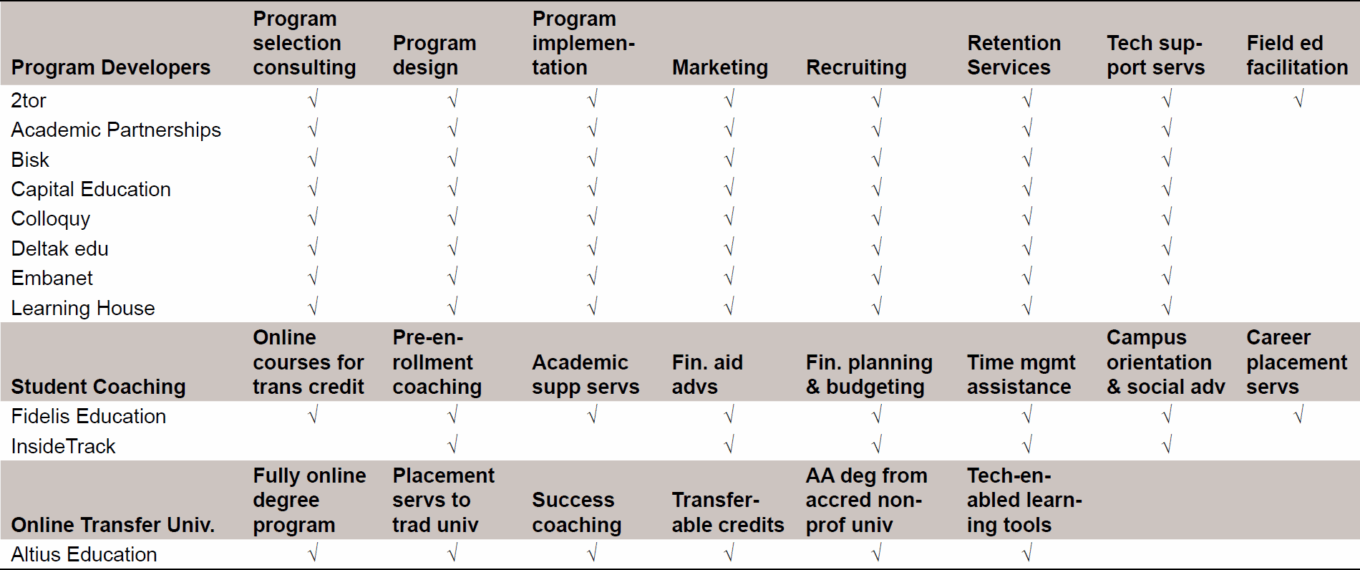
Table 1 below summarizes the companies profiled in this paper and the range of services they provide. 2tor, Academic Partnerships, Bisk, Capital Education, Colloquy, Deltak edu, EmbanetCompass, and LearningHouse are SaaS companies that serve as end-to-end providers of development, IT, marketing, student recruiting, and retention services to universities seeking to build online degree programs. While conceptually similar, there are meaningful differences among the companies, such as the types of partner institutions they serve.
So far, we believe the bulk of the programs supported by these companies are at the graduate level, for reasons discussed below, with undergraduate programs perhaps presenting a future growth opportunity. Altius Education currently operates with a public/private model, having partnered with non-profit college Tiffin University to form a joint venture known as Ivy Bridge, a fully online transfer university (i.e., an institution that provides a two-year program specifically designed to provide students the academic background required to transfer to and complete a four-year program at any one of a number of partner institutions).
InsideTrack and Fidelis Education contract with institutions to provide student coaching services with the goal of improving student engagement, persistence, and graduation rates. InsideTrack coaches all types of students, while Fidelis works only with current or former members of the military to facilitate the transition from the military to civilian and campus life.
Finally, we profile the non-profit Western Governors University, a fully online competency-based non-profit university that has experienced strong growth in recent years and garnered critical support from policymakers. WGU stands out as the only non-profit entity in this report, but we believe it’s worth highlighting due to its unconventional pedagogical model and growing popularity among both students and thought leaders in the higher education domain.
TABLE 1: Services provided by SaaS companies
Source: First Analysis and industry reports.
Although this paper focuses on the pure-play companies in the SaaS industry, we believe other, larger players in the education and technology space including Pearson, Blackboard, and Apollo Group have begun providing similar services to non-profit institutions. Blackboard and Pearson’s eCollege made their names as providers of learning management system (LMS) software for higher education and now see an opportunity to add additional value by offering a wider range of online solutions.
For example, in 2010 Pearson’s eCollege partnered with Arizona State University, the second-largest U.S. non-profit university, to offer fully-online undergraduate degree programs. The company not only supplied ASU with the LMS and usage analytics, but offered the school recruiting, student support, and retention services, similar to the services offered by many of the companies profiled in this report. At the moment, we believe the industry is fragmented, with a large potential market capable of supporting the growth of many firms, but we expect new entrants and existing company growth to eventually result in a degree of industry consolidation. We view some of the companies discussed in this report as potential IPO candidates, while others may consolidate amongst themselves or be acquired by larger, diversified industry players.
Industry drivers
While companies have been providing distance learning and other outsourced services to higher education for many years, we believe there are a number of factors driving growth in online learning among traditional institutions at present. These trends are discussed below.
- There is a growing awareness of the quality and access-enhancing potential of online education among both faculty and administrative personnel. We believe this perspective has been driven not only by societal pressures but by specific data, such as a 2010 meta-analysis of online learning studies conducted by the Department of Education that revealed that students receiving online instruction performed modestly better than those learning in a traditional classroom.
- Technological advancements have dramatically improved the richness and experience of online learning, with offerings including synchronous and asynchronous instruction, rich media, collaborative workspaces, chat features, social networking, mobile technology, and content and curricula that have been designed specifically for online delivery.
- There is a renewed emphasis by policymakers on increasing the number of U.S. college graduates, driven by a weak employment market and stagnant wages. The Obama administration has specifically established a goal of making the U.S. the top nation in the world in college degree attainment by 2020.
- Consistent with policymakers’ goal of encouraging institutions to expand access to higher education through alternative delivery methods, and despite promulgating regulations that have focused largely on the proprietary sector, the Department of Education (DOE) has taken steps to ensure the non-profit sector can continue to partner with for-profit entities in order to enhance enrollment. For example, we note DOE’s changes to incentive compensation regulations, which became effective in July 2011, could have initially been interpreted as banning the type of revenue-sharing model used by many SaaS companies. However, in a “Dear Colleague” letter distributed subsequent to publication of the final regulations, DOE made it clear SaaS companies would be specifically exempt from the revised regulations, stating, “the Department does not consider payment based on the amount of tuition generated by an institution to violate the incentive compensation ban if that payment compensates an unaffiliated third party that provides a set of services that may include recruitment services.”
- The dramatic rise in the cost of a post-secondary degree is driving students to demand and colleges to offer less expensive degree options without sacrificing academic quality. The cost of higher education measured by the Higher Education Price Index (HEPI) has outpaced the overall increase in consumer prices by about 1% annually on average since 1980.
- Reductions in state funding for public institutions and shrinking endowments at some private institutions are forcing colleges to consider new sources of revenue. In addition, many schools are capital-constrained, precluding them from making the large up-front investments needed to build an online degree program themselves.
- There is a greater awareness within the higher education community of the importance of college completion. More attention has historically been given to promoting access to higher education, particularly among low-income and minority students, relative to efforts aimed at increasing persistence and graduation rates. Declining completion rates are increasingly viewed as one of the primary obstacles to increasing the number of college-educated adults. This sensitivity presents an opportunity for companies like InsideTrack and Fidelis that can demonstrably improve persistence and graduation rates.
- Top-tier institutions like MIT, Stanford, the University of Southern California, Georgetown, and others are increasingly embracing the technology, lending greater legitimacy to the online medium. We believe the actions of premier institutions are highly influential in shaping the attitudes toward online education among administrators and faculty at other institutions.
- Public and private institutions have been placing a greater emphasis on the importance of serving the educational needs of non-traditional students for whom taking classes on campus is often not a practical option. Indeed, achieving the Administration’s 2020 college completion goals, while extremely challenging under any circumstances, is almost entirely impossible without a concerted effort aimed at educating the working-adult population.
- Increased competition for students across all types of institutions (including proprietary schools) is necessitating expansion into the online realm.
- A tech-savvy generation of traditional-age students who grew up using the internet and are comfortable learning online is increasingly demanding a technology-enabled learning environment.
Industry outlook
We view the SaaS industry as relatively fragmented, with players at a variety of stages and ample room for future growth. According to DOE data, there are approximately 3,300 Title IV eligible public and private non-profit two-year and four-year degree-granting institutions operating in the U.S. In addition, data collected by Eduventures suggests that in 2010, just 2.4% of institutions accounted for 55% of students enrolled in fully online degree programs, while 44% of institutions offered no online degree programs. This degree of concentration is mostly reflective of large numbers of online students enrolled at a handful of proprietary institutions, but also demonstrates just how many non-profits had yet to adopt online learning.
The large number of non-profit institutions with little or no online presence represents an attractive organic growth opportunity for companies offering online program development and implementation services. Indeed, many of the SaaS companies we discuss here are experiencing double-digit top-line growth, a trend we see as sustainable for the next several years.
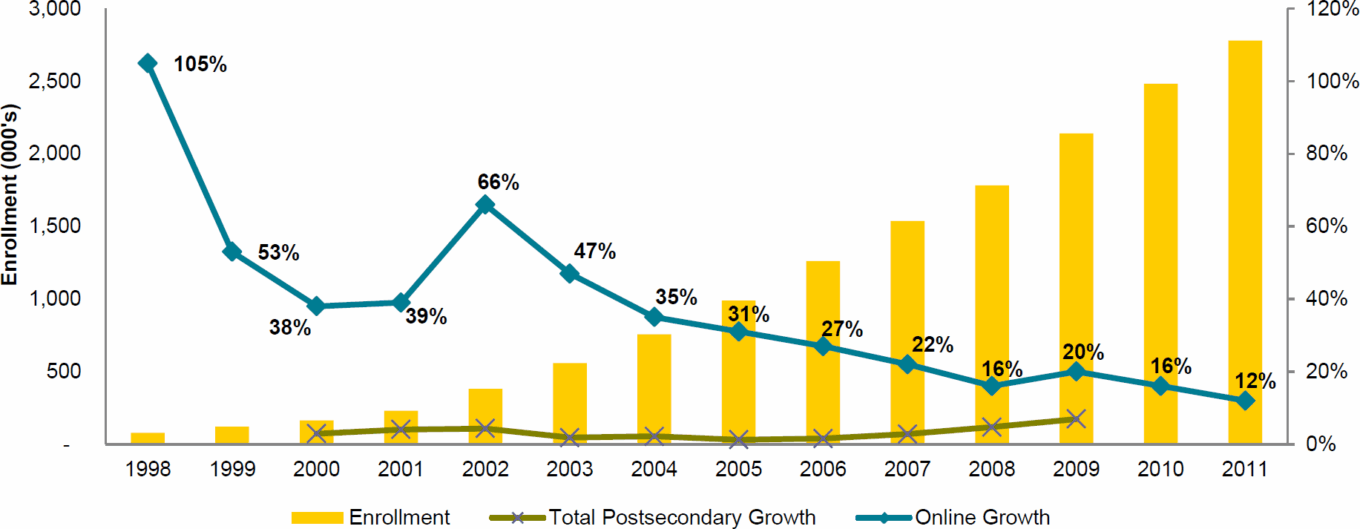
The online education market has grown rapidly in the past 10 years, far outpacing the overall growth in post-secondary enrollment (see Table 2). According to the 2011 annual survey of online education conducted by the Babson Survey Research group, 6.1 million students (or 31% of total post-secondary enrollment) were taking at least one college course online in the fall of 2010.
TABLE 2: Total online enrollment and growth
Source: Eduventures and Department of Education.
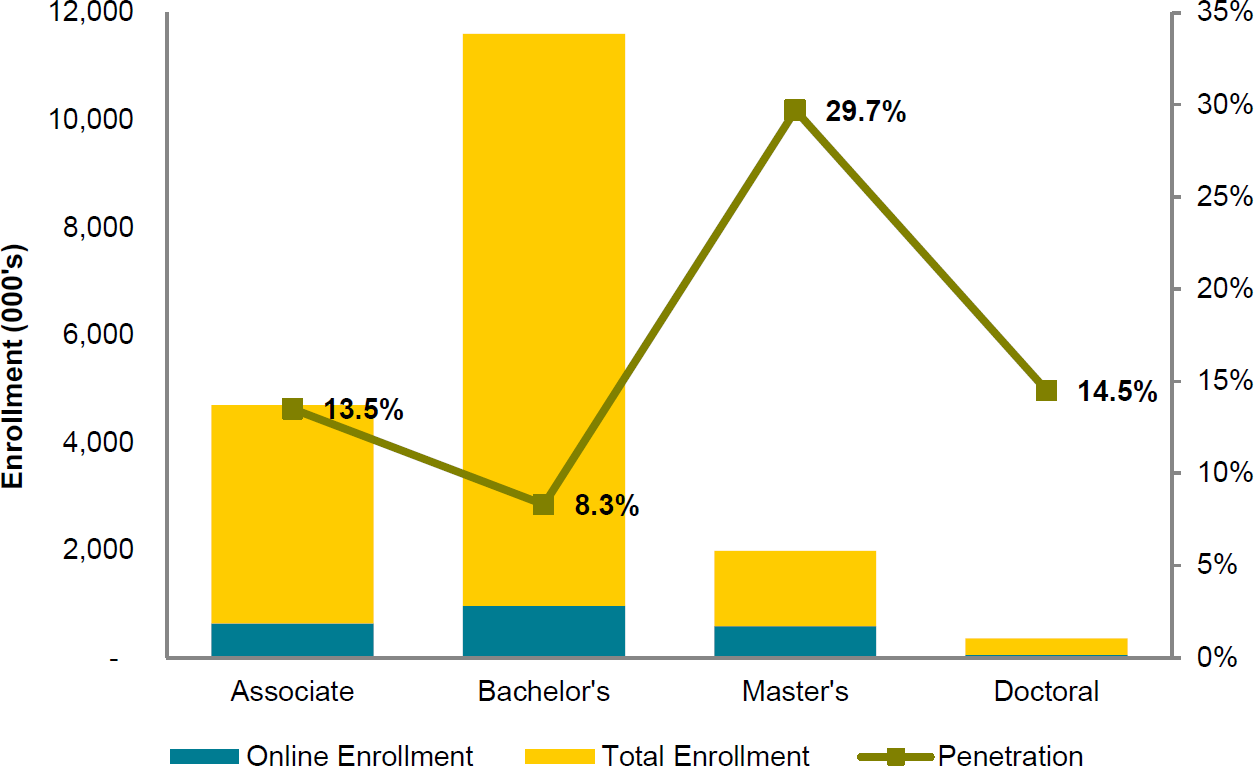
Data from Eduventures suggests nearly 14% of college students in 2010 took more than 80% of their college courses online, while nearly 30% of graduate students are online (see Table 3). The Babson Survey also noted that between 2002 and 2011 the proportion of chief academic officers (CAOs) at over 2,500 institutions who agree that online education is critical to the long-term strategy of their institution rose from 49% to 65%. The survey found that CAOs at public institutions cite online education as being critical to their long-term strategy at a higher rate than CAOs at both private for-profit and private non-profit institutions, suggesting the demand for online learning solutions is high at state-funded institutions. The Babson results also suggest that while online education hasn’t yet garnered strong acceptance across the academic community, negative attitudes toward the medium among faculty have softened.
TABLE 3: Online enrollment by degree level, 2010
Source: Eduventures.
Although the percentage of CAOs indicating faculty at their institution accept the value and legitimacy of online learning has remained fairly consistent since 2002 (in the range of 30% to 35%), the percentage who say faculty don’t accept the value of online education has fallen recently from 17% in 2009 to 11% in 2011 (around half of CAOs indicated a neutral opinion on faculty acceptance of online education).
Market size
We believe SaaS companies have been experiencing accelerating growth in recent years, driven by the factors we discuss above. The majority of programs being developed by the SaaS companies we profile in this report are at the graduate level (for reasons discussed below), and we believe most of the SaaS opportunities in the near- to medium-term will be at that level. According to data gathered by the Council of Graduate Schools, total enrollment at public and private non-profit graduate schools was nearly 1.6 million in 2010. Furthermore, data gathered by Eduventures suggest the online penetration rate at the masters-degree level for all types of post-secondary institutions was 29.7% in 2010 (online enrollment defined as students taking more than 80% of classes online), suggesting the total number of graduate students at non-profit institutions earning their degree online is between 400,000 and 475,000.
Additionally, Table 2 demonstrates the rapid growth in online enrollment compared to overall post-secondary education since the late 1990s. Although growth in online enrollment has moderated from early, elevated levels, we believe growth in online will continue to outpace overall post-secondary enrollment growth and the percentage of students learning online will continue to increase. Eduventures projects online headcount to grow to 22% of total post-secondary enrollment in 2020 from 12% in 2010, projections we view as reasonable, given all the factors highlighted under “Industry drivers” above.
Although no specific data exist on the current size of the SaaS industry, based on our research and discussions with industry participants, we believe the industry is currently generating between $300 million and $400 million in annual revenue and growing about 30% annually, with variance in growth rates among the various players, and between 45,000 to 60,000 students enrolled in programs developed by SaaS companies.
In making these estimates, we are confining the industry to the companies that are providing end-to-end solutions for building and growing online programs at traditional institutions. We think there is ample room for companies in the industry to expand by taking a larger share of a growing market, and we expect the SaaS industry as a whole will continue growing more than 20% annually over the next several years (see Table 4).
TABLE 4: Estimated SaaS industry market size

Source: Council of Graduate Schools.
Competitive impact
Although the SaaS industry is still young and developing, making its impact on competitors difficult to gauge, we believe non-profit graduate-level programs, which have been the primary focus of the industry thus far, are already viable competitors with proprietary institutions. Based on our conversations with SaaS companies and for the reasons we cite below, we believe competition with proprietary institutions at the undergraduate level remains less intense, although we expect competition to grow over time, placing pressure on proprietary institutions to continue innovating and building differentiated brands. As the access-enabling aspect of online education becomes less of a differentiator, we believe proprietary institutions will need to intensify their focus on finding ways to enhance the student experience and improve outcomes.
At present, we don’t believe there’s substantial overlap between the types of students attending proprietary institutions, most of which are open access, and those seeking online degrees at the more up-market non-profits. Moreover, we believe the majority of the new programs being developed by non-profits are at the graduate level. Although some proprietary institutions like Capella University have a large presence in the master’s market, most proprietary institutions’ mix is weighted toward offerings at lower degree levels.
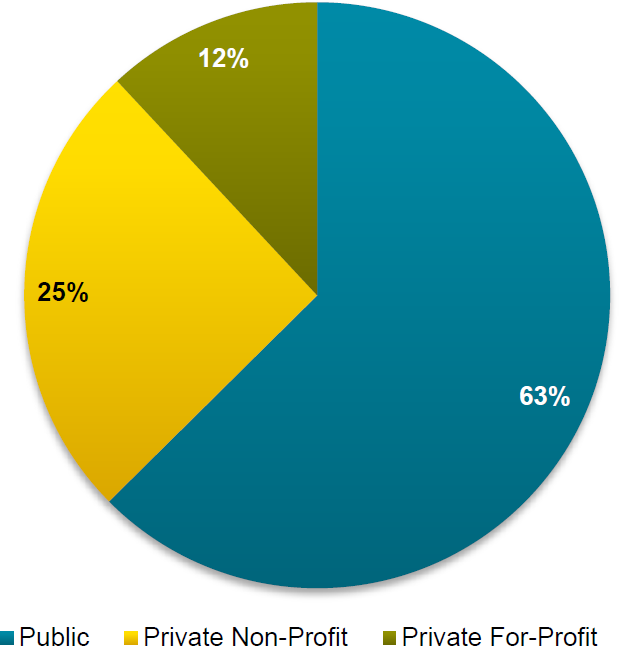
The smaller master’s degree market has always been competitive, and as Tables 5A and 5B illustrate, the proprietary sector’s somewhat lower market share in graduate programs than at the undergraduate level reflects this competition. While we think there is plenty of appetite among non-profit institutions for new graduate-level online degree programs, we believe institutions are more cautious about moving into online at the undergraduate level in a meaningful way. Some of this hesitancy relates to maintaining institutional identity and brand value, but much is reflective of the logistical challenges and complexities of building an undergraduate program requiring the input of multiple departments and disciplines, as well as questions over acceptance of transfer credits when serving the non-traditional students who typically enroll in online bachelor’s programs.
TABLE 5A: 2009 undergraduate enrollment percentage by ownership
Source: The Integrated Postsecondary Education Data System.
TABLE 5B: 2009 graduate enrollment percentage by ownership
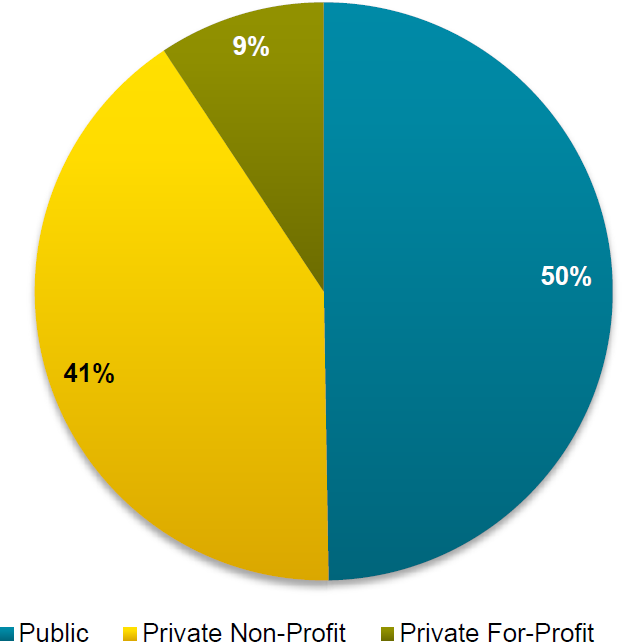
Source: The Integrated Postsecondary Education Data System.
As such, we believe non-profit online degree programs are currently concentrated primarily at the graduate level, with most four-year non-profits not yet making a meaningful attempt to target the proprietary schools’ traditional market of non-traditional bachelor degrees learners. This could eventually change, of course, with some of the SaaS companies with whom we’ve spoken discussing a goal of making more inroads at the bachelor level.
SaaS company profiles
2tor
Launched in 2008 by Princeton Review founder John Katzman, 2tor develops and provides support for online programs offered by traditional post-secondary institutions. The company provides initial funding to launch the program, works with faculty to translate a school’s curricula to an online modality, designs and implements a proprietary learning management system, provides technical and logistical student support, and engages in marketing and recruiting efforts to promote the program and attract qualified students.
The company is unique in that it focuses exclusively on developing online programs for top-tier universities, and, unlike some other companies that partner with multiple schools to develop and manage online programs, 2tor intends to work with a single partner within each academic category. To date, the company has partnered with only three universities (the University of Southern California, the University of North Carolina at Chapel Hill, and Georgetown University) to build and manage four online masters’ degree programs in the fields of business, nursing, social work, and education. We believe the company’s goal is to ultimately have the largest non-profit program in each of the academic vertical it serves in the U.S.
We believe 2tor has carved out an interesting and defensible niche in the online education market. We believe the richness of the company’s proprietary learning management system combined with the unmatched curriculum and faculty quality and strong brand equity found at partner institutions make 2tor a provider of some the highest quality online programs currently being offered.
Focus on online programs at elite universities
2tor partners with top-ranked institutions with the goal of developing online degree programs that meet or exceed the level of academic quality found on-campus. Important to 2tor’s business model is the commitment to program exclusivity, wherein the company will only work with a single institution in each program discipline (i.e. 2tor only partners with UNC in offering an MBA program, only partners with Georgetown in offering graduate degrees in nursing, etc.) The company believes maintaining exclusivity is important to avoid potential conflicts between 2tor and partner institutions. If a potentially attractive marketing or recruiting opportunity presents itself, the company doesn’t want to be in the position of having to choose which partner institution will benefit.
Ideal partner institutions are ones that share a strong commitment to expanding access to higher education through online learning and that eventually expect to offer the program on the requisite scale needed to make the partnership economically viable for both the partner and 2tor. The company launched two programs in 2011, and we expect it to announce additional institutional partnerships during 2012. Management has set a medium-term goal of having online programs in every major graduate program category. A summary of each of 2tor’s four programs is provided below.
USC School of Social Work (MSW@USC)
The Virtual Masters in Social Work program is, we believe, the first blended (online instruction with field study) program of its kind offered by an elite university (USC’s MSW program is ranked 8th in the country by U.S. News and World Report). The MSW program was the second of 2tor’s four programs to launch, and the inaugural class began classes in October 2010.
The tuition, curriculum, and degree conferred in the Virtual MSW program are equivalent to the traditional, on-campus version. The learning management system developed for the program provides both synchronous and asynchronous instruction. The asynchronous platform includes an interactive online community with features like social networking, groups and organizational tools, and 24-hour access to self-paced coursework that includes original, documentary-style videos, reading materials and class assignments produced by faculty and instructional designers.
The synchronous platform allows students and faculty to participate in scheduled, weekly, live online class sessions through live face-to-face video streaming. Students can schedule live office hours with professors, and collaborate one-on-one or in groups with classmates and faculty. The pedagogical model of most masters’ social work programs generally includes an extensive field study component whereby first- and second-year students work hands-on with recipients of social services in a supervised environment.
2tor works with USC to place online students in the field, no small feat given students are spread across the country and overseas. We believe USC was targeting program enrollment of more than 700 students in 38 states and four countries by the beginning of 2012.
USC Rossier School of Education (MAT@USC)
USC’s Masters of Arts in Teaching online program known as MAT@USC was rolled out in June 2009, making it the first online program developed by 2tor and the first of its kind offered by a top research university. Like the MSW program, the MAT@USC program combines online instruction with numerous field-based educational experiences.
2tor works closely with Rossier in developing the necessary relationships with school districts across the country required to place online students in a hands-on learning environment and fulfill the program’s field study requirement (students extensively record and upload their field experiences for discussion). As of December 2011, there were 2,500 students participating in the USC@MAT program, about 30 times the number of students earning the degree on-campus. The total cost of the 13-month program is around $45,000.
UNC Chapel Hill Kenan-Flagler Business School (MBA@UNC)
UNC’s Kenan-Flagler Business School launched its fully online Masters in Business Administration program, known as MBA@UNC, in the summer of 2011 with an inaugural class of 19 students. With tuition of $89,000, the program is somewhat less expensive than the $98,000 non-residents pay for the on-campus version.
The program aims to be as collaborative as possible, with students and professors interacting in real time over live video chat and students able to work together on projects synchronously and asynchronously through the company’s proprietary learning management system. To help foster personal relationships, students are brought together periodically (currently four times over the course of the program) in locations across the world in interactive sessions known as “immersions.”
Georgetown University School of Nursing and Health Sciences (MS Nursing)
The graduate online nursing program offers students across the country the opportunity to earn a Georgetown University Master’s degree in Nursing through the School of Nursing & Health Studies’ nationally ranked program. The program was launched in the spring of 2011 and has a structure similar to the other 2tor-designed programs. The program utilizes web 2.0 technology and combines a didactic component with a field study portion completed at a medical facility in the student’s home community. The program also features periodic trips to Georgetown’s campus to meet face to face with faculty and receive training with the school’s advanced medical equipment.
2tor-designed programs are structured such that all core academic and admission functions are handled by the institution, which owns the content and curriculum. 2tor provides recruitment and student services and serves as the producer and information technology provider. The online experience offered by 2tor is intended to be more like Facebook than Blackboard, meaning the online interface is highly interactive, social, and designed specifically for the online modality (i.e., not designed primarily to be ancillary to a physical classroom experience). About half the students also study on their mobile devices through 2tor’s apps on iPad, iPhone, and Android.
While 2tor doesn’t make public the details of its revenue-sharing agreements with institutions, we believe that conceptually, it provides the initial funding needed to build the content and infrastructure necessary to support each online program. We believe the company invests in the vicinity of $10 million to $15 million in the first few years of each program to develop the program and build an enrollment base. (Since 2008, 2tor has attracted nearly $70 million in venture funding, making it among the top-funded New York City-area ventures in the recent past.)
With its exclusive focus on top-tier institutions, we believe 2tor has identified a potentially profitable niche in the online educational services market. Although historically ambivalent to online education, we think top-tier institutions are increasingly embracing the value of online learning and recognizing that these programs, if done correctly, are capable of offering instruction of comparable academic quality to traditional classroom learning. Given 2tor doesn’t intend to partner with large, geographically disbursed institutions, we believe a key factor for the company will be its success in identifying channels through which recruits can be cost-effectively identified and enrolled. To this end, we think 2tor focuses largely on keyword search, as well as on some selective international efforts (such as a recruiting operation in Hong Kong).
We expect 2tor’s relationships to be relatively sticky given contracts with partners tend to be long-term and our belief that there are substantial switching costs for institutions once they’ve partnered with the company to offer an online program. As such, we expect 2tor to enjoy a considerable economic moat with existing customers. Another advantage of working with elite institutions is pricing power. Strong demand for degrees from top-tier institutions allows schools to price tuition at a premium, and, because the degrees conferred to online students are equivalent to the on-campus version, online students typically pay equivalent tuition as on-ground students. Although some less prestigious institutions have looked to online programs as a means of offering degrees at a lower cost to students, we don’t believe the institutions working with 2tor have plans to offer programs at a discount. The premium price point of 2tor partners should help the company earn relatively high revenue-per-student.
2tor’s focus on the upper end of the educational quality spectrum leads us to believe the company isn’t likely to compete against most proprietary post-secondary education providers. The profiles of students attending elite and proprietary institutions are generally quite different, and there is little chance the two types of institutions will compete directly for students. To the extent 2tor and proprietary schools use the same marketing channels, 2tor’s (and similar companies’) presence in the market could be a contributing factor to higher advertising and inquiry acquisition costs for proprietary institutions.
Academic Partnerships
Founded in 2007 by entrepreneur Randy Best, Academic Partnerships (formerly known as Higher Ed Holdings) is a provider of online development and support services to traditional post-secondary institutions. Like other SaaS providers, Academic Partnerships designs and markets online courses on behalf of non-profit universities; however, the company is distinguished by the fact that it works exclusively with public institutions.
This strategic focus is premised on the idea that large, well-known public institutions have brand value that is not being fully leveraged due to the physical capacity constraints of the traditional campus. Academic Partnerships helps institutions capitalize on their brand value by assisting them in transferring degree programs online, where they can be accessed by a larger number of learners, particularly non-traditional students for whom attending a physical campus is not a viable option.
In the past, large public institutions have been slow to adopt the online education model, largely ceding the market for online learners to proprietary institutions, but in recent years, these universities have been pursuing online education more aggressively, a desire with which we believe Academic Partnerships is well-positioned to assist.
Public universities offer economies of scale in online programs
The concept of using online delivery to leverage institutional brand value is a key part of the business models of several of the companies operating in this sector, but in contrast to companies that target smaller private or elite colleges, Academic Partnerships sees advantages of scale in catering to public universities. Providing education to the masses has always been part of the institutional mission of large state-funded universities, and we believe the access-enhancing potential of online education makes the modality a natural fit for these institutions. While the lower tuition rates of public institutions may result in lower revenue per student than at companies that serve higher-priced competitors, the lower-cost nature of Academic Partnerships’ customer base should position it well to attract its fair share of students.
Since 2008, when Academic Partnerships inked its first partnership deal with Lamar University, the company has established between 20 and 25 partnerships with public universities across the country, including Arizona State University, Purdue University – Calumet, the University of Texas at Arlington, Arkansas State University, and Ohio University. Academic Partnerships offers partner institutions marketing, recruiting, coaching and student support services, along with IT and course development services. The company’s suite of services are summarized below.
Marketing and recruiting: Academic Partnerships assigns a team of recruiters and marketing experts to work with each institution to attract qualified prospects and assist them in the application process. Unlike some others operating in the space, Academic Partnerships has robust international, as well as domestic marketing reach, with recruiting centers in Latin America, East Asia, and the Middle East. A team of field representatives establishes and maintains relationships with corporations, professional organizations, public school districts, hospitals, health care systems, state and municipal organizations, law enforcement agencies, and branches of the military – a network that serves as a vast source of potential recruits.
Course development and IT: Designers and information technology personnel with expertise in learning management systems and student information systems work closely with faculty to adapt the course curriculum to an online platform. The company currently uses a learning management system known as Epic, with the possibility of alternatives down the road.
Coaching and student support: Academic Partnerships works closely with Instructional Connections, a provider of online academic support services. Academic coaches, similar to teaching assistants in a traditional on-campus setting, assist instructors by grading assignments, leading online discussions, and supporting instruction in any other way needed.
Company background
Randy Best has founded or acquired more than 100 businesses and has been active in the education sector since 1995, when he started Voyager Expanded Learning, a provider of curriculum, services, and technology to support at-risk students (now a part of public company Cambium Learning Group). In 2007, when Best founded Academic Partnerships (then known as Higher Ed Holdings), it was based on the idea of helping public institutions of higher learning offer technology-enabled solutions to enhance student access.
Another education company founded by Best, Whitney International University System, is a group of proprietary institutions providing online and on-ground higher education programs throughout Latin America. Although Academic Partnerships and Whitney operate independently of one another, we believe the relationship provides an opportunity for Academic Partnerships to leverage Whitney’s South American presence in marketing to international students.
Costs and revenue model
Although the cost to attend varies across institutions, tuition for Academic Partner-ship’s online programs is typically priced below the cost of a comparable on-campus program. This offers a contrast to online degree programs at more elite universities, which we believe generally charge online students the same tuition as on-campus students. We believe the company has historically operated most of its partnerships on a revenue-share model, splitting tuition on a per-student basis.
Outlook
In its first three years, Academic Partnerships has partnered with nearly 25 public universities, and we see promising future growth opportunities ahead for the com-pany. We believe online education will play an increasingly significant role in fulfilling public universities’ mandate of expanding access to higher education. Academic Partnerships has technical expertise in online program development, but more importantly, has vast marketing resources and a recruiting infrastructure that makes it advantageous for institutions to work with the company rather than develop programs in-house.
We believe the company’s international recruiting resources will be increasingly valuable to public institutions looking to fill gaps in state funding by enrolling larger numbers of foreign students who are willing to pay full fare. Broadly speaking, we think the long-term trends in online education and funding constraints at state universities position Academic Partnerships well to grow in the coming years.
Altius Education
Altius Education operates an online transfer institution known as Ivy Bridge College through a joint venture with Tiffin University, a private non-profit college located in Ohio. Ivy Bridge is a unique type of institution in that its main function is to serve as a gateway to admission to a bachelor’s-level program at an outside institution. Ivy Bridge grants associate-level degrees, with a focus on providing students the knowledge and skills needed to ultimately complete a bachelor’s degree. Through articulation agreements with nearly 130 public and private institutions, Ivy Bridge associate degree graduates are typically granted automatic admission or preferential status in admission to a bachelor program at a partner institution. Placement counselors also provide support and assistance for students who seek to transfer credits to non-affiliated schools.
While the role of graduating students in associate programs with an eye toward pre-paring them to transfer to a four-year institution has traditionally been the purview of community colleges, Altius was founded to fill a fundamental gap in the educational model of community colleges. Specifically, community colleges serve multiple roles in providing both short-term vocational programs and longer associate programs to prepare students to continue their education at four-year institutions and often lack sufficient resources to fulfill all their roles equally and adequately. Although a large majority of students entering community college indicate they plan to earn a bachelor’s degree, only about 20% end up transferring to a four-year institution and completing a degree. Altius was created for the sole purpose of providing associate-degree students the foundation they need to transfer to and succeed in a four-year program, and all of its programs and support structures are designed to help students meet that goal.
Started in 2007, Altius began enrolling its first students in the fall of 2008. We believe Ivy Bridge currently graduates or transfers around 60% of its students, well above typical levels at community colleges. We believe Ivy Bridge’s success has been a result of four factors: 1) online modality, 2) a focus on building the fundamental knowledge and skills required at the bachelor level, 3) intensive counseling and support, and 4) articulation agreements that provide access to a wide variety of four-year institutions.
Online modality
Online courses offer Ivy Bridge students the convenience of asynchronous instruction, a major benefit to students with significant work and family commitments. Due to budgetary constraints, many community colleges don’t offer the level of convenience and flexibility many students require, a contributing factor to higher drop-out rates. In fact, online learning is so popular among Ivy Bridge students that about 95% remain in the fully-online modality after transferring to a four-year institution, even though many had previously intended to pursue an on-campus or blended learning environment.
Although the fully online modality doesn’t, in and of itself, make the program unique, we believe the online element is critical to the success of the Ivy Bridge model. Ivy Bridge provides all of its instruction through an online learning management system developed by Pearson, although we believe it’s in the process of moving to an open-source alternative. The curriculum was developed by non-profit partner Tiffin University, which tends to appeal to the four-year institutions that ultimately accept graduates of Tiffin’s programs.
Focused approach
An oft-recited critique of community colleges is that their effectiveness has been undermined as they’ve continually widened their scope. Community colleges’ attempts to be all things to all students, combined with budgetary pressures, have eroded their ability to target offerings to students with the goal of transferring to a four-year institution. For example, most community colleges are tasked with educating both students seeking vocational training as well as those preparing for a four-year degree in business, information technology, or education. Ivy Bridge offers a curriculum specifically designed to prepare students for success at the bachelor level. The curriculum is broad, general, and designed to teach fundamental concepts students will need in bachelor-level programs.
Counseling and support
A key element of Altius’s strategy to increase the number of pre-bachelor students moving into four-year programs is providing intensive counseling and student support services. We believe a significant factor in determining whether a given student will drop out or persist is the presence of someone in the student’s life who has completed a bachelor’s degree. For example, a 2004 study conducted by ACT, a non-profit education research organization, cited social support and engagement factors as among the most important non-academic determinants of student retention. Whether this person is a family member, a friend, or other acquaintance, the availability of someone who understands and can support a student as they face the challenges of earning a degree has a significant impact on whether a student will ultimately graduate. With this insight in mind, Altius offers each student a learning success coach who is a college graduate and is available to provide academic assistance and moral support to all Ivy Bridge students.
Articulation agreements with partner institutions
We believe one of the most important factors in Altius’s success is the large network of partner institutions that have agreed to enroll Ivy Bridge graduates. Under these articulation agreements, Ivy Bridge graduates who have earned a sufficiently high GPA gain automatic admission to a partner institution. The GPA thresholds for each institution vary but generally correspond with the level of selectivity or institutional prestige. Partner institutions don’t set quotas on Ivy Bridge transfers so students are not necessarily competing directly against one another for acceptance at a preferred school. Altius currently has between 120 and 130 agreements with such schools as George Mason University, Valparaiso University, and the University of Cincinnati, to name just a few. Graduates of the Ivy Bridge program receive an associate degree from Tiffin University, which is regionally accredited by the Higher Learning Commission.
Future growth plans
Ivy Bridge College is in the process of applying for accreditation from the Western Association of Schools and Colleges, and if granted, we believe it will disassociate from and operate independently of Tiffin University. We believe that operating Ivy Bridge as an independent institution will help provide the control and flexibility Altius needs to reach its goal of becoming “America’s transfer college.”
Deltak edu
Deltak edu provides a range of distance learning services to public and private non-profit post-secondary institutions, including the design, implementation, maintenance, and marketing of online courses. The company offers customized program selection and market strategy consulting services to help partner institutions select online programs tailored to their strengths and individual requirements. The company conducts market research to identify programs with strong student demand that are consistent with the educational mission of the institution. Once the program has been selected, Deltak’s Academic Services team works with faculty and subject matter experts to design and develop courses, delivering the traditional curriculum in the online environment. Since its founding 15 years ago, Deltak has partnered with 24 separate institutions and developed over 90 programs.
Company background
The company that would become Deltak was founded in 1996 as Eduprise Inc. The venture drew upon the work of a University of North Carolina – Chapel Hill-based think tank focused on online education. In 2001, the company merged with Collegis Inc. and transitioned to its current full student-service business model to address the early signs of demand for online education from traditional schools. When Collegis was acquired by SunGard Data Systems in 2004, a subset of Collegis was spun off and renamed Deltak. Up until July of 2011, Deltak was a wholly-owned subsidiary of Rasmussen Inc., the parent company of Rasmussen College, a non-publicly-traded post-secondary educational services company offering degrees through a network of 23 campuses. The separation of Deltak from Rasmussen was precipitated by recent changes in incentive compensation regulations.
Marketing, recruiting, and retention
Student support and recruiting are an important element of the suite of services offered by Deltak. The company’s marketing team uses a variety of channels to attract qualified applicants to partner institutions, including third-party aggregators, direct- to-corporate selling, social media, text messaging, click-to-chat, and direct mail. Like many of the proprietary schools that we cover, Deltak historically relied heavily on third-party aggregators to attract potential students, but has recently moved to diversify its marketing mix. As the company deemphasizes lead aggregators, corporate selling and social media marketing are becoming more important channels for reaching potential students.
Once a potential student has been identified, a Deltak program manager steps in to provide recruitment services. Program managers are trained to help each prospective student make an informed decision about which program best fits their needs based on personal preparation and career goals. The recruiting team assists prospective students in completing applications and student aid forms, which are then submitted to the partner institution. The institution then makes the decision on which applicants will be accepted into the program. Over time, Deltak develops a better understanding of the type of student likely to be accepted at each institution and becomes more efficient in identifying and delivering prospects that fit partner criteria.
The company earns revenue only on those students accepted into a program, so there is a strong built-in incentive for Deltak to provide high-quality prospects to its partners. For enrolled students, Deltak provides retention services through a team of student service coordinators who provide proactive retention services, as well as its Personal Support Center (PSC). PSC representatives are available 24 hours a day, seven days a week to provide technical support to students, faculty, and administrators.
Business model
Deltak has historically targeted mid-market, four-year institutions and lists a number of religiously-affiliated private schools as customers. The company has had success signing larger institutions as customers of late, as well, including Boston University and Purdue. Unlike many upper-echelon schools, most mid-market private institutions lack large endowment funds (and the ones that do have endowments are likely to have sustained significant losses during the 2008-2009 period). According to recently released data from the National Association of College and University Business Officers and the Commonfund Institute, as of the end of 2011, the average university endowment has realized a paltry 1.2% annualized return since 2007, well below cost growth over a similar period. Public universities face a similar challenge as they look to fill funding gaps created by state cuts to higher education. As a result, both public and private mid-market institutions have sought cost-effective new sources of revenue, with online programs a potentially attractive option. We expect this dynamic, along with a growing awareness among college administrators of the access-enhancing merits of online instruction, to drive continued growth at Deltak. Although competition has increased, we believe Deltak is well-positioned in a segment of the market where demand appears to be strong and is likely to continue to grow.
Across Deltak’s 24 partner schools and 90 degree programs, a little over 80% of students are at the master’s level, with the remainder enrolled in bachelor and doctoral degree programs. Deltak provides all the support functions for its online programs, while institutions retain control over instruction, admissions, and financial aid. While some competitors provide instruction facilitators (similar to TAs), Deltak has opted not to offer this type of service, preferring to leave all academic functions to the partner institutions. Many faculty and administrators at non-profit institutions remain wary of external involvement in instructional and academic matters, so Deltak has sought to allay any concerns by confining its operations to IT, student support, and recruiting functions. We believe this clear separation of academic functions could be a selling point for institutions that are concerned about outsourcing a core competency to an external provider.
We believe Deltak has had success partnering with a number of schools by effectively communicating the unique aspects of these institutions’ culture, community, and learning environment. Deltak has put a considerable amount of time and effort into incorporating the social presence element when developing courses. Social presence is fostered by designing courses that are highly interactive, with an emphasis on building a sense of community among learners, an approach not unlike social networking sites like Facebook. We believe this approach gets at some of the largest challenges in developing online programs for traditional schools, which are not technical in nature, but rather relate to finding ways to capture and communicate the differentiated elements of an institution in an online setting.
After signing a new partner, Deltak builds a website for the institution’s online programs, develops a marketing strategy, and trains an admissions team specifically assigned to the institution. All of the upfront technology and human capital investment is shouldered by Deltak, an attractive proposition for partner institutions that might otherwise be unwilling to assume these risks. We believe the long-term nature of Deltak’s contracts and a high renewal rate make the financial model an attractive one for the company as well.
While the entry of new players has resulted in a more competitive landscape, we believe plenty of growth opportunities remain for Deltak in this relatively young industry. We think Deltak’s long track record of delivering quality online programs and services will allow the company to remain a major player in the SaaS space.
EmbanetCompass
Founded in 1993, Embanet was one of the pioneers of the SaaS industry, and following its 2010 merger with Compass Knowledge Holdings, the combined company, EmbanetCompass, continues to be one of the top providers of distance learning solutions to traditional universities in the U.S. The company provides program development expertise, marketing resources, and recruiting and retention services to schools seeking to build new online degree program offerings. It offers customers end-to-end online program development solutions as well as a limited-service recruitment and retention-only package. With the full-service option, EmbanetCompass provides pre-design research and consulting services, course development solutions, post-development technical support, and student recruitment and retention services. The more limited service package provides marketing, recruiting, and retention services to those institutions operating existing online programs or who plan to build their own. The company targets higher-tier institutions, generally those ranked in the top 200 in the U.S. News and World Report list of best colleges, and currently has a portfolio of 110 online programs (over 90% at the graduate-level) with 35 separate institutions.
EmbanetCompass’ suite of distance learning services allows the company to be a full-service provider to institutions wishing to expand their online degree offerings. A list and description of the services provided by the company are below.
Program development and implementation: EmbanetCompass engages in a three-step process in developing an online program and works collaboratively with faculty to migrate existing curricula online. In the pre-design stage, designers work with faculty to define learning outcomes and objectives for the program. The company then uses project management tools to build the course and, upon completion, conducts a full evaluation, producing a report card that includes an assessment of the success of the program and recommendations for future improvement. Throughout the process, faculty are trained on best practices in online instructional delivery.
Marketing: EmbanetCompass markets online programs on behalf of institutions through a variety of channels, including direct response marketing, search engine optimization, database marketing, email, social media, paid search, pay-per-click, conferences, business-to-business, online educational directories, and other forms of traditional advertising. The company relies little on lead aggregators, which we believe account for less than 10% of inquiries. EmbanetCompass derives significant marketing advantages from leveraging the brand value of well-known universities. For example, potential recruits can be identified as candidates for a Wake Forest University online program after searching for news about the school’s basketball team.
Student recruitment: EmbanetCompass provides targeted marketing and admissions advisory services for online programs developed internally as well as for previously existing programs. Analytical techniques are used to identify and contact recruits at the point of maximum interest while a team of knowledgeable admissions advisors helps prescreen candidates and make them aware of financial aid resources. While the institution makes the final decision on applicants, EmbanetCompass recruiters are available to help organize and assemble prospective students’ application materials prior to submission. Over time, the company’s enrollment advisors (EAS) develop a strong understanding of the criteria each partner institution looks for in a candidate, augmenting the company’s efficiency in targeting appropriate prospects.
Student retention services: EmbanetCompass assigns student service advisors (SSAs) to each online student to help guide them as they progress through their programs. The SSAs facilitate student instruction, augmenting the institution’s existing faculty. Unlike faculty or teaching assistants, SSA’s perform a number of facilitating functions, including ensuring students have received their textbooks, identifying and coaching at-risk learners, facilitating survey-based course feedback, and building personal relationships with students. This level of personalized attention helps institutions retain students at a higher rate while relieving the school of the need to invest additional resources in student services.
Course migration: Institutions transferring to a new learning management system (LMS) often require technical assistance to facilitate a seamless migration. EmbanetCompass has experience conducting course migrations with LMS platforms including Blackboard, WebCT, Moodle, and Sakai. Discussion boards, assignments, lesson content, tests and exams, web-links, and course-link information are seamlessly transitioned between platforms with minimal disruption of instruction.
Help desk support: EmbanetCompass provides 24/7 live help desk support to online students. Services include live online chat support, live toll-free telephone support, email contact, FAQ/self-help webpage, and online audio tutorials. Partner institutions are guaranteed service levels, including assurances of minimum performance on metrics like live response time, first call resolution, call abandonment rates, and average speed of answer.
Business to university (B2U): The B2U program allows EmbanetCompass to serve as something of an educational broker, helping to match companies’ employees to the myriad of online program offerings provided by traditional universities. EmbanetCompass works to find a program that best fits the continuing educational needs of a company’s employees. By working with EmbanetCompass and its large network of partner institutions, companies, including 100 of the top Fortune 500, can secure discounts on employee tuition at select institutions.
Revenue share model
EmbanetCompass operates under a revenue share model that varies by service level. Under the full-service, end-to-end program development package, the company shoulders all the upfront investment in IT infrastructure and personnel and thus receives a greater portion of any revenue generated from student tuition. The limited-service (i.e., marketing, research, recruitment, and retention) package is less capital intensive for the company, and we believe the revenue share agreement is generally closer to an even split. We believe about half of the company’s programs are of the full-service type, and half are limited-service arrangements. Contracts with institutions are typically signed on a seven- to ten-year basis, and we believe the company’s renewal rate is high. The course content and curriculum are owned by the institution, but the online course is jointly owned with EmbanetCompass. Thus, any institution wishing to terminate the relationship but maintain an online program would not only need to invest in marketing and recruiting resources but would also need to completely redesign the online course. We believe high customer switching costs translate into a strong competitive advantage for EmbanetCompass given that the company has built an extensive client list over its 19-year history.
Graduate-level focus and institutional roll-up strategy
The vast majority of EmbanetCompass’ 110 online programs are graduate-level. In part, we believe this is a result of the fact that it is easier to introduce online graduate programs than undergraduate ones at traditional institutions. (Unlike undergraduate programs, graduate programs don’t include general education requirements that would require coordination among and buy-in from leadership of multiple departments within a given institution.) Additionally, we believe many traditional institutions are particularly attracted to the possibility of introducing graduate-level online programs, given graduate students are typically older than undergrads and often have children and careers. As a result, the convenience and flexibility of online learning are usually particularly appealing to graduate students. That said, we believe that as partner institutions gain experience with graduate online programs, EmbanetCompass will have growing opportunities to roll out undergraduate programs with its clients as well.
We believe EmbanetCompass has significant opportunities to grow by leveraging existing institutional relationships to launch additional programs in new academic disciplines. We believe the company has a robust pipeline of potential new programs and maintains strong relationships with existing clients (we think the company could effectively double its program offerings without adding a new partner institution). We view positively the company’s strategy of seeking to offer multiple programs at a single institution since we suspect the incremental cost of introducing new programs declines with each successive roll-out as the company better understands and anticipates the unique needs of an institution. (We believe this strategy should help EmbanetCompass add to its undergraduate program portfolio over time.) Judging by the full pipeline of new business and the stickiness of its partner model, we believe EmbanetCompass is well-positioned to grow. We believe the company’s long track record of building quality online degree programs makes it a highly regarded player in the SaaS industry, and institutions interested in expanding their online footprint will continue to look to the company for solutions.
InsideTrack
Since 2001, InsideTrack has partnered with higher learning institutions to provide executive-style coaching services to both traditional and non-traditional students, with the goal of helping institutions improve student engagement, persistence, and graduation rates. Unlike traditional university-provided academic advising, which is generally narrowly confined to academic-related issues, InsideTrack coaching assists students in coping with the wide range of challenges they encounter while in college. Coaches help students develop stronger study habits, adjust to academic life, better manage time, and more responsibly manage their personal finances. InsideTrack’s experience has shown that providing structure and positive reinforcement can significantly increase students’ ability to persist in their college careers and ultimately graduate.
Since the company’s founding in 2000 by education entrepreneurs Alan Tripp and Kai Drekmeier, InsideTrack has counseled over 350,000 students at over 50 campuses nationwide. While InsideTrack has a very different model than the end- to-end providers of online degree programs, we highlight it here to demonstrate the diversity within the SaaS industry, as an example of a company with a specific focus that helps improve the success rate of the types of learners who typically enroll in online programs.
InsideTrack has conducted multiple controlled studies demonstrating the efficacy of student coaching. The research suggests InsideTrack’s coaching methodology improves student persistence and increases graduation rates by 13% on average. Higher student retention and graduation rates improve the reputation and standing of an institution while also generating additional revenue from students who would have otherwise dropped out, a clear instance of alignment between student and institutional interests. Although direct one-on-one student coaching may appear labor-intensive, InsideTrack has demonstrated that it can actually generate significant net savings for an institution compared to the costs of recruiting and enrolling the large numbers of new students needed to replace those who drop out. As heightened competition for new students has driven acquisition costs higher, student turnover is becoming increasingly expensive for institutions. According to Noel-Levitz, a higher education consulting firm, private universities spent on average $2,185 to recruit a student in the 2010-2011 academic year. We believe the number is even higher for many proprietary schools at present. Thus, higher new student acquisition costs, as well as policymaker scrutiny, have generated incentives for administrators to allocate more resources toward improving student retention.
Compared to other methods of improving student retention, the data suggest InsideTrack offers a strong value proposition to institutions. In 2011, Stanford University funded an independent study of InsideTrack’s impact on student outcomes. The study, led by Professor Eric Bettinger, notes that two semesters of coaching (at a cost of around $1,000) increases retention rates by an average of 5%, while a $1,000 increase in financial aid results in only a 3% increase. Professor Bettinger and Rachel Baker of the Stanford University School of Education analyzed 17 randomized studies of students receiving InsideTrack coaching and found coached students were 5.2% more likely to be enrolled after six months than a control group that received no coaching. The positive impact on retention and graduation was notable even after the coaching had ceased. Studies have not shown noticeable differences in the efficacy of student coaching between traditional and non-traditional students, suggesting that coaching should be of interest to institutions across all sectors.
We believe a confluence of factors should position InsideTrack well to continue growing over the coming years. As regulators and accreditors focus more attention on quality metrics like student retention and graduation rates, we believe institutions will be looking for effective ways to maintain student engagement. (In one recent and high-profile example, President Obama proposed altering the formula for determining campus-based aid, providing incentives for schools to focus more attention on quality measures like graduation rates. Explaining the proposal in Michigan following a speech made by the President, Secretary of Education Arne Duncan noted, “It’s not just about access, it’s about completion.”) Schools will be looking for cost-effective ways to meaningfully improve retention, a goal we believe InsideTrack is well-positioned to serve.
Other SaaS providers
Bisk Education
Bisk Education offers online program development solutions to non-profit, post-secondary institutions and is a major provider of continuing education products and services to business professionals. Founded in 1971 by Nathan Bisk to serve the continuing education needs of accounting and tax professionals, the company has evolved into a major provider of internet-based, instructor-led online degree programs at traditional universities. While the company continues to provide CPA and CPE test preparation products along with executive education programs and workshops for working professionals, Bisk’s University Alliance division, which provides end-to-end higher education solutions to universities, has been a source of growth for the company since the first program was launched in 1997. University Alliance advises on program selection and develops, implements, markets, and brands online courses on behalf of partner institutions. Additionally, University Alliance recruits prospective students and provides ongoing relationship management and retention services to online students.
University Alliance’s list of highly-regarded partner institutions, which includes Michigan State University, Villanova University, University of Notre Dame, Tulane University, the University of Vermont, and the University of San Francisco, suggests the company has the skills and expertise to effectively build and implement large-scale online programs. For example, Florida Tech’s online bachelor’s degree program, developed by University Alliance, received one of four spots on U.S. News and World Report’s recently announced “Honor Roll,” a list highlighting outstanding e-learning programs. In addition, Florida Tech’s MBA program secured one of 14 spots on the magazine’s list of outstanding graduate business programs.
Capital Education
Capital Education (CapEd) provides a range of services in support of customer institutions’ distance education needs, including marketing, admissions, student support services, and program development. The company is owned by publicly traded K12 Inc. CapEd has developed over 700 courses in a wide array of disciplines, including business, arts & sciences, education, and the behavioral sciences. The company uses a fully integrated customer relationship management system, which streamlines marketing and recruiting efforts, allowing the company to quickly identify and contact high-quality candidates for a given program. CapEd employs teams of course developers knowledgeable in a range of pedagogies to work with faculty subject matter experts in developing courses customized to the academic requirements of each institution. The company has developed a highly social and community-based learning platform designed to create a true virtual campus atmosphere, enhancing student engagement and connections with fellow students, faculty, and the on-campus community.
Colloquy
Colloquy, a division of the Washington Post Company’s Education Division, works with traditional universities to provide integrated distance education services. Colloquy assigns a team that works closely with each partner institution to provide feasibility analysis, course development and integration services, marketing, information technology support, and student recruitment and retention services. Like other SaaS companies, Colloquy allows institutions to launch scalable online degree programs without the risk of a large up-front investment in infrastructure and technology. The company leverages extensive experience in applying Web 2.0 technologies like search engine optimization and click-to-chat to reach a wide audience of potential recruits. Colloquy has provided its services to U.S.-based institutions as well as schools overseas like the University of Adelaide in Australia.
Fidelis Education
Fidelis Education is a relatively new Bay Area company with the goal of helping former military service men and women bridge the gaps between the military, college, and a civilian career. Founded by former Marine and Harvard Business School graduate Gunnar Counselman, Fidelis seeks to offer recruitment services to partner institutions and provide coaching services to students attending traditional universities, institutions that often have difficulty serving their military populations. Although demand for higher education among members of the military is strong and many colleges are eager to educate military students, schools are often ill-equipped to help these students adapt to the culture shock of college life.
Military students face unique challenges in college that can lead to frustration and disillusionment with the experience, leading many to drop out. Colleges work with Fidelis to address the needs of their military student populations, with the goal of increasing retention rates and student satisfaction. At Fidelis, students have the opportunity to take preliminary courses through an affiliated online university while still in the service and can then transfer the credits to a traditional university upon leaving the military. After students graduate, Fidelis helps them jump-start their civilian careers by providing job placement services with military-friendly employers. The company is currently developing cloud-based software that will allow users to manage personal and professional goals from matriculation, through graduation, and continuing into their careers. Each student is assigned a mentor providing advice and encouragement through the entire process. The company expects to enroll its first class during 2012 and has been in discussions to partner with top-tier institutions like Harvard, Stanford, and MIT.
Learning House
Started in 2001, Learning House is a SaaS company serving primarily small and medium-sized liberal arts colleges. The company’s services include curriculum development, faculty training, marketing and lead generation, admission and enrollment management, student retention services, technical support, and LMS support and hosting services. Learning House is currently working with over 100 institutions and continues to grow rapidly, having added 22 new institutions in 2011. The company considers small liberal arts colleges (often with a religious affiliation) an underserved and attractive market for SaaS services, as these institutions often have limited financial and technical resources making it difficult to develop online programs internally.
Working with Learning House, small colleges and universities can provide students a differentiated online learning experience capable of competing with programs offered by larger institutions with greater resources. Unlike other SaaS companies that focus primarily on developing and marketing entire degree programs, we believe Learning House is doing more individual course development, with the courses often integrated into a blended learning environment. The company offers two product tiers, eLearning Essentials and eLearning Complete. The eLearning Essentials package offers the full suite of services mentioned above, while the eLearning Complete package provides those same services but focuses on marketing and lead generation services. Learning House also offers partner institutions learning management system solutions and support.
Western Governors University
Western Governors University is a non-profit, fully online, competency-based university established in 1997 by a bipartisan group of 19 state governors with the mission of providing affordable post-secondary education, primarily to working adults. Unlike most traditional universities that require students to take a predetermined course-load or earn a certain number of credits, WGU operates under a competency-based system where students can skip courses by exhibiting mastery of a subject. This is usually done by passing an exam at a time of the student’s choosing. Although WGU’s status as a non-profit distinguishes it from the SaaS universe, we highlight it here due to its rapid enrollment growth and unique pedagogical model, which we view as a potentially disruptive force in online education.
Competency-based learning
Unlike most traditional post-secondary institutions, in which students are required to sit through a predetermined number of courses, Western Governors allows students to bypass lengthy coursework and receive credit by passing an exam, demonstrating proficiency in the subject matter. This competency-based approach often allows students to complete a bachelor degree in far less time than the traditional four years, resulting in significant tuition savings. The average student completes a WGU bachelor’s degree in just 30 months, and with annual tuition of around $6,000, the university offers a compelling value proposition to learners who often lack the time and financial resources to attend either a traditional university or a proprietary institution. Thus, a typical WGU learner can attain a full bachelor degree for approximately $15,000: well below the tuition at many traditional schools and even the low-cost proprietary schools. Despite the abbreviated learning period, research evidence suggests learning and employment outcomes for students remain strong. According to WGU, graduates score significantly above the national average on national business and teaching exams and WGU alumni are consistently rated highly in employer surveys.
Western Governors’ success in bringing quality education to large numbers of adult learners has won it praise from a number of education policy experts and reformers. The chancellor of the university, Robert Mendenhall, was recently invited to meet with President Obama (along with nine other university heads) to discuss innovative methods to stem rising costs in higher education. Another chancellor participating in the meeting afterward commented to reporters that he expects the administration to include some of the ideas discussed in future policy proposals. As college access and affordability become more prominent issues in the national discourse, we think we may begin to see lawmakers putting forth proposals designed to promote and expand the WGU model.
There are a little over 30,000 students currently enrolled at Western Governors University, and growth has accelerated in the past few years as students attending the university have secured access to state funds in places like Indiana, Texas, and Washington. At present, we don’t think WGU is large enough to impact enrollment meaningfully at competing colleges, but the school’s strong student outcomes and inexpensive tuition could help it take market share, especially if the WGU model were to receive additional support from states and the federal government.
Despite many of the positive things Western Governors has to offer, we think there is reason to believe many of the students traditionally served by proprietary institutions would have difficulty succeeding under a WGU-like model. For one, Western Governors takes a largely hands-off approach to instruction. Much of the material is meant to be self-taught, and students have discretion on the pace of course progression and the timing of exams. Students don’t have professors but “mentors” who check in periodically to monitor progress. Although this unstructured and autodidactic learning environment can be good for self-motivated individuals with background knowledge in their field of study and a clear understanding of what they want to get out of their program, we believe many of the students attending proprietary institutions require more attention, structure, and direction to be successful in persisting in a program and ultimately earning their degree. Even proponents of the model admit it’s not for everyone, leading us to believe the school will serve well as a subset of the online learner market but won’t push proprietary institutions and other online programs into irrelevancy.
Profiled companies summary

2tor supplies top-tier universities with the tools, expertise, and global recruiting needed to design and implement online education programs. 2tor’s technology platforms enhance traditional offline curricula to create instruction using the best educational and Web 2.0 technologies. 2tor also provides the vital logistical components of any online program, including comprehensive student support services from enrollment through graduation as well as practical learning experiences within distant communities around the country.
| Headquarters: | New York, N.Y. |
| Service provided: | Program developer |
| Key offerings: | Develops and provides support for online programs offered by traditional postsecondary institutions |
Academic Partnerships uses the latest distance learning technologies to support the efforts of its partner colleges and universities to deliver high-quality, accredited online programs with the goals of expanding access, increasing enrollment and promoting student success.
| Headquarters: | Dallas, Texas |
| Service provided: | Program developer |
| Key offerings: | Provides online development and support services to postsecondary institutions |

Altius Education’s joint venture approach aims to bring together the best of non-profit and for-profit education, creating a student-centric university ecosystem that guides students of all ages and backgrounds to successful outcomes. The foundation of this system is Ivy Bridge College, created in partnership with Tiffin University. Ivy Bridge is a transfer college, providing a direct path and support services for students to pursue an associates’ degree online, then transfer to one of nearly 130 public and private four-year partner institutions across the United States.
| Headquarters: | San Francisco, Calif. |
| Service provided: | Online transfer university |
| Key offerings: | Operates an online transfer institution known as Ivy Bridge University through a joint venture with Tiffin University |
Bisk Education is a leading provider of professional education online. The University Alliance (UA), a division of Bisk, facilitates the promotion and online delivery of associate’s, bachelor’s and master’s degrees as well as professional certificate programs from the nation’s leading traditional universities and institutions. Powered by UA’s technology and support services, Bisk’s university partners have surpassed 450,000 online enrollments – making UA the largest facilitator of e-learning in the country.
| Headquarters: | Tampa, Fla. |
| Service provided: | Program developer |
| Key offerings: | Offers online program development to postsecondary institutions and business professionals |

Capital Education (CapEd) is a full-service provider of online learning programs. CapEd works hand-in-hand with its partner colleges to deliver an enhanced online learning experience, ensuring that students complete their programs and attain their degrees. CapEd is owned by K12 Inc. (NYSE: LRN), a technology-based education company and leader in online education.
| Headquarters: | Chicago, Ill. |
| Service provided: | Program developer |
| Key offerings: | Provides a range of services in support of customers’ distance education needs |

Colloquy partners with institutions to help effectively and efficiently expand their reach online and around the globe. Offering proprietary solutions and tested technologies, Colloquy can help its clients connect with a worldwide audience. Using the Colloquy 360° Methodology, the company’s proprietary integrated approach, Colloquy offers a hands-on process that addresses each critical step in the distance learning lifecycle. The company’s product suite is built on proven methodology, processes, and technology, all of which are designed to mitigate the challenges of creating and managing in-house online programs.
| Headquarters: | Delray Beach, Fla. |
| Service provided: | Program developer |
| Key offerings: | Works with traditional universities to provide integrated distance education services |
Deltak works with traditional colleges and universities to expand the reach of their master’s, doctoral, and bachelor’s degree programs to new audiences and increase both enrollments and revenue. Deltak’s partners benefit from its expertise and capabilities in market strategy, operational management, marketing, student recruitment, student retention services, faculty support, and online course development.
| Headquarters: | Chicago, Ill. |
| Service provided: | Program developer |
| Key offerings: | Provides distance learning services to public and private non-profit postsecondary institutions |
EmbanetCompass partners with traditional not-for-profit academic institutions to help them launch and manage successful online academic programs that ensure quality outcomes for students and expand their institutional reach. EmbanetCompass provides the entire complement of online learning support services–including market research, program marketing, student recruitment, instructional design and technology, student retention support, faculty training and support and technical helpdesk, allowing its university partners to concentrate on delivering high-quality academics.
| Headquarters: | Chicago, Ill.; Toronto, Ontario; and Orlando, Fla. |
| Service provided: | Program developer |
| Key offerings: | Provides full-service online program development |
Fidelis is a new education services company formed by a handful of recent veterans, education experts, and a senior engineer from Google. It has a deep understanding of the academic potential and needs of military alumni, strong relationships within the military network for recruitment and mentoring, and a robust understanding of the regulatory and financial aid systems that impact military students. The company is working to develop key partnerships with elite U.S. universities and colleges.
| Headquarters: | San Francisco, Calif. |
| Service provided: | Student coaching |
| Key offerings: | Offers education solutions for the military-to-civilian career transition |

InsideTrack is a leading provider of student coaching services. Its mission is to improve student engagement, persistence, and success. InsideTrack has coached more than 350,000 students at leading campuses across the country. Its clients include Penn State University, University of Dayton, Florida State University, and Columbia University School of Continuing Education. A recent study funded by Stanford University found that InsideTrack Coaching improves retention and graduation rates by 10-15 percent and is more cost-effective than previously studied interventions.
| Headquarters: | San Francisco, Calif. |
| Service provided: | Student coaching |
| Key offerings: | Provides executive-style coaching services to both traditional and non-traditional students |

The Learning House is a comprehensive online education solutions partner that helps colleges and universities develop effective and affordable ways to deliver online degree programs. Learning House has partnered with more than 90 colleges and universities in 30 states. Learning House provides a total online campus solution to each of its partners, including online curriculum development, marketing and enrollment management, technology, learning management system customization and hosting, faculty training and professional development, 24/7 support, and consulting.
| Headquarters: | Louisville, Ky. |
| Service provided: | Program developer |
| Key offerings: | Provides end-to-end SaaS services primarily to small and mediumsized liberal arts colleges |
Western Governors University is an online university driven by a mission to expand access to higher education through online, competency-based degree programs. WGU serves more than 30,000 students from all 50 states. The university aims at adult learners who need flexibility to achieve their education and career goals.
| Headquarters: | Salt Lake City, Utah |
| Service provided: | Online university |
| Key offerings: | Non-profit, fully online, competency-based university in the U.S. |