
From the archive: Smart Home
Smart Home market large and underpenetrated, stage set for strong growth

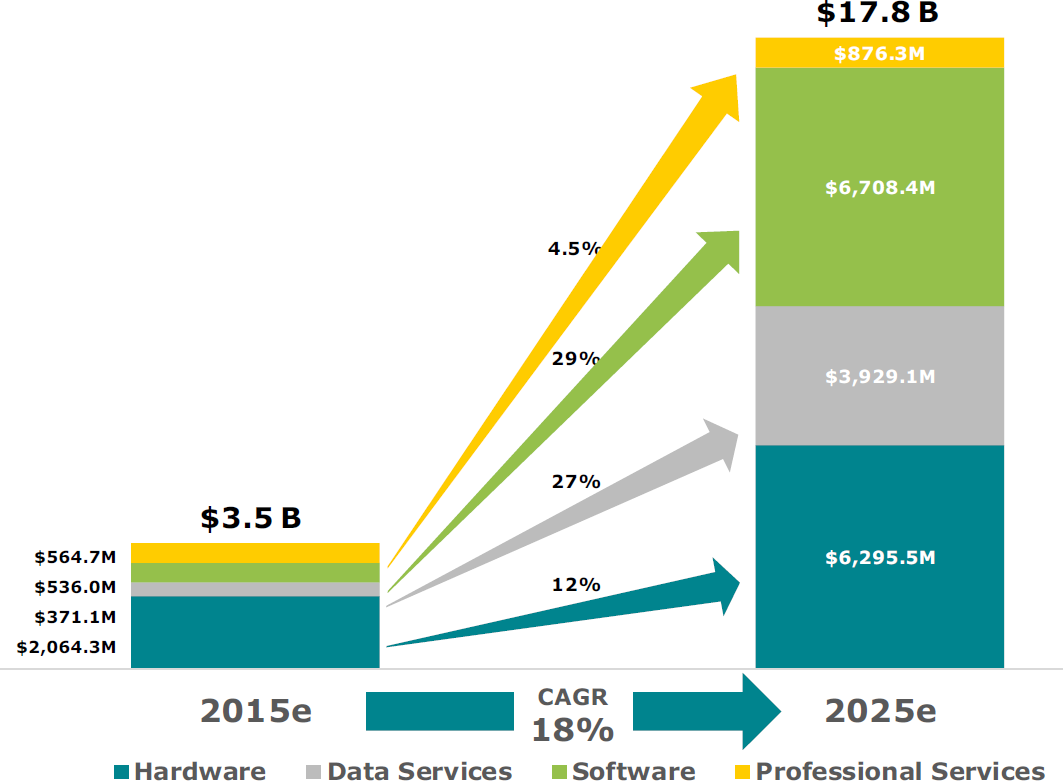
We are expanding our research on the Internet of Things (IoT) to include Smart Home, a market we expect to reach $18B in the U.S. alone by 2025, up from 2015’s $3.5B (and a current penetration rate of less than 10%) and representing a 17.5% CAGR.
Consumers have historically been slow to adopt connected device technologies in the home environment, but we think the stage is finally set for this to change, driven by the dissemination of smartphones, the growth and expansion of broadband networks, increasing interoperability among vendors, improving consumer awareness, and cheaper point solutions that are both easy to use and install relative to historical systems.
The Smart Home market is crowded, featuring hundreds of players with a variety of offerings and business models. In the short term, we believe many will enjoy strong growth stemming from a focus on the right initial vertical to support a land-and-expand strategy, being open and fostering interoperability, meeting the market’s ease-of-use requirements, and bridging the gap between the high prices of Smart Home products and their traditional counterparts with thoughtful messaging on their relative benefits.
Longer term, we expect the most successful companies in Smart Home to be those that occupy a position as the home’s central hub or platform given what it means for add-on sales opportunities, customer stickiness, and the creation and monetization of emerging services. This report provides a high-level overview of the Smart Home market, beginning with a description of basic solutions and their components. We then look at industry history, use cases, potential benefits, market size, growth expectations, and factors driving adoption. In addition, we segment the market in a variety of areas and outline the attributes we expect successful companies in the space to exhibit in the near and long term. After this overview, we profile some key players.
TABLE OF CONTENTS
- What is a Smart Home?
- Benefits
- History
- Why Smart Home adoption has been limited to date
- Why now? What’s changed? A look at key adoption drivers
- Our focus in the Smart Home
- Sizing the Smart Home market opportunity
- Segmenting the market
- Customers
- Competitive backdrop: Market features hundreds of players, number still rising
- Business models
- Distribution, channels to market
- Success drivers
- Highlighted Smart Home company: Alarm.com
- Private and public company profiles
Includes discussion of Alarm.com Holdings Inc. (ALRM), Amazon.com Inc. (AMZN), August Home Inc., Clare Controls, Curb Inc., Electric Imp, Essence Group, Grid Connect Inc., HomeKit (Apple Inc.; AAPL), Icontrol Networks, IFTTT, Innit, Nest Labs (Alphabet Inc.; GOOG), Nexia (Ingersoll-Rand; IR), Notion, Rachio Inc., SmartThings Inc. (Samsung), Sonos Inc. and Stringify
What is Smart Home
Smart Home. Connected Home. Home Automation. Interactive Home. From a high level, these terms essentially describe the same thing, solutions where residences and/or everyday household items are equipped with sensors and wireless networking hardware to facilitate remote monitoring and control as well as automation. Users can access home infrastructure and electronics data and settings in real time through a web-based interface supported by smartphones (apps), tablets, and PCs. Smart Home solutions and systems are being adopted by consumers for a variety of reasons, including to increase home safety/security, optimize energy/resource consumption, automate processes and drive efficiencies, improve wellness, and increase situational awareness.
Overview of a solution
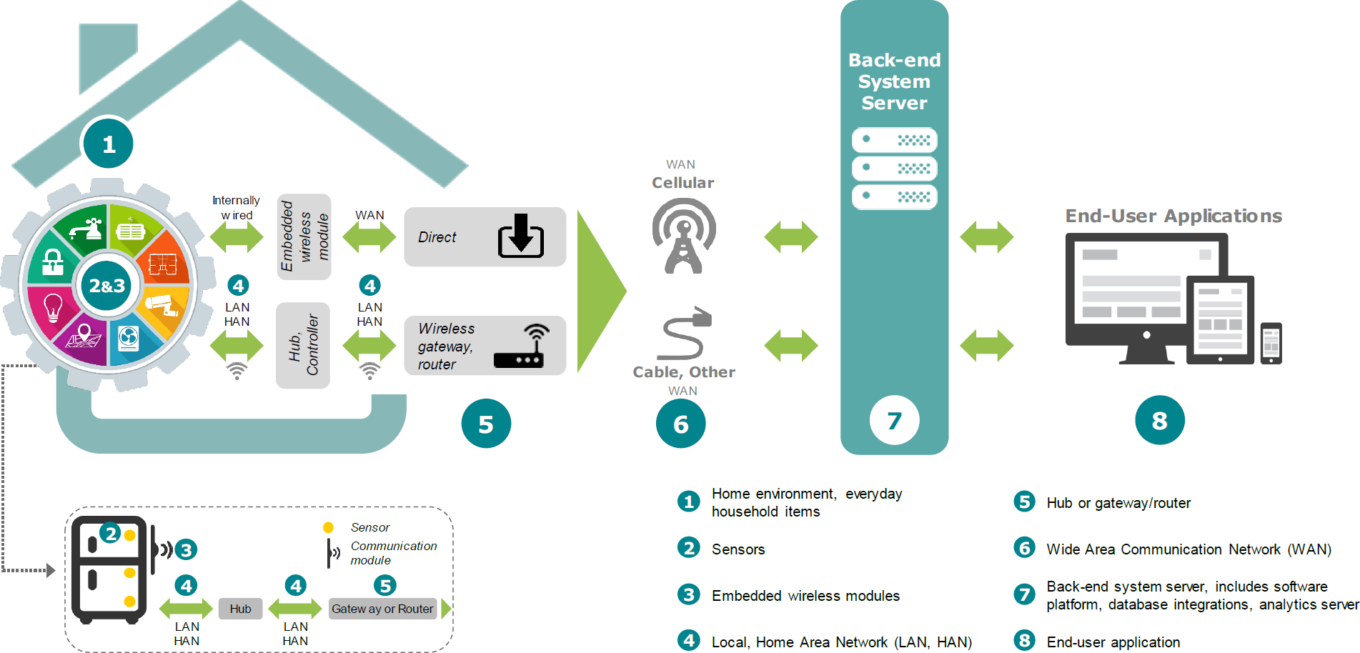
A Smart Home solution typically consists of a handful of components, which we illustrate in Table 1. These include: 1) a home or household item to be monitored/controlled, 2) sensors placed around the home or in items to capture data, 3) embedded wireless modules to transmit collected data locally (often using a proprietary communication protocol) over 4) a home or local area network (HAN, LAN), 5) a hub or gateway device that passes the aggregated data through 6) a long-range communication network (cellular, long-range/low-power, cable) to 7) a back-end system (software platform) where the data is processed and analyzed, turning it into actionable information reviewable through 8) an end-user application that a customer can access on the Internet via a control device such as a mobile handset, tablet, or PC.
TABLE 1: Components of a Smart Home solution
Source: First Analysis.
Notes: LAN: Local Area Network; HAN: Home Area Network; WAN: Wide Area Network.
We note in some cases the wireless hardware doesn’t leverage a local network or hub/gateway, instead passing the data directly to the back end through a wide area network (WAN); this approach isn’t common currently but is gaining some popularity as wireless hardware costs decline. The hardware components noted above have firmware (basic software) embedded to enable specific functionality, and most devices support two-way communication, being able to transmit data in addition to receiving data (instructions, updates) from the back-end system.
Solution flavors
Given the encompassing nature of the term “home,” it’s not surprising that many people view each Smart Home solution as a holistic collection of functionality. However, this is not always the case as solutions can readily be found in the market possessing a wide range of capabilities, from single-purpose to comprehensive. We highlight the different types of solutions we have observed in the market below.
Point Solutions are products or services created to address only one specific problem or need in the home without regard to other issues or use cases. Typically, a point solution represents the combination of highly customized hardware (sensors, enclosure) and software (firmware, application). Examples include basement leak detection, lawn irrigation control, and garage door (open/closed) monitoring. Point solutions are generally do-it-yourself (DIY) offerings, where the level of complexity is minimal, enabling the end customer to install/configure the solution without needing costly professional help. Notably, these solutions have seen the greatest adoption to date, which we attribute to lower cost relative to complete systems, the ability to self-install and maintain, and customers focusing on solving a single problem vs. a broad array of problems. By definition, these solutions are purchased on a standalone basis and consumed individually, not as part of a broader system or service, but we note point solutions are increasingly being made to be interoperable with other products, systems, and platforms.
System Solutions represent the bundling of several applications in a single offering to meet a broader set of use cases, often extending across multiple Smart Home verticals and subcategories. Specifically, single components (e.g., lighting, thermostat, doors) are networked together and connected to a primary hub, giving the consumer centralized access and control of various functions of the home. System solutions rely on the proprietary hardware and software capabilities of a single provider (e.g., Control4, Crestron, Savant Systems), although integration with third parties (often point solutions providers) to extend system functionality and value is becoming more common. We note system solutions are generally the most expensive, with the hardware and software cost generally starting at $10,000 and professional installation often adding 50% to this total. This in part explains the common perception that Smart Home solutions are only for the affluent. In addition, installation can be time-consuming and complex, with ongoing maintenance and adjustments to settings, leading to ongoing support needs.
Extensible Platform Solutions are infrastructure software offerings that support proprietary hardware and software applications as well as integrate those of third parties to enable multiple or even a suite of Smart Home services, accessible through a single unique interface. These solutions were designed expressly with openness and interoperability in mind. The Smart Home of the future was expected to support a “mix-and-match” approach of many independent applications and vendors, with end customers able to expand or contract services at will. Importantly, many platform solutions are built to support exporting or integrating data as well as to drive additional value longer term through analytics. The industry already features many companies with a platform offering, including Alarm.com, Samsung (SmartThings), Apple (HomeKit), Amazon.com (Alexa), and Zonoff.
Several verticals and subcategories
The Smart Home is a discrete ecosystem within the broader IoT/M2M industry. It represents a collection of vertical markets and subcategories with numerous underlying applications, delineated by the aspect(s) of the home to be monitored/controlled (e.g., appliances, temperature) or the purpose of the application (e.g., security, automation). We’ve identified seven distinct markets within Smart Home: security, home automation, energy management, healthcare/wellness, environmental, appliances, and entertainment. In Table 2, we provide a sampling of common applications in each market. We note that while some functionality is applicable and can be leveraged across categories, many of the vertical applications have unique requirements. As one would expect, adoption rates among these groups have varied, with security, home automation, and energy management experiencing the greatest adoption to date. This is a function of pricing, customer awareness, perception of the benefits, and ease of installation/use, among other factors.
TABLE 2: Sample Smart Home solutions/apps by vertical
| Security & safety | ||
| Smart lock A lock designed to connect to the internet and be controlled leveraging wireless hardware, mechanical actuators, and software; typical functions include remote door lock/unlock, status check, and the creation of encrypted guest access keys. |
Remote video monitoring Cameras leveraging wireless embedded hardware and software that enable video footage to be transmitted and viewed in real time over the internet through a smart device; solutions often support video storage for later viewing and analysis. |
Wireless alarm failover Functionality that enables the automated switching of a network connection from the primary wired line to a standby wireless connection in the event of communication failure or other irregularities, thus maintaining interaction with the appropriate security service provider. |
| Energy/utilities | ||
| Smart plug Next-generation outlets that allow users to turn plugged-in objects on/off in real time or according to a set schedule with a smartphone; smart plugs also enable measurement and recording of energy use, increasing an appliance’s operating lifespan through recommendations for more efficient use. |
Connected thermostat Devices responsible for controlling a home’s HVAC system; users can remotely adjust the temperature of their home in real time or automate changes with scheduling features. Often these units can sense when an individual is present and affect temperature settings accordingly. |
Smart meter An electronic device that records data on home energy, water, or gas consumption and transmits it back to a utility for monitoring & billing; many deployments support two-way communication, enabling utilities to make recommendations on how to optimize or reduce resource use. |
| Home automation | ||
| Automated irrigation A solution enabled by a hardware controller and app software, allowing users to control in real time or by schedule the frequency and duration of watering, factoring in soil/plant type/land grade; some factor in weather, overriding scheduled watering if it recently rained or is about to. |
Automated lighting Solutions that network single lights or systems, enabling them to be remotely controlled with wireless devices; functionality includes turning specific lights on/off either in real time or by schedule, adjusting brightness/color, and tying light ops to triggering events. |
Blinds/shading control An automation solution that lets users control shades in real time through a connected device as well as program opening/closing based on a time schedule or other conditions, improving home comfort and driving energy savings. |
| Wellness/healthcare | ||
| Medication adherence A system with wireless capabilities that holds and dispenses prescribed medications or attaches to standard pill bottles to record pill-taking activity, sending reminders, and reporting issues around adherence to third parties (families, doctors). |
Wellness monitoring Service using monitoring devices or sensors to capture information on outpatient vitals (blood pressure, weight, pulse, blood sugar, etc.) that are transmitted via an aggregating hub to a healthcare service provider. Changes in key metrics trigger review and/or action. |
Remote diagnostics, consultation Functionality links patient data captured in-home to a medical facility where it is periodically reviewed; variances or changes in trends trigger more immediate review and treatment recommendations. |
| Smart appliances | ||
| Predictive, preventative maintenance Functionality enabling data on an appliance’s electrical system and normal operations to be captured and examined with the aims of identifying mechanical or maintenance issues before they occur and initiating corrective service. |
Proactive goods/supplies reordering Functionality that automates the ordering of regularly used household goods and other items by monitoring supply levels and frequency of use; typically facilitates on-demand purchases as well. |
Remote activity control Solutions enabled by embedded wireless hardware, allowing users to control various aspects of appliances through an app. For example, a connected stove can be turned on/off, pre-heated, different modes selected – all remotely, in real time or by schedule. |
| Smart entertainment | ||
| Smart speakers Speakers that have short-range wireless connectivity embedded, enabling remote control through a smart device, access to a central music library, and a consistent/optimized listening experience factoring in home/room dynamics. |
Room controlling home theatre A video system, tightly integrated with the speakers, lighting units, and blinds/shades in a room, making frequent adjustments to these items via wireless communications to optimize the sound and ambiance, enhancing the user experience. |
Automated entertainment Solutions where networked speakers or TVs are activated and play the desired content; this occurs through smart device control or the presence of triggering events (garage door opened, smart lock accessed, etc.). |
| Environmental | ||
| Air monitoring, gas detection Wireless devices designed to alert homeowners when detecting smoke or harmful levels of carbon monoxide; alerts are passed in real time through a smartphone in addition to the traditional sound alarm in the home. |
Roof monitoring Solutions leveraging wireless sensors and software to monitor roof condition, load (snow, water buildup), and individual presence; the goal is to facilitate maintenance when needed, prevent collapse, and detect security breaches. |
Leak monitoring Solution geared toward watching for water leaks throughout the home, closing off valves when one is detected. A common feature is alerting users with notifications to a smartphone app. |
Source: First Analysis, industry reports, company literature.
Benefits
Smart Home products and solutions offer a range of benefits to individual consumers/homeowners as well as other ecosystem participants. While it is possible to quantify the benefits (i.e., calculate an ROI) associated with some Smart Home applications (e.g., energy management, aging in place), most other applications (e.g., home automation, security, entertainment) feature outcomes (e.g., convenience, safety/peace of mind) that are difficult, if not impossible, to measure. That said, we think the benefits, whether calculable or not, are starting to be understood, driving interest/adoption and support for such functionality.
TABLE 3: Sampling of potential Smart Home benefits to various constituents
| Consumers, homeowners | Service providers (MSOs, etc.) | Manufacturers (OEMs) | Packaged goods providers, etc. |
|---|---|---|---|
Enhanced safety/security, peace of mind while away Convenience Cut costs, lower bills (e.g., energy, water) Greater productivity, ability to manage work life balance Help anticipate needs (supplies needed reminders) Breakdowns averted via remote diagnostics, predictive maintenance Continuously improved products from OEMs leveraging usage data Helps elderly remain in homes, cost savings from managed care Lower insurance costs due to monitored security deployment |
Additional revenue streams Ability to leverage existing infrastructure Increased customer satisfaction Reduction in customer churn, increased stickiness (extends customer lifetime) Helps maintain or increase ARPU |
Discovery of new services Enhances new product development Increased customer satisfaction Reduction in customer churn, increased stickiness Additional revenue streams (from products, accessories, services) Visibility into end consumer usage patterns Usage data to continuously improve products and services Gain higher-margin recurring revenue streams Sustain/increase customer loyalty Ability to do targeted promotions Change consumer path of purchase Limits commoditization of products Accelerates product renewals |
Incremental revenue from products, supplies, services Targeted marketing, promotions Offer consumers a different path to purchase Maintain mindshare, increase/sustain customer loyalty Purchase data enables better resource/inventory management |
Source: First Analysis, industry literature.
History
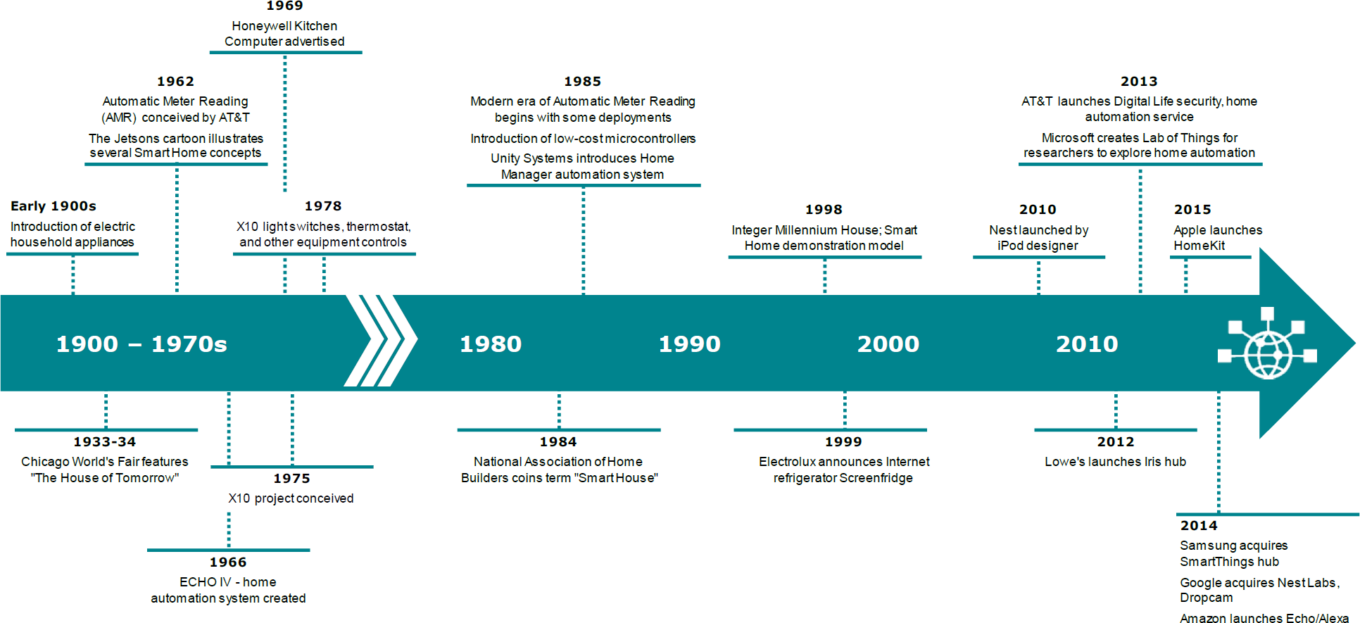
The concept of leveraging technology to monitor or control appliances and other household items originated years ago. It goes back to at least the Chicago World’s Fair (1933–34), which featured early automation and control products in “The House of Tomorrow.” These products were aspirational in nature, as the technology didn’t exist to support the concepts. The industry took a step from concept to functional products in the late 1960s with the creation of the Electronic Computing Home Operator (ECHO IV) and Honeywell’s Kitchen Computer. The ECHO, built by a Westinghouse engineer from surplus electronics, was an early home automation system tasked with things like tracking home inventory, controlling home temperature, turning appliances on/off, and handling messages. The Kitchen Computer, building on the ECHO idea, could tell individuals what could be made with ingredients on hand. While innovative and tangible, neither was viable commercially due to high cost and complexity; ECHO was never put into production, and The Kitchen Computer cost $10,600 in 1969 ($69,000 in today’s dollars) besides requiring users to take a programming course to operate.
The Smart Home moved meaningfully forward in the late 1970s with the launch of X10, a simple system that uses a home’s power lines to foster communication between devices (e.g., light switches, thermostats, appliances) and a control console. Home electronics are plugged into an X10 module that in turn is plugged into a wall outlet, allowing access by the console. The introduction of a computer interface (running on the Apple II, MS-Windows) in the 1980s enabled functionality beyond control, including status checking (e.g., on/off, temperature, dimmer levels). X10’s approachable functionality and distribution (via Radio Shack, Sears) helped it see commercial success that continues to this day. The success of X10 and the advent of cheap microcontrollers in the late 1980s led other electronics and software companies to enter the market and offer proprietary products and comprehensive systems. However, Smart Home adoption was lackluster overall, stemming from prohibitive device/system costs, technical complexity, the perception that such capabilities were only for tech-savvy early adopters and the rich, and limited consumer awareness.
TABLE 4: The Smart Home: Key events timeline
Source: First Analysis, industry reports.
In recent years, the incorporation of wireless networking technologies that enable monitoring and control over the web has rejuvenated the Smart Home concept. Due to declining costs of network connectivity and hardware as well as increasing network availability (both home and wide area networks) – items which should continue to improve – it is becoming possible to connect virtually everything in the home.
The opportunity associated with a broadly Smart Home ecosystem has drawn hundreds of new players into the space, including large, recognizable names such as Apple, Amazon.com, Google, and Samsung (through organic efforts and/or high-profile acquisitions). These companies hope to monetize their existing offerings, create stickier customer relationships, or facilitate a more robust data play. To drive adoption, companies have created more affordable products/apps instead of expensive systems/services, are offering more flexible business/pricing models, and are working toward interoperability. These changes, including leveraging smartphones/tablets given their ubiquity as the common interface to the home, are making the Smart Home more accessible to customers and generating renewed interest.
Why Smart Home adoption has been limited to date
Below we highlight and discuss the factors we think have been the most responsible in limiting Smart Home product and solution adoption to date.
System, solution pricing
Price has been a consistent impediment to mass market adoption of Smart Home products. Whole home automation systems (e.g., Crestron, Savant Systems) cost multi-thousands of dollars when introduced, factoring in hardware and installation, which effectively made them luxury items limited to a fraction of the market. Pricing has come down some for systems offerings but not enough to materially widen their appeal. The advent of point solutions has helped open up Smart Homes to a significantly larger audience, with single-purpose applications priced in the $100s.
While the lower pricing makes them more attractive, adoption of these products has been modest. This has stemmed from the wide price differential between the connected point products and their traditional counterparts, particularly since the value is often difficult to quantify and the vendors haven’t done a great job communicating it. For example, a Schlage smart deadbolt lock set costs about $300 relative to $70 for the conventional alternative. Its customers have to determine if the additional features (i.e., keyless entry, remote lock/unlock, unique code creation for different users, video monitoring) provide sufficient benefit (e.g., convenience, security) to justify the 4–5X cost. Similar gaps can be seen across the spectrum of “smart” products vs. their “dumb” counterparts, as shown in Table 5.
TABLE 5: Sampling of pricing of Smart Home products relative to traditional counterparts
| Product | Vendor | Smart home | Traditional |
|---|---|---|---|
| Deadbolt lock | Schlage | $303.44 | $70.78 |
| Thermostat | Honeywell | $84.71 | $18.25 |
| Refrigerator | Samsung | $5,599.00 | $1,699.99 |
| Light bulb | Philips | $59.99 | $15.47 |
| Smoke/CO2 detector | Google Nest, Honeywell | $99.00 | $29.99 |
| Light dimmer | GE | $36.54 | $10.87 |
Source: Amazon.com, Google, Lowe’s, Samsung.
Perception and awareness issues
Smart Home products and services historically have not been well promoted in the market, but we think consumers now possess the general knowledge such offerings exist, particularly whole home automation systems. However, this hasn’t translated into adoption partly because of perception, with many consumers under the impression Smart Home solutions are expensive and meant for the high-end or luxury home market and, by extension, are difficult to install and operate. We think this, combined with limited promotional activity, has contributed to a lack of consumer awareness about the more recent introductions of DIY offerings, which are easier to install and much cheaper than the aforementioned systems.
Interoperability, extensibility
The Smart Home market historically has been relatively siloed, with most vendors providing products/solutions and systems not designed to work or communicate with third-party offerings. This has made it difficult for customers to fill in functionality gaps of existing systems offerings and has required customers to assemble multiple single-purpose (point) solutions to enable a custom suite, download separate apps for each smart device, and manage them individually (leading to “app bloat”). Many consumers are also concerned, given the early stage of the industry, about making an investment in a product or system that could become obsolete, requiring additional investment to replace it. This risk of obsolescence is something interoperability could solve if it were more widespread. Some customers have been hesitant to commit to a broader system while others have not been sufficiently encouraged to purchase additional devices to expand their home solution, believing it best to wait for the ecosystem to evolve and move toward interoperability.
Complexity
Smart Home products and solutions have generally featured complex designs and functionality, which have created frustration for early adopters during installation, setup, and ongoing use. We think many people are aware of these challenging experiences, causing potential buyers to hesitate and doing little to alleviate the commonly held perception that a Smart Home may be too complex for them. In addition, some of the smart solutions are unduly complex relative to the use case (e.g., turning a light on or off) or the existing solution (a manual thermostat), making users question the need for such functionality in the first place.
Why now? what’s changed? a look at key adoption drivers
We believe Smart Home products and services are poised to finally see strong adoption given a confluence of factors that we anticipate being in play for the foreseeable future. In our view, the change is being driven by an ongoing reduction in the barriers discussed above as well as the proliferation of smart devices, greater broadband availability, and flexible business models, among other things.
Proliferation of smart devices: Natural interface to access and control home environment
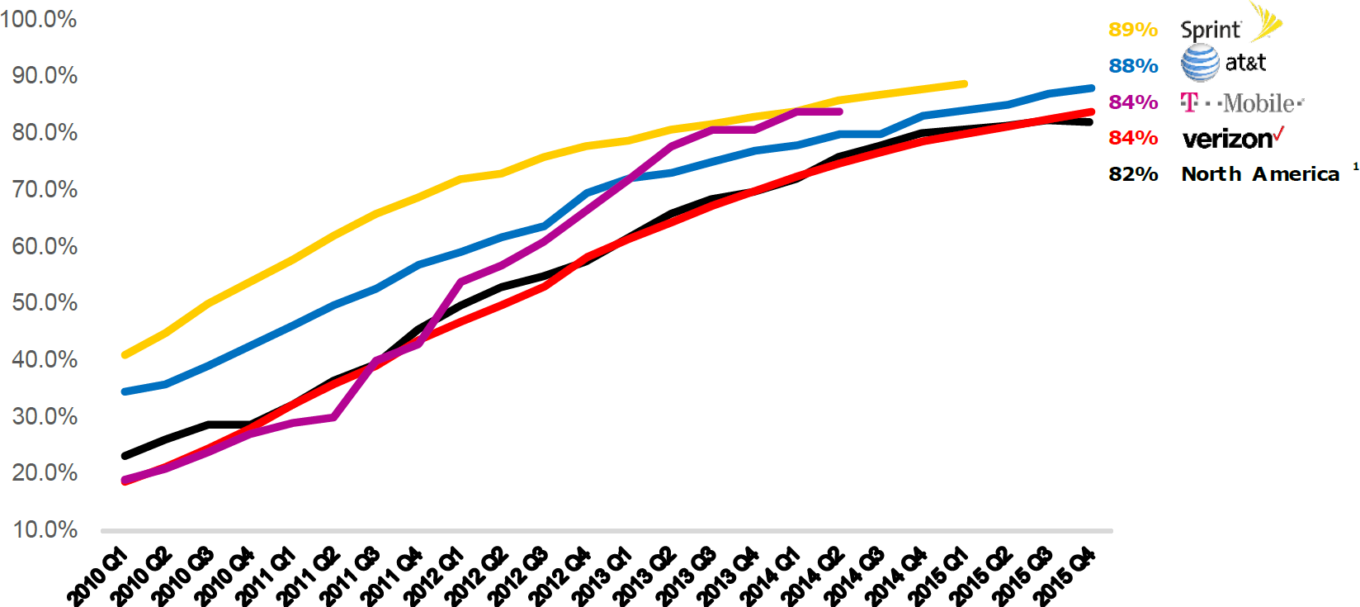
The widespread availability and increasing adoption of smart devices (smartphones, tablets), in our view, are having a dramatic influence on Smart Home product and service uptake. In North America, smartphone penetration (as a percentage of the wireless subscriber base) has reached 82% from about 23% in just over six years, and the penetration rate among the big four (AT&T, Sprint, T-Mobile, and Verizon) is about 85%; in addition, we note nearly half of the world’s population already owns a smart device. This has resulted in a level of remote access and control at an individual’s fingertips that hadn’t been seen before, particularly on the go. Prior to smart devices, there was no viable way to interact with data and objects unless using an interface tethered to a PC or panel at a fixed location. We think individuals have grown to appreciate the real-time access to data these devices enable, and this has led many people to run more aspects of their lives through them. This is beginning to extend to the home environment. Consumers are recognizing existing smart devices are a natural interface to access home-related information and control the multitude of items it contains. As a result, they are increasingly demanding or investigating such functionality.
TABLE 6: Sampling of pricing of Smart Home products relative to traditional counterparts
Source: Bloomberg.
Notes: (1) Includes: AT&T, BCE, Cincinnati Bell, Leap Wireless, MetroPCS, NTELOS Holdings, Rogers Communications, Shenandoah Telecommunications, Sprint, T-Mobile USA, TELUS Corp., Telephone & Data Systems Inc., and Verizon.
In addition, smart devices eliminate or reduce some of the key adoption barriers for the Smart Home, such as high cost and difficult use. Specifically, a customer’s existing smart device often makes it unnecessary to purchase an expensive embedded home controller (panel). It also features a screen that can be leveraged among multiple applications, creating a unified customer experience, and home applications running on smart devices commonly feature a plug-and-play experience without requiring complex setup.
Broadband Internet connections: Enabling low-cost home area networks
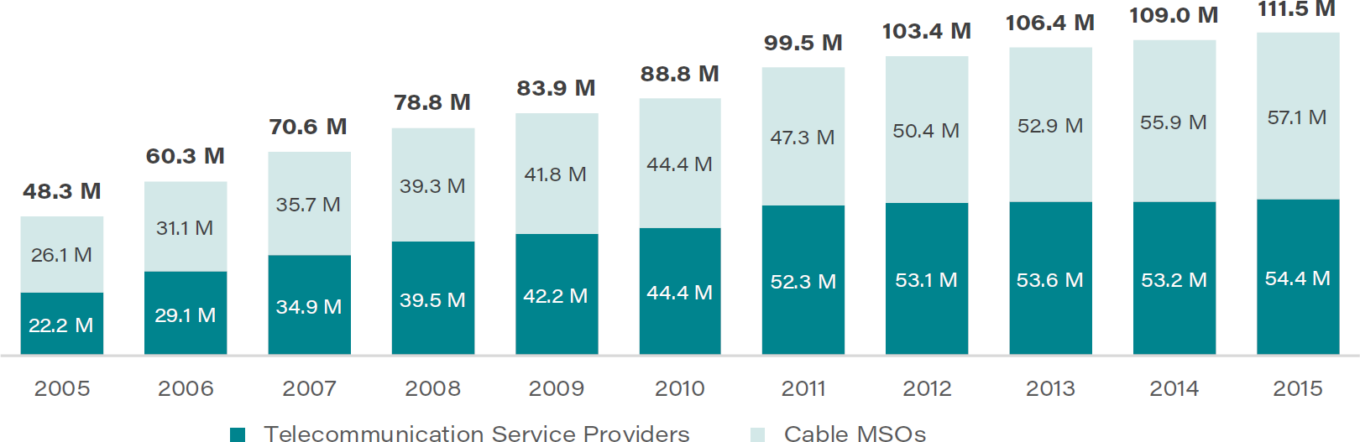
We believe the Smart Home industry has benefited from the increasing availability of broadband networks over the past decade. The penetration rate of broadband in the U.S., for example, eclipsed 80% in 2015, up from about 20% in 2005. Broadband is generally defined as “always on” Internet access to the home that is faster than traditional dial-up service, with the connection to the house being either wired or wireless. It supports the creation of wireless home area networks (HAN) such as Wi-Fi, which can cost-effectively connect multiple end-point devices (beyond laptops, tablets, or phones). This is aiding the adoption of Smart Home products and services that require quick and easy (i.e., plug-and-play) access to reliable and affordable networks for connecting multiple assets simultaneously. Broadband networks should continue to spread.
TABLE 7: Fixed line consumer broadband access connections in North America: Growth over the last decade
Source: Bloomberg, First Analysis.
Awareness: Vendor efforts, word of mouth starting to help
Limited consumer awareness of modern Smart Home solutions/capabilities has been an ongoing issue. However, we believe this is changing due to the efforts of a handful of large, high-profile companies that have entered the connected space, leveraging positions of strength built in a range of other industries, and are more aggressively promoting Smart Home initiatives (via TV, online, in store, etc.). These companies (and their offerings) include Amazon (Alexa, Echo), Google (Nest, Dropcam, Home), Apple (HomeKit), Samsung (SmartThings), AT&T (Digital Life), and Philips (Hue). In addition, we think improving awareness is coming from friends and family who have purchased products/solutions and are relaying their experiences. Beyond general product awareness, we think both companies and friends/family are starting to educate prospective buyers on the potential use cases and benefits available from deploying these products and services. We expect better awareness combined with education to help devices, solutions and even systems sales.
Interoperability: The world is changing
Seamless access and control within a single interface across multiple products and services, irrespective of vendor, is something consumers clearly want — and vendors are responding. This is evident from a cursory examination of Smart Home vendor websites, where it is fairly common to see partner integrations prominently featured (“works with x” or “supports x”) and recent integrations promoted through press releases. In addition, when we discussed strategic initiatives with dozens of Smart Home companies, most indicated the desire to integrate and be interoperable with more third-party product and service providers. The industry, in our view, will continue moving toward interoperability, with most companies pursuing and adding integration partners, enabling a growing portion of the ecosystem to work together.
Lower-priced solutions, declining costs: A trend that’s expected to continue
We believe Smart Home adoption benefited significantly from the introduction of point or single-purpose solutions, which are an order of magnitude cheaper than multi-purpose home systems — evidenced by point solutions outnumbering systems deployments by a ratio of 4 to 1. The lower price points relative to systems were enabled mainly by the reduction in functionality but also cheaper components (sensors, actuators, wireless modems, airtime plans, etc.) and the frequent elimination of dedicated controllers by using a customer’s existing smartphone or tablet. That said, prices of point solutions remain high compared to their traditional, non-connected counterparts. We anticipate this gap will shrink as a result of several factors, including price competition, companies achieving scale and leveraging it to gain component cost breaks that are passed along to consumers in the form of lower pricing, optimized designs, and the natural degradation of hardware component costs. We believe these trends will push down total solutions costs to the consumer over time, spurring increasing Smart Home adoption.
The short-term rental market: Positively impacting Smart Home adoption
The short-term rental market is situated in the gray area between residential and commercial real estate. It’s an $85B industry (according to Entrepreneur magazine) that has expanded greatly in the last few years, primarily with the advent of rental services like Airbnb and HomeAway. These services simplify a formerly complex process, enabling individual homeowners and tenants to quickly rent out their properties. To access rental income, all that’s needed is a few pictures of a room or apartment and a profile on one of these or other platforms, which will advertise the space to millions of travelers, similar to how hotels do it. Due to lower barriers to entry and an efficient matching process, the number of people offering short-term rentals has increased tremendously; Airbnb alone has more than 2.2M homes worldwide.
As a result, Smart Home products and solutions (e.g., smart locks, thermostats, and lighting) are being noticed and appreciated by short-term-rental-property providers. This makes sense, in our view, as smart devices can help owners mitigate risk, reduce costs, and gain additional control over their properties. For example, a smart lock can enhance site security by monitoring who enters and leaves the rental and be used to set up temporary user access keys that avoid logistical challenges between the owner and renter. In addition, smart thermostats enable owners to control temperature when a renter leaves the property to reduce energy waste. Given this, it is unsurprising to find that when evaluating whether to rent out a property — weighing the revenue opportunity, direct costs, and risk exposure — hosts are increasingly factoring Smart Home technology into their decision. This is having a direct impact on Smart Home product and solution adoption, with growing numbers opting to invest in some capabilities, particularly millennials and Generation X.
Smart Home products and solutions in short-term rental properties are also being noticed by guests. By renting a property equipped with smart technology, guests are gaining hands-on exposure, which translates into awareness and education. We think this is driving some interest and even leading some to invest in the technology for their own homes. We expect these factors to have an ongoing positive effect on Smart Home adoption.
Multiple business models, external subsidies: Vendors trying new things
The typical Smart Home business model is the one-time sale, with the price reflecting various components (hardware, software, airtime, etc.). However, vendors have been experimenting with different models to generate interest and adoption, particularly given the high price of wireless hardware relative to traditional counterparts. For example, instead of selling hardware upfront, it is possible to find vendors subsidizing the hardware and other pieces, rolling it into a monthly subscription rate to reduce the burden on the consumer. We are not predicting this or other new models will replace the dominant one-time-sales model, but we think they will stick around, and the added flexibility/choices should provide an ongoing lift to interest/adoption for some consumers.
In addition, we have been seeing companies from outside the Smart Home industry driving some adoption by subsidizing the hardware/solutions as part of various strategic initiatives. Some examples can be found among home insurers (for safety and property monitoring) and utilities (to improve home climate and resource consumption). Specifically, insurers Liberty Mutual and American Family Insurance are subsidizing Nest Protect smoke detectors in exchange for monthly confirmation that they are on and connected to Wi-Fi, and utilities Columbia Gas and Consolidated Edison are integrating and subsidizing smart thermostats. We think other insurance companies and utilities will be active in Smart Home in similar ways, and we also expect many other constituencies such as healthcare companies (to promote wellness and assisted living), online retailers, and digital advertisers to get involved and subsidize products, solutions, and systems.
New home construction: Builders looking at Smart Home as a way to differentiate
There is a growing expectation among the newer generations of homebuyers that homes come with some degree of wireless capabilities or embedded smarts, such as interactive security or a smart thermostat. This is influencing home builders, some of which are turning their current (and planned future) units into Smart Homes to make them more attractive to prospective buyers while increasing their revenue/profit potential per home.
The aging of society
We think the desire among the elderly to remain independent and the high (and increasing) cost of assisted living facilities will drive many families to invest in Smart Home technologies for their loved ones, particularly for aging in place and security solutions.
Regulation: A wildcard, but likely driving incremental demand
We are not depending on regulation to be a major driver of adoption and growth in the Smart Home space due to its unpredictability in both passage and enforcement. That said, regulation has spurred modest adoption to date in some home categories, such as energy management/smart meter. We could see further incremental adoption over the next several years as the government recognizes cost-effective IoT/M2M technologies in the home can produce measurable benefits for society as well as for government when broadly deployed. As a result, it might push mandates calling for use of such technology. Besides energy, the categories most likely to be affected by regulation, in our view, are healthcare/wellness and environmental, areas the government spends a considerable portion of its budget supporting and monitoring. In Table 8, we highlight actual regulations to be satisfied with Smart Home solutions in addition to a sampling of pending/proposed legislation where such capabilities may apply.
TABLE 8: A sampling of regulations and programs affecting Smart Home or where Smart Home solutions apply
| Year | Regulation | Vertical/ end-market |
Country/region | Specifics |
|---|---|---|---|---|
| 2011 | California Telehealth Advancement Act | Healthcare | United States | Designed to reduce the administrative and regulatory barriers in CA regarding remote patient monitoring and providing other medical services remotely; streamlines approval process for telehealth and supports expansion throughout CA. |
| 2012 | European Energy Efficiency Directive | Energy & utilities | Europe (EU) | The European Union requires, as part of this regulation, smart meters for electricity in 80% of the homes in member states by 2020; gas and water meters are likely to follow. The goal is to increase energy efficiency by 20% by 2020. |
| 2014 | Access to Consumer Energy Information Act | Energy & utilities | United States | Directs the DOE to release voluntary guidelines to encourage open access to electricity data; a key component of data access policy is the ability of consumers to allow third parties (e.g., energy management companies) access to consumption data. |
| NA | Fostering Independence Through Technology Act | Healthcare | United States | A bill establishing pilot projects under Medicare to provide incentives for home health agencies to utilize home monitoring and communication technologies. |
Source: First Analysis, industry reports.
Our focus in the Smart Home
We are primarily focused on products, solutions, and systems that leverage wireless connectivity within the home (local and home area networks, e.g., Wi-Fi, Bluetooth) and either wireless or wired connectivity (Wide Area Networks; e.g., cellular, cable) when transmitting the data from the home to a back-end system or application. Our emphasis is also on solutions that rely on smartphone/tablet applications and web-based portals to monitor, control, or automate functions in the home. We purposely exclude solutions that use wired (fixed) control panels (e.g., traditional security systems, X10), switches, or timers in the home — despite their allowing a degree of control and/or visibility — since the industry is increasingly moving toward wireless technologies that give customers an enhanced level of functionality relative to legacy solutions, such as real-time data access and remote management/control of home assets.
Sizing the Smart Home market opportunity
The Smart Home market is relatively challenging to size due to a general lack of visibility into the average number of connected devices or solutions per home. In addition, because most hardware sales are one-time in nature with the other components bundled into the price, it is challenging to divide the market into its component parts of hardware, infrastructure platform software, end-user application software, network connectivity, and professional services. We thus rely on a number of assumptions, assigning prices to the various component parts to get to a reasonable value for each and the aggregate market.
We estimate the U.S. market leveraging wireless capabilities generated $3.5B in revenue in 2015, and we expect this number to grow to about $18B by 2025 (17.5% CAGR). In sizing the market, we started with the number of homes, consisting of owner occupied, renter, and vacant housing units. We then estimated the number of homes where at least one smart product, solution, or system is in use, which we believe was approximately 10.3M at 2015 year-end (representing a penetration rate of 7.6%). This number roughly corresponds to an aggregation of public data on various Smart Home devices and services, including the number of wireless interactive security systems and smart thermostats deployed, which represent the two vertical solutions having the most adoption to date. Our figure was derived from granular data on the number of households by age bracket in each home category; we assumed a Smart Home penetration rate for each bracket, multiplying the number of homes by these rates before aggregating the results. Some important assumptions include owned units featuring a greater incidence of Smart Home solutions relative to renters due to lower incentives to invest in non-owned property, the elderly (65+ years old) being slower to adopt the technology compared to other age brackets due to less technical sophistication, and greater adoption among 30- to 44-year-olds from greater earnings power and tech savvy. We then made assumptions for the number of smart devices and solutions by age bracket for each household category, multiplying these by the number of estimated Smart Homes per bracket. Aggregating the numbers yields roughly 17M smart devices, with an average of 1.7 per Smart Home.
TABLE 9: Estimated size of the U.S. Smart Home market by revenue category (2015e, 2025e)
Source: First Analysis estimates.
Using the changes in the number of Smart Homes and smart devices for 2015 (off of 2014 numbers estimated in similar fashion as described above), we calculate the revenue for each solution component by applying a pricing estimate for each. Prices are based on the averages we have observed in the market for each category. Aggregating the results, we come up with $3.5B for 2015. We discuss the individual components in more detail below.
Looking forward, we estimate ~25M homes in the U.S. will be connected using at least one smart device, solution, or system by 2020 (17.6% of all homes, assuming eligible homes grow 1% a year) with the number expanding to ~42M by 2025 (28% of the eligible market). Our 2020 estimate has the total number of Smart Home devices reaching 93M (40.5% CAGR), or 3.7 devices on average per Smart Home. By 2025, we estimate about 239M smart devices (30.2% CAGR), or an average of 5.7 devices per Smart Home. We assume the number of homes and connections per home increases each year as a function of the adoption drivers discussed above. We note our model assumes prices decline every year for each solution component over our horizon.
TABLE 10: Estimated size of the U.S. Smart Home market, number of Smart Homes, objects per home, revenue by category
| 2015e | 2018e | 2020e | 2025e | CAGR | |||
|---|---|---|---|---|---|---|---|
| 3-year | 5-year | 10-year | |||||
| Homes, smart devices | |||||||
| # of U.S. households (M) | 135.3 | 139.4 | 142.2 | 149.5 | 1.0% | 1.0% | 1.0% |
| # of smart homes (M) | 10.3 | 18.9 | 25.1 | 41.9 | 22.5% | 19.6% | 15.1% |
| Smart home penetration (%) | 7.6% | 13.5% | 17.6% | 28.0% | |||
| Total number of smart devices (M) | 17.0 | 53.3 | 93.2 | 238.9 | 46.4% | 40.5% | 30.2% |
| Smart devices per home | 1.7 | 2.8 | 3.7 | 5.7 | 19.4% | 17.5% | 13.2% |
| Price per: | |||||||
| Hardware – hub unit | $250 | $198 | $169 | $115 | -7.5% | -7.5% | -7.5% |
| Hardware – application specific unit (smart device) | $200 | $171 | $155 | $120 | -5.0% | -5.0% | -5.0% |
| Hardware – sensor unit | $35 | $28 | $24 | $16 | -7.5% | -7.5% | -7.5% |
| Network access connection (annualized) | $24 | $19 | $16 | $11 | -7.5% | -7.5% | -7.5% |
| Data storage per connection (annualized) | $120 | $95 | $81 | $55 | -7.5% | -7.5% | -7.5% |
| Infrastructure S/W platform per connection (ann.) | $36 | $31 | $28 | $22 | -5.0% | -5.0% | -5.0% |
| Application software, analytics per connection (ann.) | $60 | $51 | $46 | $36 | -5.0% | -5.0% | -5.0% |
| Professional services per system installation | $2,000 | $1,750 | $1,500 | $1,000 | -4.4% | -5.6% | -6.7% |
| Revenue by category ($M) | |||||||
| Hardware – hubs1 | $527 | $573 | $516 | $604 | 2.8% | -0.4% | 1.4% |
| Hardware – application specific (smart device)2 | $1,308 | $2,622 | $2,974 | $5,019 | 26.1% | 17.8% | 14.4% |
| Hardware – sensors3 | $229 | $423 | $455 | $673 | 22.8% | 14.7% | 11.4% |
| Total hardware opportunity | $2,064 | $3,618 | $3,946 | $6,296 | 20.6% | 13.8% | 11.8% |
| Network connectivity4 | $330 | $868 | $1,360 | $2,418 | 38.1% | 32.7% | 22.0% |
| Data storage5 | $41 | $239 | $510 | $1,511 | 79.6% | 65.4% | 43.4% |
| Total data services opportunity | $371 | $1,107 | $1,870 | $3,929 | 43.9% | 38.2% | 26.6% |
| Infrastructure software platform6 | $495 | $1,411 | $2,330 | $4,735 | 41.8% | 36.3% | 25.3% |
| Application software, analytics7 | $41 | $259 | $583 | $1,973 | 84.4% | 69.8% | 47.2% |
| Total software opportunity | $536 | $1,669 | $2,913 | $6,708 | 46.0% | 40.3% | 28.7% |
| Professional services8 | $565 | $720 | $712 | $876 | 8.4% | 4.8% | 4.5% |
| Total revenue opportunity | $3,536 | $7,114 | $9,441 | $17,809 | 26.2% | 21.7% | 17.5% |
Source: First Analysis estimates.
Notes: (1) Hardware hub/system revenue determined by multiplying average hardware hub unit price (assumed to decline 5-10% a year) by the change in the number of Smart Homes relative to the prior year; each Smart Home is assumed to have only one hub. (2) Application specific hardware revenue determined by multiplying average hardware unit price (assumed to decline 5% a year) by the change in number of smart devices relative to the prior year; each application is assumed to have unique hardware that connects to a hub. (3) Determined by multiplying average sensor unit price (assumed to decline 5-10% a year) by the change in number of smart devices relative to the prior year; each connection is assumed to be paired with unique sensor hardware for monitoring and control. (4) Revenue from network connectivity determined by multiplying the annualized airtime fee by the average number of smart devices connected; assumes 5-10% annual degradation. (5) Assumes over time a growing percentage of smart devices require data storage to support applications and analytics; revenue determined by multiplying this percentage by the average number of smart devices and the annualized rate for data storage per connection; price assumed to degrade 5-10%. (6) Determined by multiplying the annualized subscription price to an infrastructure platform by the average number of smart devices connected; assumes 5% annual price degradation. (7) Assumes an increasing percentage of smart devices have an associated application/analytics that is paid for over time; revenue determined by multiplying this percentage by the average number of smart devices and the annualized rate per connection for such functionality; pricing modeled to decline 5% each year. (8) Assumes a percentage of newly connected homes are for more comprehensive solutions/systems requiring professional installation; this percentage is multiplied by the change in number of Smart Homes times the rate per home.
Hardware
We believe hardware will grow to be a $6.3B opportunity in 2025 (11.8% CAGR), up from $2.1B in 2015, and be the largest category of the market for much of our horizon. It is made up of three distinct components: 1) hubs, 2) application-specific units, and 3) sensors. Hubs are intermediary devices that aggregate and transmit data back and forth between various Smart Home devices/solutions and the home gateway/router, which in turn is connected to the back-end software. Application-specific units are devices built to enable and support unique monitoring and/or control functions; examples include smart locks, water shutoff controllers, and smart thermostats. Sensors, connected to these units, collect various data points (e.g., temperature, open door/window, water leak) depending on the application. To size this market, we apply a price for each unit type to the change in the estimated number of devices (or homes in the case of hubs) and sum the results. The prices used for 2015 represent the averages of prices observed for hardware of that type in the market; subsequent pricing is adjusted for annual price degradation of 5–10% per year.
Data services
We think data services, composed of network connectivity and storage, will represent a $3.9B opportunity in 2025 (26.6% CAGR), rising from 2015’s estimated $370M. To size the network portion, we apply an annualized rate to the average number of wireless devices expected to be connected in homes for that year; we use this number as opposed to the change since every unit requires connectivity that’s assumed to be paid for on a regular basis. While some customers will leverage existing wireless or broadband plans for Smart Home, seeing modest changes to their monthly billing, we start with $2/month/device — in line with pricing observed in the market to support some of the more pervasive solutions like security — to estimate the portion network vendors receive from this ecosystem. We assume prices degrade 5–10% annually. These prices on our average number of smart devices yield $2.4B in revenue by 2025 (22% CAGR), up from $330M in 2015. Added to this is data storage revenue from supporting specific use cases (e.g., video monitoring) as well as analytics offerings that require access to historical information, which we expect to reach $1.5B in 2025 (43.4% CAGR), off a relatively small base in 2015.
Added to this is data storage revenue from supporting specific use cases (e.g., video monitoring) as well as analytics offerings that require access to historical information, which we expect to reach $1.5B in 2025 (43.4% CAGR), off a relatively small base in 2015. Here, we multiply the average number of smart devices each year by the percentage estimated to be paying for data storage for any purpose. We then multiply this number by the annualized data storage rate, starting with $10/month/device and assuming 5-10% annual price erosion.
Software
We expect the software opportunity to reach $6.7B in 2025 (28.7% CAGR), up from about $540M in 2015. Software consists of the infrastructure platforms as well as the end-user applications and analytics packages they support. Platform software, by our estimate, represents a $4.7B opportunity (25.3% CAGR) and should be the largest component of the category over our horizon. To size the infrastructure piece, we assume each smart device is supported by a platform to handle the configuration and provisioning of new devices in addition to ongoing needs such as updating software and changing app configurations or parameters. Standalone infrastructure platform pricing is about $3/month/connection; we expect this to decline 5% a year from competition among similar offerings.
Application software and analytics by our estimates will hit $2B in 2025 (47.2% CAGR), rising from a relatively small base in 2015. This component is difficult to size, particularly in out years, since most apps are currently free of charge and analytics capabilities are not yet a focus for the industry. To size this market, we estimate the percentage of smart devices in the home where end users are actually paying for an application and/or analytics package. We then apply an annualized subscription charge to this portion of the market for each year; we start at $5/month/device given observed pricing and expect pricing to decline 5% a year. The percentage of deployed devices supporting a paid application or analytics is assumed to be fairly small in 2015 but is expected to rise over our horizon as a function of lower pricing, improved functionality, and better messaging around potential ROIs from leveraging data.
Professional services
We anticipate professional services for the installation of systems or complex solutions to grow to about $900M in 2025 (4.5% CAGR) from $565M in 2015. To size this market, we focus on the newly connected households where a portion each year requires setup services. We apply a charge per deployment to this percentage of net new connected households to get to our size estimate; we start with $2,000, based on the average of the typical installation fees of high-end systems and lower-cost (but somewhat complex) solutions, but have this rate declining over time as the mix shifts to solutions that are easier and thus less costly to install. Most of the deployments requiring assistance would be in owner-occupied units relative to renter and vacant properties given the investment required with our estimates between the groups reflecting this over our 10-year horizon.
Other
It’s important to highlight that our market size estimates for each year do not account for multiple revenue streams (e.g., monetization of platform data to OEMs and other commercial third parties, advertising on in-home devices) we think likely to emerge. These items are difficult to size given uncertainty around pricing/business models, release timing, and market emphasis. Our estimates also do not include tangential sales (e.g., sales of more consumables, field maintenance) or other indirect opportunities that are going to accrue to various types of vendors given how we define the industry. We note any of these items could be material to our numbers over our horizon, making Smart Home all the more compelling.
Segmenting the market
We highlight a handful of ways the Smart Home market can be reasonably segmented. This list is not meant to be comprehensive, but rather a simple guide to analyze companies for potential investment.
Value-chain position
Vendors can be classified by the hardware, platform software, application software and analytics, professional services, or end-to-end solutions and systems they provide. The industry features a number of players that fit squarely into one of these buckets, particularly hardware or platform software, but many others defy simple classification due to offering multiple solution components. Our view is that the lower levels of the value chain, specifically the hardware layer, will be commoditized over time despite providing focused providers strong near-term opportunities while the Smart Home ecosystem is built out.
In contrast, application software providers should normally accrue a disproportionate share of the value created over time due to a higher probability of creating sustainable differentiation. However, we don’t expect this to be the case in Smart Home as most apps are generic and free — things we don’t anticipate changing. Instead, we see the platform providers with access to smart device connections and the related data, by extension, in addition to vendors focused on deeply analyzing that data as best positioned for sustainable monetization and thus accruing much of the value of Smart Home over the long term.
Specific vertical (or subcategory) focus vs. horizontal (vertical-agnostic)
As mentioned above, the ecosystem features multiple verticals and subcategories. Most of the industry’s product and solutions providers currently pursue one of these segments. Vertical and subcategory focus are important as the opportunities presented by each market can vary considerably, stemming from different demand characteristics (as a function of solution complexity, cost, and consumer awareness), competitive dynamics, and adoption/penetration rates, among other things. The reward to these vendors from being in particular segments at the right time with solid offerings can obviously be great, but the converse is also true.
Horizontal players are generally the infrastructure platform software players (and increasingly the traditional home systems providers) that are building proprietary capabilities or leveraging third-party integrations to support many home verticals or subcategories. We expect both approaches to see success over the near term. However, we expect the horizontal players to accrue a disproportionate amount of the value created in Smart Home long term due to their being at the center of the home environment, giving them the greatest opportunity for reaching a critical mass of connections, creating sticky relationships, and seeing recurring revenue.
Point (do-it-yourself) solutions vs. systems, suites
Point, or single-purpose, solutions outnumber comprehensive systems/suites by a fairly wide margin based on current deployments. Despite this, it remains common to segment the market in this way. In Table 11, we highlight and compare several key dimensions of these offering types. We think point solutions will continue to dominate the landscape due to ease of installation (often do-it-yourself) and use, an increasing ability to integrate with other vendors, and their being lower in relative cost. In addition, we note customers tend to shop for products and services that satisfy a specific pain point at a particular moment in time, not to fulfill use cases where they don’t yet perceive a need — a reality that also favors point solutions. However, we don’t envision systems/suites going away. Systems and suites continue to generate interest and be relevant, particularly with this segment becoming more open to integration/interoperability with third parties, including point solution providers. Comprehensive systems/suites, in our view, make sense for customers looking to assemble multiple solutions at once and being extensible only helps in making them look more attractive, making us believe both models will coexist.
TABLE 11: Point solutions vs. systems, suites
| Characteristics/criteria | Point solutions | Systems, suites |
|---|---|---|
| Functionality | Single purpose | Comprehensive |
| Customer feature needs | More basic | More advanced, robust |
| Customized or turnkey | Often turnkey | Both, customization common |
| Typical installation | Do-it-yourself (DIY) | Professionally done (do-it-for-me) |
| Installation, setup complexity | Simple to moderate difficulty | Complex, time consuming |
| Dedicated support | Uncommon | Common |
| Ease of use | Very important | Important, but more effort expected |
| Sales cycle | Short | Long |
| Cost | Among lowest in industry | Among highest in industry |
| Hardware pricing model | Typically upfront capital expenditures | Typically upfront capital expenditures |
| Contracted service | Rare | Uncommon, but observable |
| Integrations, interoperability | Becoming more common | Growing in importance |
Source: First Analysis.
Customer focus: residential (consumer) vs. commercial vs. government
A useful way to classify a provider is by the customers targeted. In general, Smart Home offerings are built for residential consumers. Within this wide classification, consumers can be segmented against a number of different dimensions, each of which could be a specific focus market for a company. Some of the important classifications include income (affluent or luxury vs. mainstream), ownership (owner-occupied vs. rented), location (urban vs. suburban), arrangement (single- vs. multi-family units), and property type (new home vs. existing). The customers targeted with these offerings are also starting to include commercial enterprises and government/municipal, each of which can be subdivided further into different segments as well. The specific customer type(s) targeted is important to understand as it affects a vendor’s product and services (features offered, complexity), business model, go-to-market strategy and messaging, and support/services required, among other items.
Open vs. closed; breadth and depth of integrations
In light of consumer interest in interoperability and providers focusing more on integrations, we think classifying players in terms of openness and breadth of integrations will become increasingly popular. When discussing openness, we are referring to the ability of products, solutions, and systems to communicate or work with offerings of other vendors with minimal effort. Openness increases consumer choice, improves product sustainability, and positively impacts functionality — factors that enhance the attractiveness of a Smart Home vendor’s offering. For this reason, we think most companies are going to move in the direction of an open architecture. Closed systems, in our view, can thrive for a time, particularly if associated with a large player with influence (e.g., Apple), but we anticipate such players will make the change to support interoperability eventually. We generally view more integrations as better than less, which increases the probability of a vendor being able to meet specific interoperability needs, but we feel some integrations (e.g., Amazon, Samsung) are certainly worth more than others as they can drive adoption of a partner’s core offering or raise stickiness.
An important component of interoperability is the communication protocols a solution uses. Vendors often support only a single local area network (LAN, e.g., Wi-Fi, Z-Wave) to access a wide area network (WAN, e.g., cellular, cable), but it is becoming easier to find solutions that support multiple LANs. The networks supported usually depend on the anticipated adoption rate associated with a connection type and an understanding of its nuances, including the communication protocols that can run on them (see Table 12); protocols are well-defined formats (rules, conventions) for exchanging messages over a system. Vendors often elect to use a standard protocol in their solutions to facilitate communicating with third parties or develop a proprietary one to leverage a perceived technical strength (e.g., security). We don’t anticipate Smart Home being dominated by any particular type since each has relative strengths, but we do expect the industry to settle on a handful of communication protocols given the widespread push for interoperability. Thus, we think vendors with a broader approach and an ability to support different networks/protocols over time as demand materializes are better positioned for long-term success.
TABLE 12: Smart Home networking technologies, protocols
| 6LoWPan | HomeGrid | RF | Widi |
| Airplay | HomePlug | RFID | Wi-Fi |
| Bluetooth | Insteon | Satellite | Wi-Fi-ah (HaLow) |
| Bluetooth Low Energy (BLE) | Io-homecontrol | Sep 2.0 | WirelessHart |
| Cellular (Mobile WAN) | KNX | Thread | Wireless M-Bus |
| Dash7 | LonMark Int’l | UPB | X10 |
| DECT ULE (ultra low energy) | Miracast | Watteco | X2D |
| EnOcean | Nanotron | Wavenis | ZigBee |
| Ethernet | OPEN ADR | WeMo | Z-Wave |
| Femtocell |
Source: First Analysis, industry publications.
Customers
Smart Home products, solutions, and systems are generally geared toward individual consumers. As one would expect, interest in and adoption of these offerings vary among this diverse group, often driven by factors specific to each individual consumer. From our research and conversations with industry participants, we identified the factors that most commonly affect interest and demand. Below, we highlight these items, noting the usual directional impact of each.
Income, wealth. The likelihood of a consumer seeking out or having a Smart Home or even multiple devices increases at higher levels of income or greater wealth. As income and wealth rise, it is more likely a consumer will know others of similar status who already have Smart Home capabilities, which can be a positive influence on their education and adoption.
Home ownership. Consumers are more likely to show interest in or adopt a Smart Home offering if they actually own the property vs. rent. Owners who plan to stay in their homes for a while have an easier time justifying their investment in long-term enhancements. Renters may vacate their units faster and might not see a path to reusing the products/solutions elsewhere.
Age. Interest and adoption are generally the lowest among older consumers (age 60+), often due to less technological sophistication and diminished earnings power. In contrast, interest and adoption appear to be the highest among 30–40-year-olds due to greater (more frequent exposure at work, etc.), strong earnings generation (particularly relative to their 20s), presence of a spouse/family, and home ownership/transition.
Education. At higher levels of education, consumers tend to be more tech savvy and/or generate greater income or possess more wealth, which increases their likelihood of interest or adoption.
Family situation. The presence of a spouse and kids typically has a positive impact on interest and adoption, particularly as it relates to solutions for security and awareness. It also usually means greater combined income/wealth and a higher probability of home ownership, which should have a positive impact, as noted above.
Transition. Consumer willingness to consider or adopt Smart Home technology increases when buying a house (new construction or not) or moving.
Change. Consumers making renovations or upgrades to a home typically are more willing to adopt Smart Home products and solutions; they are more likely to come across smart offerings alongside their traditional counterparts during in-store or online searches.
Existing ownership of a product/solution. Consumers who already own a Smart Home product or solution generally show greater interest in adopting additional ones given their exposure to the benefits, ease of use, etc.
Customer roster likely to expand to include commercial, government
While the products and solutions discussed in this report were created primarily for the consumer segment, many are applicable to other markets, often with little to no adjustment. Specifically, opportunities exist for current Smart Home products in both the commercial (small retailers, convenience stores, restaurants, doctors’ offices, etc.) and government/municipal (police stations, schools, town halls) sectors. Some of the more obvious offerings to cross-leverage, in our view, include energy management, interactive security, automation, and environmental awareness (e.g., leak detection). We have identified a handful of players (such as Alarm.com, PlotWatt, and Rachio) that are going after new business in these areas as an addition to their current focuses in Smart Home. We expect to see more companies take this route in order to augment growth and reduce volume/revenue volatility.
Competitive backdrop: Market features hundreds of players, number still rising
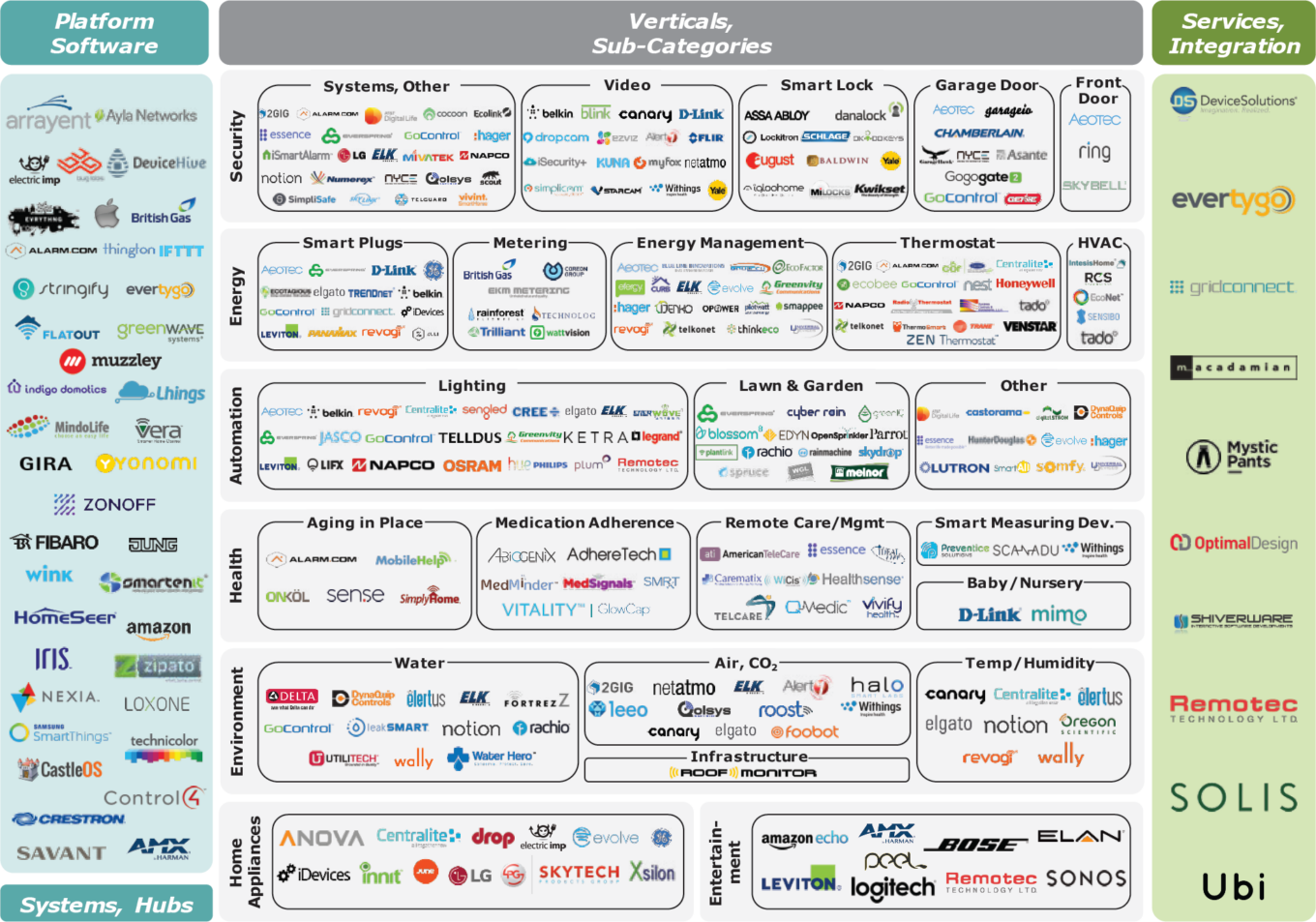
The global Smart Home market is served by a few hundred vendors by our count offering point products and services, complete system solutions, or extensible platforms. This number includes pure-play companies (e.g., Alarm.com, Control4, August, Ayla Networks) as well as large players with a reputation in completely different businesses possessing Smart Home capabilities (e.g., Amazon, Samsung). In Table 13, we map out some of the companies we have come across in Smart Home, grouping them by core vertical focus and subcategory.
TABLE 13: Mapping out the Smart Home market
Source: First Analysis.
We note the competitive set is still expanding, with startups, service providers, legacy consumer products companies, and diversified technology companies, among many others, being drawn into the market. Most are attracted to the market because of its size and because it’s relatively underpenetrated with many adoption catalysts in play. They see this combination as a recipe for solid growth for years to come. For others, particularly the consumer products companies, the motivation goes deeper. They might want to create a direct and thus more meaningful (stickier) relationship with customers that maintains mindshare, gain insights into features used or into issues that need diagnosing to help product design and support, or enable recurring revenue streams for historically one-time sales businesses. We think these factors coupled with the early stage of the Smart Home market and the general absence of players in leadership positions mean the entry of new players will continue for some time.
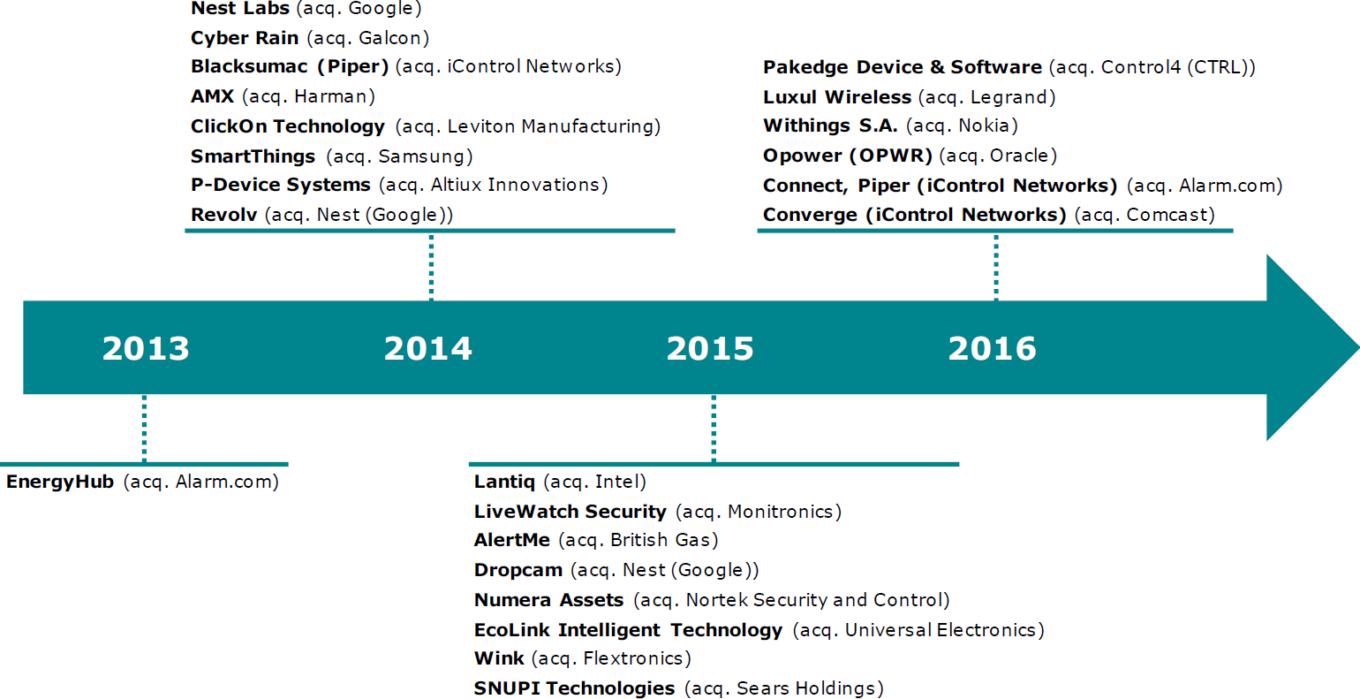
Relative to other verticals in IoT, such as telematics, Smart Home has not featured much consolidation activity to date. Recent activity has been dominated by large companies (e.g., Google, Samsung, Harman) involved in fairly substantial deals compared to what has been seen in other areas of IoT. We expect the pace of consolidation to pick up as participants gain a better understanding of what components are needed to scale and secure a winning position.
TABLE 14: Sampling of acquisitions in the Smart Home space since 2013
Source: First Analysis, company reports.
Business models
The global Smart Home market features a diverse range of business models, including standalone hardware sales, standalone monthly recurring services (for the application, platform software, or airtime), and freemium. Each of these models comes in many configurations, often with the monetization of various components subsidizing other aspects of a solution.
Currently, the most common model in Smart Home is the upfront or one-time hardware sale (as exhibited by Notion and Grid Connect), which corresponds to how most consumers are used to buying home-related products and thus the model we think likely to remain dominant into the future. The revenue from the equipment sale typically will cover the end-user application software and supporting platform, with the home’s existing network connectivity leveraged or the upfront hardware charge including an amount (often not observable by the consumer) for airtime (e.g., text messaging) over the expected life of the device.
Recurring revenue models (as exhibited by Alarm.com, AT&T’s Digital Life, and Ingersoll-Rand’s Nexia), the aspiration of many in the industry, are uncommon mainly due to how consumers prefer to purchase home products. However, these models have proven to be viable if a company is able to piggyback its offering on a traditional recurring service (e.g., security, cable/telco) where consumers are used to paying and currently have a monthly bill. These models can bundle the charge for hardware and other components into the monthly fee, helping customers accept the high cost of initial deployment.
Freemium models should start to become visible in the space given the monetization potential of several areas adjacent to the core solution, including data analytics (both inside and outside the ecosystem), data storage, consumables, professional services (maintenance, support), and advertising.
Distribution, channels to market
Consumers can access Smart Home products and solutions from many different avenues, as we show in Table 15. Smart Home companies prefer to engage customers directly, leveraging online sales portals and other access points, to preserve margin (incremental margin is not lost to the channel) and gain control of the customer relationship for future sales opportunities. However, the Smart Home ecosystem has not evolved to a point where a largely direct go-to-market strategy is viable for most vendors, considering individual company brand awareness, stage/resources, and customer understanding of specific products or solutions, among other factors. This explains why most vendors predominantly depend on indirect channels (i.e., a network of strategic partners) to get their products and solutions in front of customers.
Table 15: Distribution: Where customers find and purchase Smart Home products
| Source/access point | Examples |
|---|---|
| Big-box stores | Sears, Wal-Mart |
| Cable service providers | Comcast, Cox, Time Warner |
| Health care providers | Advanced Telehealth, AMC Health |
| Home appliance, electronics retailers | Abt Electronics, Best Buy |
| Home audio/visual companies | Technicolor |
| Home automation vendors | Control4, Savant Systems, Crestron |
| Home builders/contractors | D.R. Horton, PulteGroup, Lennar |
| Home improvement retailers | Home Depot, Lowe’s, Menards |
| Home security service providers/monitoring companies | ADT, Monitronics, Tyco, Vivint |
| OEM/product manufacturers | August, Rachio |
| Online-only retailers | Amazon.com, Newegg.com |
| Professional installers | Audio Design Innovations |
| Resellers/dealers | Automated Outlet, WYNIT Distribution |
| Service contractors (HVAC specialists, electricians, plumbers) | Daikin, National Air Warehouse, Watsco |
| Telecom service providers | AT&T, Verizon |
| Utility companies | British Gas, CEIVA Energy |
Source: First Analysis, industry reports, company literature.
Some of the more commonly used indirect channels include service provider resellers (communication, security, healthcare; on a white-label basis), brick-and-mortar retailers, online distribution partners, and professional installers/dealers in specific verticals. We thus see a strong collection of strategic channel partners/distributors as currently essential to reaching customers and driving growth. However, while a material quantity can be helpful, we think quality relationships are more important, defined by a Smart Home vendor having mindshare with a partner and the partner being well recognized in the market by end consumers.
Success drivers
We think only a subset of the hundreds of players operating in Smart Home will be able to distance themselves from the broader group over time, accruing a disproportionate share of the value created in the ecosystem. These companies, in our view, will occupy a similar position in the value chain, that of the central platform, which will enable unique opportunities as we discuss below.
Positioning: Being the underlying platform of the home
While the entire value chain presents interesting opportunities, the most enviable position to occupy, in our view, is that of the home’s central platform. It represents the infrastructure software that is necessary to support multiple vertical products and solutions, enabling a unified customer experience and ongoing management/control. We note these platforms don’t have to be completely horizontal or support only proprietary hardware and software; they can support as little as one vertical (sub-category) and even no proprietary applications but should be extensible via internal development and third-party integrations. The value of this position starts with these vendors generally owning the customer relationship (connection), which puts them in one of the best positions to sell additional items to those customers (e.g., both proprietary and third-party home products and solutions, data services, consumables). These vendors also generally enjoy stickier relationships with customers as more products and solutions are purchased/used, making the underlying infrastructure harder to swap out.
We also see value coming from all the data generated from the different products/solutions connected to the platform, which can be collected and monetized. We ultimately expect the vendors to create new services (analytics, benchmarking, consulting, etc.) leveraging this data that can be offered to the various constituents connected in some way to the platform (e.g., end consumers, OEMs, stores/retailers, utilities, solutions providers); they can also charge third parties (such as advertisers) for access to the data or the consumer. Having success with this position requires scale and may necessitate vendors working out privacy concerns and revenue share agreements with integrated partners and other parties.
This is not to say we believe simply occupying a position as a platform provider alone guarantees long-term success. We think other attributes are needed as well to increase the platform provider’s probability of dominating the space. In addition, our belief platform providers are best positioned for long-term value creation is not meant to imply products and solutions providers can’t be successful as well. In fact, we expect many of the non-platform companies to do quite well in the near term, benefiting from the strong industry growth driven by smart device and broadband proliferation, declining costs, vastly greater interoperability, and better consumer awareness. We even think some of these players will possess some of the key attributes outlined below, which should enable them to contend with the platform providers for market leadership over the long term.
Find the right access point into the home to support sales of additional offerings
The land-and-expand strategy is fairly common in the Smart Home market, with many providers having multiple offerings. We think the strategy is sound in light of the number of household items that can be connected, the increased receptiveness to additional offerings once consumers are exposed to an initial product or solution, and the potential positive impacts on the business such as higher growth, diversified revenue, and increasing customer stickiness. That said, what’s critical to success within the Smart Home market is picking the right initial application to emphasize. The wrong focus means wasted resources, reduced flexibility, and weaker traction/financial results. The ideal application is compelling enough to be purchased and gives vendors valuable access in the home, enabling them to sell the next logical products and solutions.
Identifying the ideal starting vertical has been a difficult proposition for vendors, however, owing to the number of applications in the industry, its early stage, and the uncertainty of where consumer interest/receptivity is or will occur. So far, security has been the standout, with consumers generally aware and receptive to modern interactive offerings. Several players have made it their initial focus as a result, seeing it as the best path into the home, and have been rewarded with strong traction (e.g., Alarm.com, Telular, Essence Group); most are now moving forward to push new offerings (e.g., home automation, healthcare) to these existing security customers. With the security market getting crowded, others have been searching for an alternate path, with some getting creative in their efforts. For example, Amazon.com is using music (entertainment) through its Echo hub (with Alexa voice control) to enter the home and open it up for additional applications; traction has been strong, with Amazon selling more than three million Echo units to date. We expect other strong entry points to the home to appear in time.
Compelling messaging: Being able to clearly explain the benefits, quantify a value relative to the cost
The successful vendors in Smart Home can articulate an offering’s benefits and quantify its value in marketing materials and sales pitches. In general, the easiest products and solutions to sell are those with a reasonably positive ROI with the benefits readily quantifiable and comparable to the cost of ownership. The issue facing Smart Home is it doesn’t feature many applications that create hard-dollar cost savings that are easily referenceable to customers; we point to the apps in the energy/utilities category and some in healthcare/wellness as a few where cost savings are easily identifiable.
Instead, the industry features a range of products where the benefits may or may not be readily apparent and the value of the benefits is difficult or impossible to quantify (what we term “fuzzy”). These are often convenience solutions, such as automated entertainment, smart locks, and other areas of automation. This is problematic for customers trying to assign value to a smart product feature to bridge the large gap between its price and that of its traditional counterpart. The successful companies, in our view, will create compelling messaging with this in mind, highlighting the distinct problem solved by the application while attempting to assign a value to the wireless features provided and the achievable benefits.
Complexity-free user experience: Purposeful design goes a long way
We think a well-designed user experience is a way to differentiate products and solutions among the crowded Smart Home field. The user experience relates to installation, configuration (initial setup), and ongoing operation, including settings changes. In our view, the need for consumers to be insulated from device/solution complexity shouldn’t be understated. The majority of consumers do not want to invest material time in getting something installed and working properly or learning how to use the product; thus, many will pass on offerings, even if there is a benefit.
This, along with the fact that not all users are tech savvy, supports a view that consumers tend to gravitate to easy-to-use and -install devices/solutions rather than complicated technology. We feel this applies to professional assistance as well, with consumers reluctant to invest in others installing and setting up items that would add to the already high upfront costs. We therefore feel the successful vendors will consciously design products with easy installation and setup (plug-and-play or out-of-the-box functionality), access and control via a single device (smartphone), and an intuitive user interface with unnecessary features stripped out.
Interoperability: Open is more attractive to consumers than closed
An important dynamic in Smart Home is that most offerings were designed to function on a standalone basis — creating challenges for consumers who desired products and solutions from different vendors to communicate and work together. This desire has only increased in recent years, with consumers demanding interoperability regardless of offering, with little additional programming or configuration, and access and control of multiple solutions through a single interface.
The increased demand partially stems from consumers wanting to assemble customized systems by mixing and matching discrete components to get only the functionality needed and augment existing systems short on functionality. It also reflects consumer fears that the products and systems they invest in could become obsolete or unsupported shortly after purchase given the industry’s early stage, with interoperability a way to alleviate uncertainty and maintain support.
Thus, we believe the most successful players will have an open and flexible architecture, enabling interoperability with current third-party offerings, particularly the marquee names in the industry. This applies to most vendors in the industry, whether providing point products, solutions, or more comprehensive systems.
Vertical segment, subcategory expertise: Addressing nuances, innovating more quickly
We think it is a difficult proposition for a vendor to go after the entire Smart Home ecosystem directly and be successful, given the differences between its underlying verticals and subcategories that necessitate a confluence of detailed knowledge. More specifically, each vertical and subcategory has nuances in terms of technical requirements as well as sales, marketing, and support needs; these markets also often feature different demand characteristics and competitive dynamics.
Because of this, we believe players focused on one to a few areas of Smart Home instead of the whole ecosystem are in a better position to address those differences and have a higher probability of success. Such players can bring (or accrue) a deep knowledge base of the targeted verticals that is difficult for a completely horizontal-focused peer to replicate, leveraging this expertise to address market nuances, innovate more quickly, improve post-sales customer service/satisfaction, and optimize sales pitches/marketing messages.
Scale: Helping vendors compete on cost, monetize data
Not too many players in Smart Home have achieved scale, which we attribute to the early market stage and low current adoption rates. This is set to change, in our view, as the penetration rate of Smart Home products and services ticks up over time. As this occurs, we think scale will become an increasingly important attribute in predicting long-term winners since it better positions companies to win new business and move further ahead of peers.
Players with scale should have greater brand awareness among the hundreds of companies operating in the market, giving them a leg up for new and replacement opportunities as customers seek providers, particularly when questions of long-term viability are paramount. In addition, we expect players with scale to leverage it to extract price concessions from suppliers on hardware and other components and to pass along the savings to customers — enabling more aggressive pricing, which should help in winning a disproportionate share of new business since we anticipate price remaining a critical factor in buying decisions.
Finally, we associate scale with a material quantity of smart device connections, which implies more data captured relative to peers, setting up players for the monetization of data assets in new and different ways.
Highlighted Smart Home company: Alarm.com
Founded: 2000
Headquarters: Tysons, Va.
Funding: Public/NASDAQ
Company size: 519

History
Alarm.com, headquarted in Tysons, Va., began in 2000 as a project (business unit) within publicly traded MicroStrategy (MSTR) and was incorporated as a subsidiary in 2003. Current CEO Steve Trundle headed a team of executives at the subsidiary, most of whom are still at Alarm.com. Though focused on home security, particularly wireless connectivity to these systems, part of the original vision was to find the value of every sensor in the home environment. MicroStrategy is a business analytics software company, so it should be no surprise that an ability to leverage data is a key competency of Alarm.com and part of the focus/DNA of its culture starting at the top.
Alarm.com was one of many “skunk works” projects that MicroStrategy encouraged. As it became a bigger focus (a cost center) at MicroStrategy, the funding and corporate organization of Alarm.com became more problematic. Trundle actually left MicroStrategy and tried to buy the company before ultimately returning as a minority investor and CEO of Alarm.com. It was not practical to spend the capital needed to make a consumer brand of Alarm.com and go direct to the consumer. This reality, combined with a view that a direct model might require more DIY capabilities than the market was willing to accept, pushed the company to its current wholesale model.
Over time, Alarm.com’s subsidiary status within MicroStrategy became an obstacle to maximizing its standalone value, and MicroStrategy sold its position to ABS. Later, ABS sold some of its position to TCV (which also provided a small amount of primary capital to Alarm.com), and that is how those two companies came to own their combined 69% stake, which reflects dilution and a small amount of share sales as part of the IPO in July 2015.
Alarm.com: Key events timeline
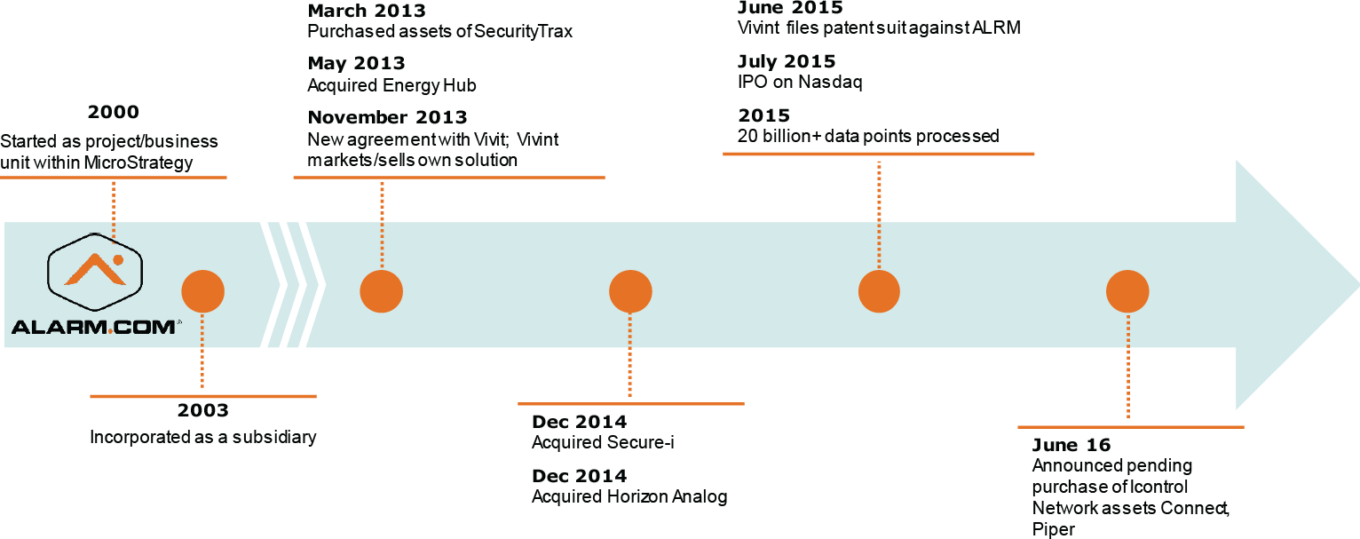
Source: Alarm.com
Business, solutions
Broadly speaking, Alarm.com provides a cloud-based SaaS platform that allows home residents and business owners visibility into and control of what goes on in their homes or offices. While this is the broad business goal and definition, to date, the vast majority of revenue has come from monitoring the home (as opposed to commercial opportunities) and has centered on security systems (as opposed to other systems that make up the Smart Home). As a practical matter, the current business can more narrowly be defined as a leading provider of a SaaS home-based monitoring infrastructure, and the company is currently providing service to more than two million homes and gathering data from over 25 million devices.
While Alarm.com sells some of the sensors and related hardware that report to its cloud-based software, its primary value, revenue, and profit generator is its SaaS platform.
Alarm.com’s interactive security offering allows customers to have traditional home security monitoring as well as a vast array of newer functionality enabled from security-related sensors in a home or business that interact with each other and a variety of external inputs. Core security is enabled by a wireless control panel that tracks sensors on windows and doors (to know if they are open or shut) as well as motion and sound detectors and in many cases video surveillance cameras. These sensors are monitored continuously, and when predefined conditions are met, Alarm.com sends alerts or takes other automated actions. The most common example is when an alarm system is activated at a home, any door or window movement, motion, or major sounds inside the house will cause Alarm.com to send this information to a 24/7 monitoring partner (the Alarm.com distribution partner), which will contact the homeowner and/or notify the police or fire department for immediate response to the address.
Alarm.com solutions
Source: Alarm.com
Though Alarm.com’s platform is most often sold for the interactive security application above, it is a rich platform that can take a variety of sensor inputs and be used for a variety of purposes. In fact, dozens of products encompassing all kinds of Smart Home functionality are integrated with Alarm.com’s platform and thus are able to be monitored and controlled by Alarm.com’s software (some samples are in Table 2). Alarm.com can analyze this data using sophisticated algorithms and take a variety of actions. For example, the system could track your cell phone location and use this knowledge to change thermostat settings as you approach your home or to automatically lock and unlock doors. The company also has specific offerings targeting areas outside security and currently markets Smart Home automation and video.
Through the internet or an app available as a free download for Apple and Android devices, Alarm.com provides an interface to end users of its solutions (e.g., the homeowner or office manager) to give them visibility into and control of Alarm.com integrated products. This enables end users to control functionality such as turning on and off alarm systems remotely, unlocking doors for workers or visitors, controlling lights and thermostats, and watching video of the premises.
Monitoring and energy management solutions
| Solution | Description |
|---|---|
| Smart thermostat schedules | Recommendations based on the analysis of system activity patterns captured over time on a more energy efficient thermostat schedule; likely to maximize efficiency during periods when the property is not likely to be occupied. |
| Responsive savings | Thermostats can respond to other devices and sensors in the home to reduce energy waste and improve efficiency. For example, when the security system is armed and the homeowner is away, the thermostat can automatically go into energy-saving mode. |
| Energy usage monitoring | Real-time and historical energy usage data giving users insight into a property’s energy consumption profile, driving more efficient use of energy-consuming devices in and around the property. |
| Thermodynamic modeling | Algorithms analyze HVAC data, weather information and other factors to determine the unique heating and cooling attributes of a property; this is used to enhance thermostat programming and make energy efficiency recommendations. |
| Geo-service | Knowledge of user location helps calibrate and optimize thermostat settings, with changes happening automatically without need for a user action or rigid schedule. |
| Demand response | Homes and businesses with connected thermostats and other connected appliances can be accessed by utilities to reduce power consumption during peak demand periods. |
Source: Alarm.com, First Analysis.
Hardware
Hardware represents about 28% of revenue but only 12% of gross profit. While we don’t view the revenue or earnings contribution from Alarm.com’s hardware as strategically important long term and it does not represent a material contributor to our valuation model, hardware is currently strategically critical to providing a quality and differentiated solution to the end customer.
We believe the cellular communication module (CCM) is the most critical hardware component. It provides a managed two-way cellular connection as well as the logic to analyze sensor inputs from a variety of devices and software to execute automated rules. The CCM is tightly integrated with the security control panel.
Alarm.com developed and sold other hardware because it saw a need for better, lower-cost, or more tightly integrated functionality than was available from other hardware vendors offering similar products. Unlike the CCM, which is required for the vast majority of Alarm.com installations, these other hardware components are used only in installations that require functionality enhancements and only if the installer/customer prefers this solution to similar products available from third parties that also integrate with the Alarm.com solution. The Alarm.com hardware line includes:
- Image sensor: a battery-controlled infrared motion sensor.
- Video cameras: optional outdoor and night vision capabilities.
- Smart thermostat: designed specifically for easy remote support and troubleshooting.
Solutions to support the sales channel
While the above are the primary solutions used by end customers, Alarm.com has a slew of products and resources designed to support its channel: the service providers that sell, install, and monitor the Alarm.com solution.
Solutions to support the sales channel
| Category | Solution/resource | Description |
|---|---|---|
| Service provider portal | Service provider website | Online tools to help providers activate and manage Alarm.com customer accounts, order equipment, access invoices/billing, remotely program customer, and access other services. |
| Installation & support | MobileTech application | Mobile app designed for technicians to facilitate the installation and programming of equipment while on site. |
| AirFX remote programming | Remote system management tools enabling service providers to make changes to a subscriber’s system programming. | |
| Business management | Web services | Integration of existing customer account management tools with Alarm.com’s platform using its web services; facilitates account creation, status updates, system programming, and plan upgrades. |
| Business intelligence | Tools providing insights into the performance of the Alarm.com subscriber account base; offers operational metrics on account plan adoption, attrition, and service quality to help grow their business and improve customer retention. | |
| Sales, marketing & training | Marketing portal | An online portal offering access to a broad suite of marketing and sales tools, including co-brandable assets such as mobile optimized websites, landing pages, lead capture, image library, direct mail, and event material. |
| Alarm.com Academy | Online training courses where service providers can access training on the full suite of Alarm.com solutions. |
Source: Alarm.com, First Analysis.
Market size
Broadly speaking, Alarm.com is targeting the entire Smart Home market described in this report. Thus, it is a portion of what we estimate as the $3.5B U.S. Smart Home market, which we anticipate growing to $18B in 2025. This is just the U.S., with the world market being two to four times larger. By this definition, Alarm.com’s share was roughly 6% of the U.S. Smart Home market in 2015.
We consider this one of the broader ways to define the market. More narrowly, looking at where most of revenue is coming from today, the market is confined to U.S. residential homes with professionally monitored security solutions. In its SEC filings, Alarm.com cites Parks Associates research data showing 22.5M U.S. households with a professionally monitored home security system (see Table 5) in 2015 growing to 29.9M households by 2020. This is out of roughly 135M households in 2015, suggesting current penetration rates for professional home monitoring are ~17%. With 2.6M subscribers at the end of 2015 and assuming a minor portion of these are commercial, international, or for other services, it appears Alarm.com has ~10% share in this market. With a run rate of roughly $160M exiting 2015, this suggests a more immediate addressable market of ~$1.5B growing to ~$2B in 2020.
Large, underpenetrated global market: Significant subscriber growth potential
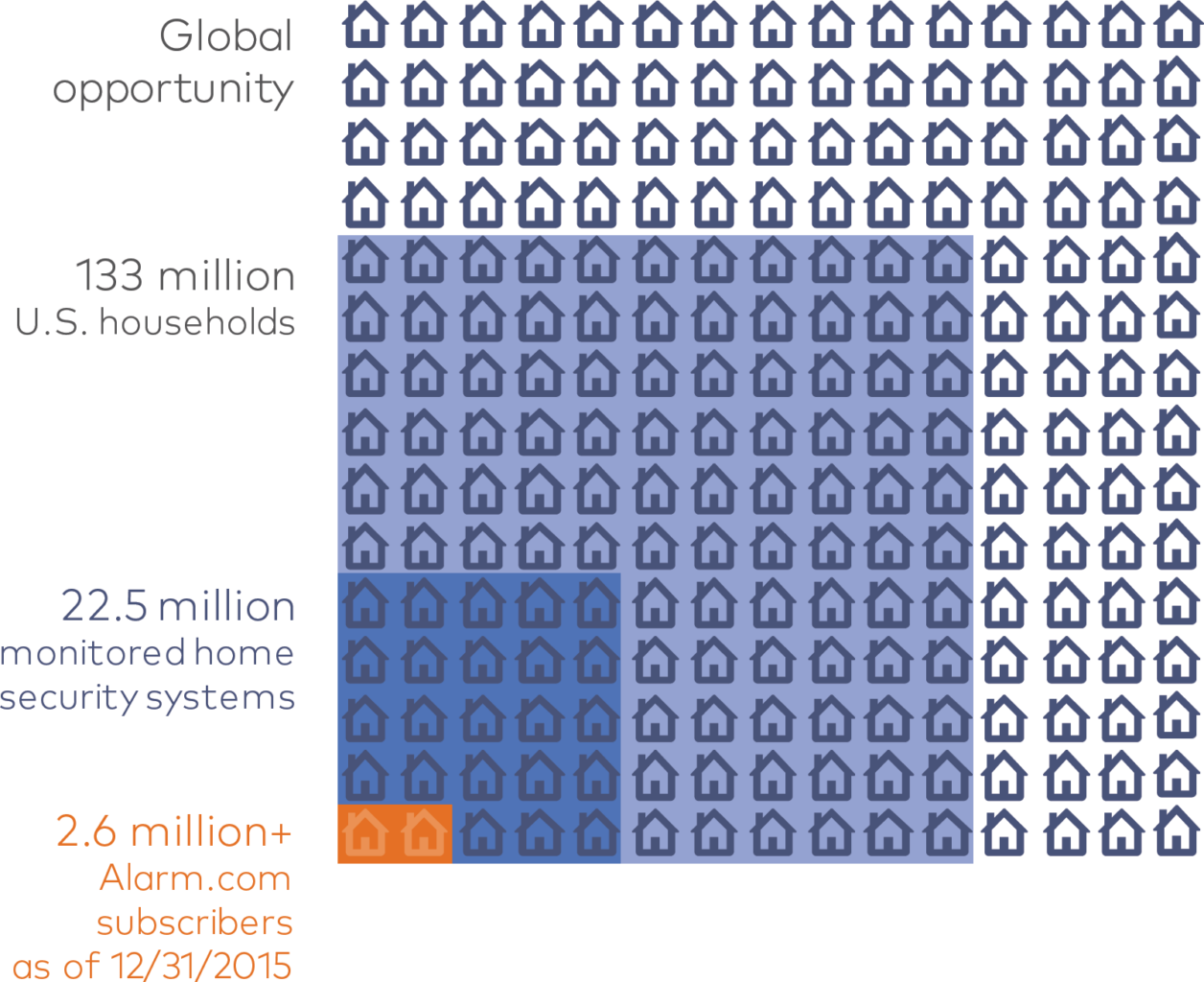
Source: Alarm.com, Parks Associates.
We believe the growth rate of monitored homes will be faster than Parks Associates’ narrow view due to the heavy marketing of Smart Home technology by cable and telecom companies that have recently entered the market. If we merge the broad and narrow views of the market size, we still have a large and growing market.
We note in defining Alarm.com’s market in both the overall Smart Home market and the more narrow U.S. professionally monitored security market, the professional monitoring portion of the market (i.e., the 80% of the end-user cost that is taken by the company installing, monitoring, and servicing the customer, or more than $7.5B annually) is outside of our definition and excluded from the market size/potential market in both cases.
Distribution, business model
Alarm.com sells its security solutions to a network of over 6,000 professional service providers who are in the business of installing and monitoring home (and in some cases business) security systems. These service providers in turn sell the security service built on Alarm.com’s platform to end subscribers (i.e., the person occupying that home or business). The service provider is responsible for acquiring and servicing the end customer, including pricing, billing, and collecting for the service. Typical contracts between the end customer and the service provider would be for a few hundred dollars upfront for hardware and installation and a monthly fee of around $40 for ongoing service, including 24/7 monitoring. In some circumstances, there is no upfront fee for installation, and the monthly fee would correspondingly be slightly higher. Contract terms are typically one to three years.
For providing the solution, including the app or website interface to the end user, Alarm. com charges a monthly fee to the service provider for each location using the service. The monthly fee for each user is determined in part by the number and type of Alarm. com modules provided for the location. It also charges the service provider for Alarm. com hardware at the time of purchase by the service provider. Because it relies on its wholesale distribution model, to be successful, Alarm.com must sign up a large number of service providers, penetrate the customer base of these providers, and have service providers that grow and ultimately succeed in the market vs. competitors on other systems.
The landscape for service providers of home security in North America is fragmented with over 10,000 providers (Alarm.com estimates roughly 13,000). Alarm.com has relationships with over 6,000 of these players. While most of the companies are small, local, or regional players, a few are larger. Notably, ADT estimates it has roughly 27% market share, followed by Monitronics and Vivint with about 4% each. Communications players such as Comcast, Time Warner, and AT&T have been promoting a bundled communication/video solution with home monitoring; each has 1% or greater share of the market.
Estimated market share: North America residential monitored security
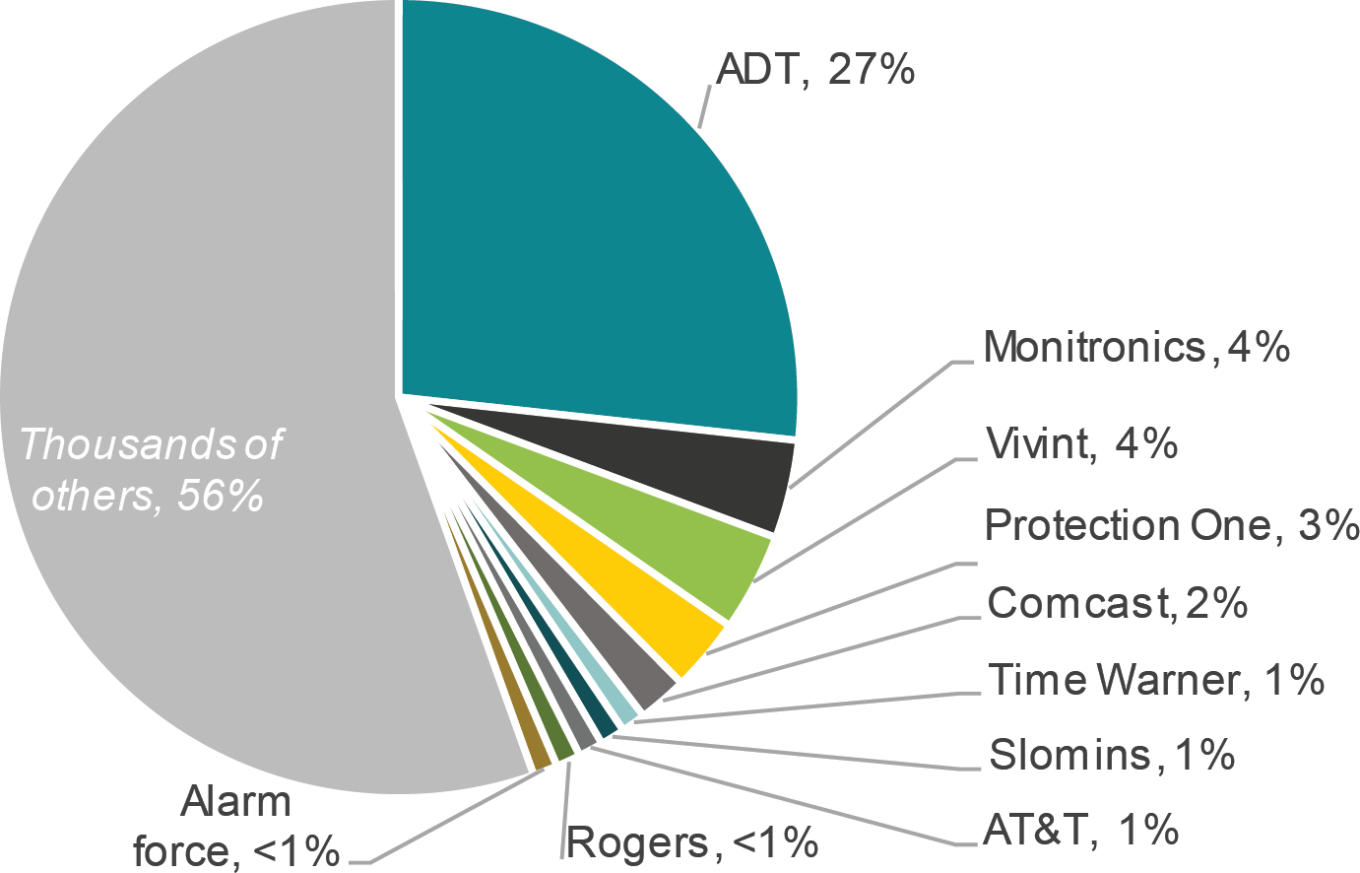
Source: ADT, Parks Associates (2014).
Management believes service providers find its solution compelling in multiple areas compared to the competition, so once Alarm.com lands a distributor, it eventually garners most of that distributor’s volume. Alarm.com believes after about five years, it has about 90% share within its installed base of distributors.
Differentiated go-to-market strategy
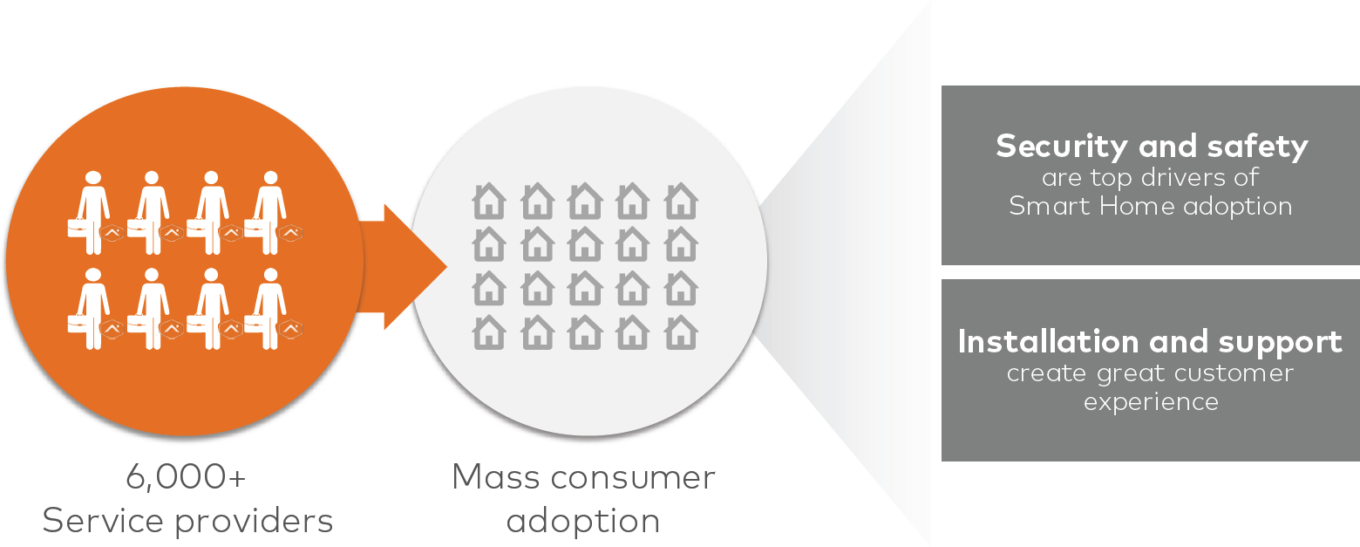
Source: Alarm.com
While Alarm.com has had success signing up and penetrating a large number (6,000+) of service providers, some of the larger players in the industry have used competing solutions. ADT, Comcast, and Time Warner all use Icontrol Networks as their backend solution; we note, however, Alarm.com has ADT Canada. Vivint moved from Alarm.com to its own solution (though it still pays amounts to Alarm.com). This dynamic is in flux with Alarm.com’s pending acquisition of most of Icontrol’s business, including its U.S. ADT business. Comcast is acquiring the other portions of Icontrol and will continue on what will now be its own proprietary system.
Compelling growth drivers
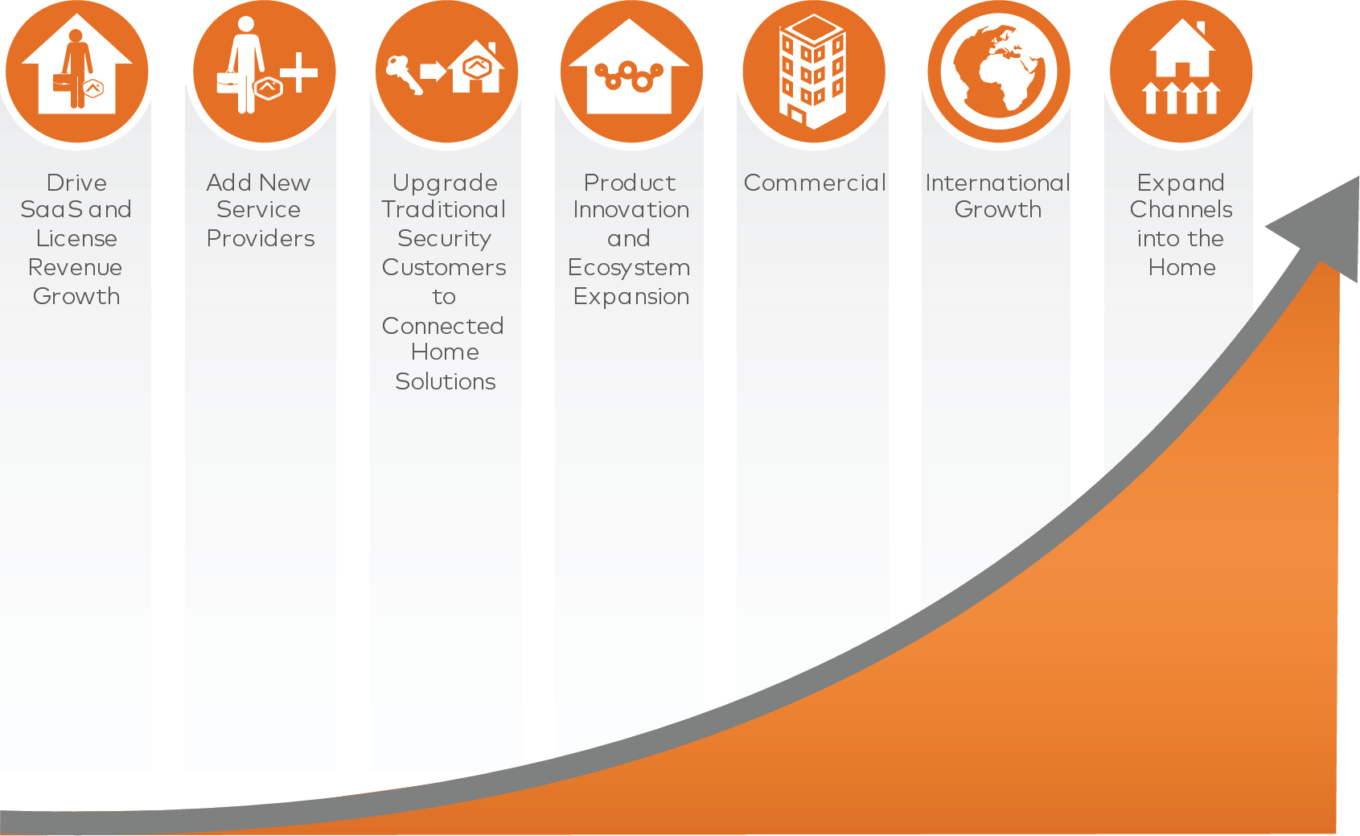
Source: Alarm.com
Customer concentration
While Alarm.com sells to 6,000+ distributor partners, its top 10 represented 63% of 2015 revenue, and this number has been in the mid-60% range for the past three years. Its largest customer is Monitronics, which represented 15-20% of 2015 revenue. It had no other 10% customers in 2015.
Competition
Alarm.com can be defined as a company competing in the Smart Home, home security, big data analytics, and other markets, areas with varied business models and go-to-market strategies, so the competitive dynamics are complex.
Most directly for the bulk of its business today, Alarm.com competes with companies vying to provide the security platform and solution used by the 13,000 North American home security monitoring service providers. Alarm.com reports Honeywell as its most visible day-to-day competitor. Honeywell has a long history in providing control panels and other hardware for this market and has more recently offered a service to its dealers similar to Alarm.com. This service, under the Total Connect brand, can, like Alarm.com, integrate thermostats, video, and other home devices. Historically, Icontrol Networks competed with Alarm.com primarily for larger opportunities such as ADT, Comcast, and Time Warner, all of which are Icontrol customers. With Alarm.com purchasing much of Icontrol, these dynamics will likely change (see the Icontrol box for further discussion). Other smaller competitors include Zonoff and Numerex, the latter of which has new management and a strong wireless history – a combination which may make this relatively unknown player more important going forward.
Alarm.com’s growth depends on the success of its service provider network to win and keep subscribers. Thus, while not direct competition, companies such as Comcast that sell home monitoring security solutions but don’t use Alarm.com’s back end are, broadly speaking, competitors; Alarm.com has a vested interest in seeing its distributor network gain share relative to distributors using other solutions. In addition, Alarm.com currently does not compete in the market for home security unless it is professionally installed and monitored. Therefore, all the DIY solutions are a general form of competition.
If one looks beyond security and views Alarm.com as a Smart Home hub or portal through which multiple third-party devices and even entire other Smart Home systems will be controlled, platform competitors discussed in the Smart Home section of this report, such as Amazon.com, Google, and Apple, enter the picture. We believe the company that is the primary portal to control home devices is in a good position to capture the lion’s share of the profit, if not the dollars, in Smart Home automation and other verticals. While we generally think one platform will dominate (consumers don’t want 50 apps to control 50 devices), we could see two or three platforms each controlling a category of devices. Security could be one area that is carved out on its own due to the third-party monitoring and sensitivities of these platforms.
Competitive advantages
We believe Alarm.com is positioned favorably relative to competitors in a few areas. First, at its core, Alarm.com is focused on data and analytics and, by extension, how to present insights in an easy-to-understand and useful way to consumers. We think this orientation is a valuable distinction compared to Honeywell and other historically hardware-focused competitors.
Alarm.com was a pioneer of two-way cellular communication for home security hardware and has a strong patent portfolio in this area. We believe managing wireless connectivity, including knowing how and when to process data locally and when to send it, is still a differentiated strength of Alarm.com that may become increasingly important as additional areas of the Smart Home are added to the platform.
Service is another area where we believe Alarm.com differentiates itself. It strives to integrate third-party products in a comprehensive manner (more than just connecting to a generic API) and, as such, to provide a level of support to its dealer network for these devices equal to or better than the third-party manufacturer’s own support. This is just one example of the culture of support it tries to instill in the organization. Though costly, Alarm. com believes it can win dealers and better penetrate the dealer network’s installed base with this type of top-tier support.
Risks, challenges
Evolution of market away from its distribution channel. We think one of the bigger risks to Alarm.com is that the home automation space evolves in a manner unfavorable to its go-to-market strategy. This could happen in a number of ways including success of DIY solutions, Comcast and other large companies it does not service taking share, or tangential home automation platforms from players such as Amazon.com, Apple, and Google subsuming the largely independent security market.
Consolidation of channel works against Alarm.com. The highly fragmented distribution channel could consolidate in a manner that hurts Alarm.com – something we could see happening in one of two ways. The less threatening, in our view, is that large players develop their own proprietary technology and thus no longer need Alarm.com’s solution. To some extent, Comcast is doing this at present and current Alarm.com customer (but historically larger customer) Vivint has taken this route as well. We think the complexities involved make it difficult for all but a handful of companies to credibly take on this mission, and we see few of those capable wanting to do so. However, the more likely scenario is that larger players use the threat of building their own solution, or simply their weight of having so many customers on the Alarm.com platform, to extract significantly discounted pricing, taking some of the revenue and profits from Alarm.com.
Vivint dynamics and litigation
At one point, Vivint had a distributor relationship similar to most Alarm.com resellers, but in November 2013, a new agreement was signed where Vivint would license Alarm.com technology but market and sell its own solution. While Alarm.com still receives a monthly fee per subscriber, it does not provide the basic security solution to the end-user, and thus the fee is much less than it was when Alarm.com provided its full solution.
Furthermore, Vivint filed a patent infringement suit against Alarm.com in June 2015. We are not experts on Vivint or this patent issue, but we suspect the ongoing fees Vivint is paying to Alarm.com despite moving away from Alarm.com’s solution to its own proprietary offering is part of the motivation for the filing of this suit.
We think the Vivint example demonstrates how the evolution of the market away from its distribution channel can harm Alarm.com’s business. That said, we think Vivint is the exception rather than the rule in terms of its desire to build and market its own security offering. This is a big undertaking, and we think few companies will want to take on and maintain this challenge. However, very large enterprises such as Comcast (which seems to be building its own solution based in part on Icontrol’s technology) have the resources to go this route, and even if Alarm.com’s customers don’t leave, the threat of leaving could have negative implications for pricing and profitability.
Acquisitions and pending Icontrol acquisition
Since 2013, the company has made four relatively small acquisitions for total cash payments of $17M. We view all of these as primarily technology-related acquisitions, and none had substantial revenue at the time of purchase.
Acquisition history
| Target | Date | Price ($M) | Acquired assets/capabilities |
|---|---|---|---|
| Icontrol Networks (assets) | Pending | $140 | Connect, an interactive security and home automation software platform, and Piper, a Wi-Fi-enabled video and home automation hub. |
| Horizon Analog | Dec-14 | <$1 | A research firm collecting and analyzing data on energy usage and consumer behavior. |
| Secure-i | Dec-14 | $2.61 | Internet-based remote video hosting services including storage and viewing. |
| Energy Hub | May-13 | $82 | Developer of solutions to help consumers and utilities reduce energy consumption. |
| SecurityTrax (assets) | Mar-13 | $5.63 | Provider of SaaS customer relationship management software for security dealers. |
Source: Alarm.com, First Analysis.
Notes: (1) $2.6M in cash and a small future potential payment. (2) $8M in cash upfront plus $5M contingent earn-out. (3) $5.6M plus roughly $1M in future consideration and earn-out potential.
Icontrol Networks
In June, Alarm.com made its first major acquisition, announcing its intent to purchase two business units from Icontrol for $140M in cash. The transaction is expected to close during 2016 and be accretive to adjusted EPS in 2017. It will be paid for with cash on hand and a drawdown of debt from its existing credit lines. Additional financial details are expected at transaction closing. Comcast is purchasing the bulk, if not all, of the remaining assets of Icontrol.
One of the units Alarm.com is purchasing, Connect, is based in Silicon Valley and provides a back-end security service similar to Alarm.com, leveraging its own distribution partner network of professional security monitoring companies. Its largest customer is ADT (1.6M subscribers), which, when combined with Alarm.com’s 2.6M subscribers, will create a clear market leader in providing this type of service. We believe there is substantial revenue coming to Alarm.com with Connect.
The other unit Alarm.com is purchasing, Piper, we view as more of a technology buy. Piper, based in Ottawa, Canada, designs and produces the Wi-Fi-enabled video and home automation hub. We think Alarm.com will use these capabilities to accelerate development of new and more broadly integrated offerings for its core market.
Private and public company profiles
In the following pages, we highlight 18 public and private players participating in the Smart Home ecosystem – a small subset of the several hundred companies competing globally in the market. We selected players across the industry to showcase its breadth, purposely including horizontal platform companies, system providers, and solutions vendors in the various vertical market subcategories. We believe the players chosen are among the most relevant in the industry on the basis of proprietary capabilities, business model, market positioning and mindshare, customers/wins, and other unique factors.
Amazon.com Inc. (AMZN)
Founded: 1994
Headquarters: Seattle
Funding: Public/Nasdaq
Company Size: > 100,000 employees
Key Metrics: 3M+ Echo units sold to date (wide release June 2015)

Offering: Hardware, platform software, applications
Supported communication: Bluetooth, Wi-Fi
Model/pricing: Upfront hardware and accessory sales
Ecosystem focus: Automation, energy, entertainment
Primary region(s): North America
Customer focus: End consumers
Competitors: Apple HomeKit, Google Home
Sample integrations: Ecobee, Garageio, Google Nest, Insteon, Philips Hue, SmartThings, Stringify, Uber
Overview: Amazon entered the Smart Home space in 2014 with the launch of the Echo voice-enabled wireless speaker and Alexa voice assistant. Echo can play music or audiobooks, create to-do lists, provide a range of information (news, weather), and order products from Amazon Prime – all initiated by voice request. It can also control and manage integrated home devices (lights, thermostats). Alexa, running on Echo or third-party devices, is a cloud-based service that receives voice commands, processes them, and responds to requests. Users can also create “skills” that are custom commands Alexa can execute.
Differentiation: Amazon stands out in Smart Home due to its emphasis on voice, which it sees as highly useful but a grossly underutilized interface compared to touch. This emphasis has paid off, with Echo achieving strong traction (3M+ sold to date), giving Amazon an early leadership position. We note few peers have taken this approach despite some having voice capabilities. Besides its voice focus, the company highlights the openness of its platform, with it being easy for third parties to integrate Alexa, and the momentum of its developer community, with 1,500+ skills created to date.
Strategic focus: Amazon’s focus is on integrating additional offerings so it has all the major players in the Smart Home ecosystem and even other markets (e.g., automotive) able to work with Alexa. It is also focused on adding more skills for Alexa from its user community and making Alexa more proactive instead of reactive with enhanced AI.
First Analysis take: We think Amazon is one of the best positioned companies in Smart Home in light of the exceptional traction of Echo and Alexa, which gives it crucial initial home access. This access is coveted to set up the sale of add-on products/solutions, which some players will achieve and monetize. But Amazon is special, in our view, as it is situated to monetize its connections – and Smart Home, by extension – at a level that few, if any, players can replicate through the repeated sale of consumables and other household items, leveraging its distribution network, supplier relationships, and scale. Going after goods makes perfect sense given the company’s core business and we think leveraging voice control as the interface to make purchasing extremely easy is novel strategy that is driving adoption. Its success has attracted an imitator in Google Home. It will be interesting to see the effect of direct competition on Amazon’s leadership position.
August Home Inc.
Founded: 2012
Headquarters: San Francisco
Funding: Private/PE backed
Company size: < 200 employees

Offering: Hardware, application software
Supported communications: Bluetooth, Wi-Fi
Model/pricing: Hardware/kits sold upfront; end-user application free
Ecosystem focus: Automation, security
Primary region(s): U.S., Canada
Customer focus: Residential consumers, end-users
Competitors: Kwikset, Schlage, Yale Smart Living
Sample integrations: Apple HomeKit, Google Nest, Honeywell
Overview: August provides a connected door lock solution that lets users monitor and control access to their home remotely via a smartphone or tablet. Key features include customizable virtual key access, video communication/monitoring, and instant alerts about front door activity. Its hardware is integrated with other Smart Home devices and services to enable more comprehensive system functionality.
Differentiation: Relative to competitors, August emphasizes the modern, sleek design of its smart locks as helping it stand out and appeal to customers as well as easy installation and use, levering a simple application interface. It also highlights seamless interoperability with a variety of platforms, including Google Nest and Apple HomeKit, as setting its products apart.
Strategic focus: August’s near-term focus is on entering additional partnerships that can extend the value of its offerings and widen its distribution footprint; these partnerships should play a role in enhancing brand awareness while driving broader ecosystem interoperability.
First Analysis take: We think August is taking a logical path in attempting to scale its business by partnering with marquee industry players that can make its interoperable and easy-to-use point solutions available to a wider customer base. In addition, we highlight August is thinking strategically and creatively in its pursuit of additional growth avenues. As an example, we point to its recent alliance with Airbnb, a company that targets the short-term rental space. This arrangement, in our view, is intriguing since this market can benefit from added security and monitoring features, few competitors are currently targeting it, August can leverage its largely unchanged existing offering in this segment, and traction could help August scale quicker. However, August being generally a hardware player puts it at risk for commoditization longer term. It will be worth watching to see how August attempts to avert this, noting it has many strategic options, including augmenting its existing offering, pursuing new verticals, and moving up the value stack to software solutions. We think an outright sale is a good possibility as well as its offering would be a strong strategic fit to security-focused players or large companies building an ecosystem.
Clare Controls
Founded: 2010
Headquarters: Sarasota, Fla.
Funding: Private/founder backed
Company size: < 100 employees
Key metrics: Works with 1,800+ devices

Offering: Hardware, infrastructure software platform, end-user applications, point solutions
Supported communications: Wi-Fi, Z-Wave, Bluetooth
Model/pricing: Upfront hardware sales, recurring monthly fee for remote platform access
Ecosystem focus: Automation, entertainment, environmental, security
Primary region(s): North America, some distribution in Australia
Customer focus: Dealers, national home builders, end users
Competitors: Nexia (Ingersoll-Rand)
Sample integrations: Crestron, LG, Google Nest, Honeywell, Yale
Overview: Clare Controls bundles hardware (gateways/hubs, peripherals) and end-user application software with its proprietary infrastructure software platform to form end-to-end Smart Home systems. The platform, which supports multiple verticals including home automation, is also integrated with many third-party products and solutions. This combination enables the assembly of highly customized systems, with users able to not only select vertical applications but also individual products that will be connected to meet specific functionality needs.
Differentiation: Clare feels it stands out relative to peers by being proactive in supporting and interacting with its channel and end users. It provides ongoing consulting to dealers and homebuilders to help them better evaluate end-user tech needs, price offerings/bundles, and market to prospects – items that drive adoption. Clare also regularly makes recommendations to end consumers, leveraging usage data and knowledge of products deployed, on how they can better use their solutions as well as how add-ons could enhance system benefits.
Strategic focus: Near term, Clare is focused on adding to its strong portfolio of integrations. It is also investing in capabilities that will enable it to leverage and monetize the data coming from its platform connections with offerings planned for consumers and commercial entities.
First Analysis take: Clare Controls possesses some of the attributes we expect to define the long-term winners in the space – positioning as a platform, focus on interoperability, and emphasis on a few verticals. While we think these are contributing to its recent traction, we believe its distribution model through dealers/homebuilders and its access to end users after deployment are worth highlighting as well. These give the company a strong reach with partners providing steady access to new potential end users through the normal course of their business and key follow-on sales opportunities. Both attributes could be a nice tailwind to growth and help Clare reach material scale. Given the company’s interest in monetizing data, we think achieving scale is paramount for the company, as it needs a sufficient number of connections to generate the data volumes to support such offerings. We think a challenge to achieving this scale is visibility, which might improve through the company’s focus on integrations.
Curb Inc.
Founded: 2012
Headquarters: Austin, Texas
Funding: Private/venture backed
Company size: < 25 employees
Key metrics: ~1,000 residential and consumer users
Offering: Enabling hardware, infrastructure software, end-user application software
Supported communications: Powered line, Wi-Fi, cellular
Model/pricing: Upfront hardware/kit sale, application free
Ecosystem focus: Energy
Primary region(s): U.S.
Customer focus: Residential consumers, commercial
Competitors: eGauge Systems, Smappee
Integrations: SmartThings (Samsung)
Overview: Curb bundles proprietary hardware and software to form a solution that gives consumers complete visibility into home electrical usage. Through its web interface or mobile app, users can remotely determine in real time which assets are on/off, see the exact drivers of the monthly electricity bill, gain tailored recommendations on how to make a home more energy efficient (through product swaps or upgrades and behavioral changes), receive usage or unusual activity alerts, and benchmark electricity costs against others in various regions.
Differentiation: The company feels its hyper focus on data accuracy and analysis, driven by a team with core expertise in data sciences and electrical engineering, sets it apart from peers and puts it in a strong position for when Smart Homes transition to a heavier emphasis on data analytics relative to basic visualization and control. Also, its software was purpose built to be intuitive and ensure a great user experience while maintaining advanced functionality; it notes many peers offer over-engineered software that is too complicated to use.
Strategic focus: Curb’s immediate focus is to grow its customer base for the core energy management offering, both domestically and internationally. It also wants to explore additional integrations with third parties, which could increase its value to existing customers and improve its market visibility. An area of interest is home automation, which it expects to enter at some point via technology partners or proprietary development. Longer term, it may add a recurring revenue stream through premium services such as data recovery or deeper analytics.
First Analysis take: Vertical players like Curb generally possess deep domain expertise that can lead to more sophisticated offerings, quicker product updates, more effective sales pitches, and better client support – items that should increase probability of success relative to peers with a broader focus and generic segment offerings. That said, such players still need an effective go-to-market strategy to scale. While Curb has seen some early traction via online sales, it is working to improve its visibility in the market, potentially through integration with marquee platforms like SmartThings – efforts that we feel are worthwhile. Starting and scaling a recurring revenue service remains an elusive goal for many in the industry. However, we think Curb’s ecosystem focus gives it a good chance since energy savings can be proven and the resulting ROI metrics may turn out to be useful in sales efforts.
Electric Imp
Founded: 2011
Headquarters: Los Altos, Calif.
Funding: Private/PE backed
Company size: < 75 employees

Offering: Enabling hardware, infrastructure software platform
Supported communications: Ethernet, Wi-Fi
Model/pricing: License for OS on hardware + ongoing service fee (monthly or multi-year upfront)
Ecosystem focus: Appliances, automation, energy, environmental, health/wellness, security
Primary region(s): U.S., Europe, Asia
Customer focus: Device manufacturers, solution providers
Customer(s): Budweiser, Cybex, Lockitron, Pebble Air
Competitors: Arrayent, Ayla Networks
Sample integrations: Amazon, Bug Labs, Keen IO, New Relic, PubNub, Salesforce, Twillio, Wolfram
Overview: Electric Imp provides a platform solution consisting of tightly integrated embedded hardware modules and infrastructure software components (OS, APIs, cloud, developer tools) that manufacturer customers can leverage to quickly and cost effectively connect traditional products (e.g., refrigerators, washers & dryers, HVAC systems) to the internet and manage ongoing connected services.
Differentiation: Management feels the company’s heightened focus on security, in place from its founding, sets it apart relative to peers. It notes best security practices and functionality (e.g., messaging certificates between all platform components, encryption of all communications, separation of the application software and operating system running environments) were purposely designed into every layer of its offering, from its hardware modules to the cloud. This, in addition to constant software updates, is meant to ensure deployed products remain functional and protected long term.
Strategic focus: Electric Imp’s primary focus near term is on gaining traction in other markets to reduce its dependency on the consumer vertical. Some of the areas Electric Imp noted as being of most interest are industrial and commercial where applications have easy-to-understand value propositions and/or quantifiable ROIs.
First Analysis take: We think Electric Imp is well positioned for success because its offering deals with the inherent (and often underappreciated) complexity involved in bringing hardware and software components together to enable connectivity – a backdrop we don’t expect to change near term. Its primary emphasis shifting to software from low-level hardware (modules) helped to facilitate or improve this position, and we see the move as a positive in its own right given the tendency for hardware to become commoditized. While the company’s strength is in the consumer space, we think its move to diversify its exposure could be a good move as it may help it scale faster or weather end-consumer fickleness. That said, we will see if this diversification has a negative impact on the company’s focus on consumers and if the company has sufficient capacity to target multiple segments.
Essence Group
Founded: 1994
Headquarters: Herzliya, Israel
Funding: Private/founder backed
Company size: ~600 employees
Key metrics: Installed base of 1.2M wireless security systems; 15M devices installed worldwide across offerings

Offering: Hardware, infrastructure platform software, end-user applications, services
Supported communications: RF, Z-Wave, cellular
Model/pricing: Upfront hardware/accessory sales, monthly fee/revenue share per connection
Ecosystem focus: Automation, healthcare/wellness, security
Primary region(s): Global (excl. Africa)
Customer focus: Resellers/dealers; security, communication, and healthcare service providers
Customer(s): G4S, GetSafe Home Security, Hills, Medical Guardian, Natali Healthcare Solutions, Securitas Direct Spain, Verisure
Competitors: Alarm.com, Daitem Atral, Honeywell, iControl Networks, RISCO Group, Sonos, UTC
Sample integrations: Aeon Labs, Apple, ASSA ABLOY, Google Nest, Yale Smart Living
Overview: Essence is an end-to-end solutions provider (bundling hardware, platform and application/analytics software, services) that focuses on three distinct verticals in Smart Home: security, automation, and home healthcare. It has a worldwide presence, offering its solutions on a white label basis through resellers.
Differentiation: The company feels supporting end-to-end solutions with completely proprietary components, resulting in tightly integrated and highly functional offerings, is a strong differentiator. It also points to its high-quality products and solutions being engineered and manufactured in Israel and Europe instead of by low-cost Asian suppliers, as well as strong domain expertise in security (from 20+ years of experience), as particularly notable.
Strategic focus: Near term, Essence’s focus is on growth within its chosen markets where it looks to expand its share. It is also looking to enhance the features/capabilities of its home automation offering through internal development and additional third-party integrations so as to further increase the overall value deliverable to end users. Longer term, the company anticipates widening its global footprint.
First Analysis take: We think Essence is one of the better positioned companies we have come across in Smart Home and one worth monitoring. This stems from its possessing several of the criteria we think will define successful companies in the ecosystem. These include scale, a solid path to market via resellers, a proven recurring model alongside upfront hardware sales, and platform software that can be extended through proprietary development and integrations. We note Essence’s multi-vertical strategy, however, might hinder its success since it could dilute management focus on the company’s core vertical (security) as well as divide resources that could prove more valuable supporting established areas rather than fledgling ones.
Grid Connect Inc.
Founded: 2003
Headquarters: Naperville, Ill.
Funding: Private/founder backed
Company size: < 50 employees

Offering: Enabling hardware, infrastructure platform, end-user applications, professional services
Supported communications: Bluetooth, Wi-Fi, ZigBee
Model/pricing: 1x hardware sale, free application
Ecosystem focus: Energy, environmental
Primary region(s): Global
Customer focus: Residential consumers
Competitors: iDevices
Integrations: Apple HomeKit
Overview: Grid Connect, a networking hardware design shop and manufacturer, has created completely proprietary products for the connected home, including a smart outlet and environmental sensors, under its own brand, ConnectSense. Using the ConnectSense app, consumers gain visibility on usage and status of the items plugged into the smart outlet and can control them in real time remotely or in automated fashion with rules and scheduling. Its Wi-Fi sensors can capture six types of data (temperature/humidity, water/moisture, door or window open/closed, dry contact, light, and motion) that is also viewable in the ConnectSense app; users can set rules (if/then) or thresholds on any of these data points to receive notifications of material changes.
Differentiation: The company highlights its deep expertise in networking technologies from its long tenure as a distributor and manufacturer, which helps in dealing with nuances and challenges when creating products and providing support, as a core differentiator relative to competitors.
Strategic focus: Grid Connect is currently focused on building awareness of ConnectSense and driving sales. It is also interested in integrating with other players in the ecosystem beyond Apple (HomeKit) not only to improve its visibility but also to make ConnectSense more relevant to customers looking to put together a home system of disparate vendor offerings.
First Analysis take: While Grid Connect has offered few Smart Home products to date, it is likely to make additional hardware products for residential consumers, leveraging its design and manufacturing expertise. Notably, the company is not really interested in moving away from its one-time hardware sales model to pursue recurring revenue as it feels customer receptivity to another monthly bill would be poor, making such a transition unsuccessful. We think this, combined with its interest in being interoperable with key ecosystem players to enhance its product value and company visibility, demonstrates the company has a good understanding of the current Smart Home space and what it needs to do to be successful as a hardware-centric player. That said, it will be interesting to see if Grid Connect can gain the visibility it needs and sufficiently communicate ConnectSense’s differentiation relative to peers offering similar products in order to scale its Smart Home products business.
HomeKit (part of Apple Inc.)
Founded: 1976
Headquarters: Cupertino, Calif.
Funding: Public/Nasdaq
Company Size: > 115,000 employees
Key Metrics: < 25 active device partners
Website(s): www.apple.com www.apple.com/ios/homekit
Offering: Infrastructure software platform, framework
Supported communications: Wi-Fi, Bluetooth
Model/pricing: HomeKit itself has no charge
Ecosystem focus: Automation, energy, security
Customer focus: End consumers
Competitors: Amazon.com, Google Nest, SmartThings
Sample integrations: Chamberlain, Ecobee, Grid Connect, Honeywell, Nest, Schlage, Withings
Overview: Apple provides HomeKit, a software platform designed to support third-party devices/applications and facilitate interoperability between them. Besides enabling approved products to work together, HomeKit allows users to control or manage multiple applications in a single interface (on an iPhone, iPad, Apple Watch) using touch or Siri voice control. Consumers can also create “scenes,” which group the actions of multiple appliances so reactions to specfic triggers (e.g., leaving home, waking up) occur at the same time.
Differentiation: The company highlights HomeKit’s emphasis on security as setting itself apart from peers. It requires third-party device makers to follow Apple’s requirements for encryption and authentication. This is geared toward protecting consumers against data theft, hacked communications, or household items being controlled by strangers. We think Apple’s proprietary if/then (triggers/actions) capabilities are noteworthy, as most peers partner to access this functionality.
Strategic focus: Apple has indicated plans to launch a Siri software development kit so third parties can integrate the voice assistant with their own apps; Apple is also working on better AI so Siri can learn and make improved recommendations. At this point, it is unclear if Apple is planning to create a proprietary device leveraging Siri to compete with the Amazon Echo and Google Home.
First Analysis take: Apple is a player to watch due to its resources, visibility, global device footprint, and devoted following, which give it a strong ability to disrupt the Smart Home market. Its HomeKit offering, in our view, is a solid platform for Apple to leverage because of its support of interoperability, emphasis on security, and unifying interface. That said, we think Apple’s positioning ranks behind rivals due to its relatively low number of integrations and lack of proprietary home products to monetize. The integration shortfall stems from its strict security demands. While strong security is a positive, fewer integrations make HomeKit less attractive when consumers are comparing platforms. Apple’s lack of dedicated home products is unusual to us since the company’s core offerings are consumer hardware and it has a strong reputation in innovative design. This stems from a strategy to protect existing handset sales, with its platform a way to keep customers locked into the Apple ecosystem. The success of rivals, however, particularly Amazon’s Echo, could be causing Apple to reconsider its strategy.
Icontrol Networks
Founded: 2004
Headquarters: Redwood City, Calif.
Funding: Private/PE backed
Company Size: < 250 employees

Offering: Infrastructure software platform, analytics, professional services
Model/Pricing: Cellular, RF, Wi-Fi, Z-Wave, ZigBee
Ecosystem Focus: License plus a per-subscriber per-month fee
Ecosystem Focus: Automation, energy, health & wellness, security
Primary Region(s): North America, Japan; in trials in Europe
Customer Focus: Service providers (cable/TV, telco, security, healthcare), systems integrators, specialty retailers, consumers
Customer(s): ADT, Comcast, Cox, Rogers, Time Warner
Competitors: Alarm.com, Clare Controls, Essence Group, Nexia
Partners: mnubo, Rachio, Zubie
Overview: Icontrol Networks offers a range of infrastructure software platforms and solutions to meet the differing needs of enterprise, SMB, and consumer accounts in the security and home automation verticals. Its core product is Icontrol Connect, a white-label software offering designed to fit on top of deployed or legacy home security systems – integrating with existing monitored security panels – to enable next-generation wireless interactive services such as remote monitoring/access and control. Converge, built for cable providers, refreshes previously installed security systems with a new touch screen and security panel, makes use of pre-existing alarm equipment, and enables remote access capabilities via wireless. Other notable products include Icontrol One for security dealers (it is based on the Connect platform and can be white labeled) and Piper, a DIY security and awareness solution for end consumers. Alarm.com announced in June it is acquiring the Connect and Piper offerings while Comcast indicated it is purchasing Icontrol’s Converge assets.
Differentiation: The company sees its differentiation relative to peers as stemming from its platform’s ability to handle scale (it can accommodate millions of devices), its open architecture to integrate a broad range of third-party offerings including legacy products, and its being highly customizable around features and functions. It also feels its top-grade support and service for large clients help it stand out from the competitive field.
IFTTT
Founded: 2010
Headquarters: San Francisco
Funding: Private/PE backed
Company size: < 50 employees
Key metrics: 1.3M daily users; > 325 integrations, channels; > 500 partners on waitlist for integration

Offering: Infrastructure platform software
Model/Pricing: Partners pay license fee for access to platform; other models in development
Ecosystem Focus: Appliances, automation, energy, security, entertainment, environmental, healthcare,
Primary Region(s): Global
Customer Focus: Enterprise, consumers
Competitors: Microsoft Flow, Stringify, Unifythings’ Yonomi
Sample Integrations: Amazon Alexa, Ecobee, Facebook, GE, Honeywell, LG, Rachio, SmartThings, Twitter
Overview: IFTTT offers a software platform that integrates third-party applications and services (called “channels”) for the purpose of facilitating customizable interactions between them. Using the platform, consumers are able to connect or link supported channels of their choice (two at a time) and write commands (“recipes”) that lead to control/automation of basic tasks or reporting of specific information. Recipes are simple by design with the user choosing the trigger (“if this” happens) and the resulting action (“then that”).
Differentiation: Relative to its peers, management thinks IFTTT’s broader positioning sets it apart. Its closest competitors take a highly concentrated approach in a specific area (customer, vertical, or technological focuses) that limits the applicability or mass-market appeal of their offerings. For example, Yonomi has a siloed vertical focus that ignores other everyday applications that can be tied in and provide consumers additional utility.
Strategic focus: IFTTT’s near-term focus is on integrating as many partners with its platform as possible to increase the diversity of the triggers and actions it can support, thereby widening its audience and appeal. Hundreds are on the waiting list for onboarding, but IFTTT is proactively uncovering additional accounts for integration that could prove strategic in the future. After achieving greater scale, IFTTT hopes to introduce new business models that go beyond its standard partner license for platform access and may include charges for premium services (e.g., data analytics/insights, more-advanced platform control).
First Analysis take: We believe IFTTT’s strong traction, evidenced by its 1.3M unique users, is being driven by the simplicity of its offering and, more importantly, its ability to satisfy the market’s urgent need for interoperability. This supports the company’s current focus on additional integrations, which should further increase the platform’s reach and appeal. However, we think IFTTT could be challenged if consumers increasingly want to simultaneously execute multiple triggers and actions – something its platform is not built to handle. Should this occur, the company would be forced to re-evaluate its tech strategy and messaging, giving early-stage peers with this capability an opportunity to erode IFTTT’s market position.
Innit
Founded: 2013
Headquarters: Redwood City, Calif.
Funding: Private/PE backed
Company size: < 50 employees
Key metrics: > 0.5M grocery products in its database

Offering: Platform software, end-user applications
Supported communications: Wi-Fi
Model/pricing: In flux; exploring freemium model with premium services under subscription
Ecosystem focus: Appliances (connected kitchen)
Primary region(s): U.S.
Customer focus: End-users, OEMs
Competitors: June, LG, Samsung
Integrations: Jenn-Air (Whirlpool)
Overview: Innit enables food analytics, kitchen automation, and inventory management through its software platform and end-user applications. Its platform leverages connections to advanced sensors and camera arrays in appliances or around the kitchen to see (via its proprietary object recognition system) what ingredients a consumer has on hand. With this data, the software can provide on-demand nutritional facts, offer up (step-by-step) recipes using the available ingredients, detect and notify consumers when products are about to spoil, and populate shopping lists with needed items. The platform is also integrated with appliances, enabling apps to control or automate items (cooking time, temperature, mode) associated with a recipe.
Differentiation: Acknowledging it and the smart kitchen is in the early stages, Innit sees its differentiation relative to peers as stemming from its technology being able to function irrespective of form factor (on a tablet, built into an appliance, in a cupboard, etc.). In addition, it points to its object recognition software, the quantity of recipes it supports, and its ability to communicate with most appliances as notable.
Strategic focus: Near term, Innit’s focus is on entering additional partnerships with manufacturers to integrate its platform into their Wi-Fienabled appliances. In addition, it is looking to find additional sources of recipes beyond its existing relationships with Good Housekeeping and others. The company’s desire long term is to integrate with food delivery services like Amazon Fresh to enable on-demand capabilities.
First Analysis take: IoT is going to transform the kitchen, in our view, just as it will other areas in Smart Home. Innit has positioned itself to take advantage of this with a neutral platform that can sit between many appliance OEMs. Theoretically, Innit should be able to leverage this position, which gives it crucial access to data, to create interesting data services offerings. Its vertical expertise (many key executives have 20+ years of experience in food & beverage) could be helpful in this regard. However, we note Innit is addressing a market with capabilities that have existed for a long time and the vertical still doesn’t feature any dominant players. Our concern is the target market may still not be interested in this kind of technology, a dynamic that may not change over Innit’s operating horizon. This would be challenging for Innit and virtually any company pursuing a single vertical where the market hasn’t arrived relative to those with a more diversified strategy.
Nest Labs (part of Google/Alphabet)
Founded: 2010
Headquarters: Palo Alto, Calif.
Funding: Public/part of Google, Alphabet Inc. (GOOG)
Company Size: > 1,100 employees
Offering: Hardware, infrastructure platform software, end-user application software
Supported communications: Wi-Fi, Bluetooth Low Energy, RF
Model/pricing: Upfront hardware sale; monthly or yearly subscription for data storage with Nest Cam
Ecosystem focus: Automation, energy, environmental, security
Primary region(s): North America, Europe
Customer focus: End consumers, small businesses
Competitors: Amazon Echo/Alexa, Apple HomeKit, Ecobee, Emerson, Honeywell
Sample integrations: Amazon Alexa, August, Control4, Crestron, EVRYTHNG, IFTTT, SkyBell, Stringify
Overview: Nest Labs (acq. 2014) offers a handful of Smart Home products. Its core offering is the Learning Thermostat, which is designed to optimize home heating and cooling from user data on temperature preferences; it can be programmed/monitored via smartphone, and the thermostat can leverage built-in sensors and phone location to put the home in energy-savings mode when no one is present. Its other products are Protect, a smoke/carbon monoxide detector, and Nest Cam (formerly Dropcam; acq. 2014), a remote security camera.
Differentiation: Nest stands out from peers due to its more frequent updates to improve its software and resolve issues; its constant fine-tuning touches its newest products as well as legacy units, ensuring early adopters are not stranded. Nest also gets high marks for both its hardware and software products being easy/intuitive to use.
Strategic focus: Nest hasn’t released a completely new product since being acquired. This appears to be a near-term focus, with new offerings announced and others anticipated. The most important is Google Home, which is to launch this year and compete with Amazon Echo; it uses Google Assistant for voice control and enables users to ask for information and will eventually allow control of household items.
First Analysis take: Google has built a solid ecosystem with Nest to go after the Smart Home given its extensible design to incorporate new proprietary products/solutions and its emphasis on interoperability. Nest has one of the largest collections of integrations we have seen in the space, which is a positive given current consumer focus on mixing-and-matching offerings. In our view, Google is one of the better positioned companies to monetize Smart Home, going beyond hardware sales, given its deep ties to the Internet and search, which should unlock a level of data analytics and services to power unique offerings that peers will have a tough time replicating. The depth in search underlies Google Home and gives it a chance to differentiate itself relative to Amazon Echo/Alexa with more targeted recommendations. The pace of new product releases has been an issue that could prevent it from attaining a long-term leadership position, but the recent departure of Nest’s CEO could positively impact its culture and pace of releases.
Nexia (part of Ingersoll-Rand Plc)
Founded: 2008
Headquarters: Tyler, Texas
Funding: Public/part of Ingersoll-Rand PLC (IR)
Key metrics: Supports 450+ devices, across a range of manufacturers

Offering: Enabling hardware, infrastructure software platform, end-user application
Supported communications: 10 different, including Wi-Fi, Z-Wave
Model/pricing: Enabling hardware bridge, supporting products sold upfront; $9.99/month for app
Ecosystem focus: Automation, energy, environmental security
Primary region(s): North America
Customer focus: National home builders, HVAC dealers, direct customers (DIYs)
Competitors: Lowe’s Iris, SmartThings (Samsung)
Sample integrations: American Standard, Fortrezz, GE, GoControl, Honeywell, Rachio, Schlage
Overview: Nexia, owned by industrial manufacturer Ingersoll-Rand (IR), provides an infrastructure software platform that integrates proprietary and third-party Smart Home products and services, enabling more comprehensive automation solutions. Nexia also offers a bridge (hardware hub) that communicates with compatible wireless home products and an end-user application so customers can monitor and manage their connected Smart Home devices in a single interface.
Differentiation: Nexia’s core differentiator, according to management, is its integration with 450+ devices and its efforts to extend the value of its platform by supporting more products and services. Nexia’s early history supporting Trane also gives it a strong, leverageable competency in equipment diagnostics within the HVAC subsegment of Smart Home, which is recognized in the dealer channel and among national home builders.
Strategic focus: Nexia’s focus near term beyond driving adoption of its platform is to evaluate additional use cases and third-party offerings for potential integration and support with its platform. Longer term, assuming broader adoption of Smart Home and a greater volume of connections per home, management indicated a desire to build out its software functionality to handle simple and complex if/then (triggers and actions) scenarios.
First Analysis take: We think Nexia possesses many attributes that increase its probability of success, including offering a platform that overlays multiple home ecosystem sub-categories, giving it several paths to adoption, its focus on interoperability through continual integration with external offerings, and its strong distribution channel via HVAC dealers and home builders where the company has apparent mind share. Being part of a high-profile parent, both with an interest in IoT and with the resources to aggressively invest in S&M and R&D, puts Nexia in an enviable position relative to peers. However, we expect Ingersoll-Rand to monetize Nexia only by helping its traditional product sales, as we think Nexia will be challenged to maintain its subscription model in the presence of competitors that also have a deep focus on integrations but much lower pricing or different business models.
Notion
Founded: 2013
Headquarters: Denver
Funding: Private/PE backed
Company size: < 15 employees

Offering: Enabling hardware, end-user application
Supported communications: Wi-Fi
Model/pricing: 1x hardware sale (sensors, bridge)
Ecosystem focus: Automation, environmental, security
Primary region(s): U.S.
Customer focus: End consumer
Competitors: Canary, Scout Alarm, SimpliSafe, SmartThings
Integrations: Google Nest, IFTTT, Yonomi
Overview: Notion, focused on the DIY market, provides a standard device that can be leveraged in multiple contexts, enabling an increasing level of home awareness as more devices are deployed. Each device comes standard with multiple sensors so it can measure things like motion, acceleration, temperature, light, sound, and water/moisture – with status data and programmed event alerts viewable in a simple app. Use cases, a function of device placement, include wine cellar temperature notification, pipe or bath leak detection, carbon monoxide detection, and front door or gun safe opening alerts.
Differentiation: Management sees the combination of a single form factor, multi-purpose device, ease of installation and setup, and a simplified but compelling user experience as differentiating Notion relative to peers. It also views its emphasis on security, with end-to-end encryption of data transmissions/transfers and client authentication, as an important distinction.
Strategic focus: Notion’s near-term plan is to execute and drive device sales as it looks to add channel partners that widen its distribution footprint. It also desires to integrate with other providers in the Smart Home ecosystem, particularly those with a platform software offering, so its products are widely accessible to end customers wanting to put together disparate vendors to form an interoperable system. The company aspires to create a recurring revenue model by offering premium services, but this is currently in the planning stages.
First Analysis take: In our view, Notion’s multi-purpose device is what sets it apart from peers and is compelling. Its multiple sensors do make it more expensive than devices optimized to include only those sensors needed to support a specific application, which could negatively impact adoption. However, this configuration allows customers to adjust their use cases over time as needs/tastes change without requiring investment in additional hardware. This should attach a level of stickiness to Notion’s products that gives it an enviable position if it is able to create a compelling recurring revenue service alongside device sales.
Rachio Inc.
Founded: 2012
Headquarters: Denver
Funding: Private/PE backed
Company size: < 50 employees

Offering: Enabling hardware, end-user application software
Supported communications: Wi-Fi
Model/pricing: Upfront hardware sale, application free
Ecosystem focus: Automation, environmental
Primary region(s): U.S.
Customer focus: Residential consumers, some commercial, some government/municipal
Competitors: RainMachine, Skydrop
Sample integrations: Alarm.com, Amazon Alexa, Control4, Crestron, Google Nest, IFTTT, Nexia
Overview: Rachio provides a Wi-Fi-enabled sprinkler system controller and software application that enables users to remotely manage irrigation with any smart device (smartphone, tablet, laptop), making adjustments in real time or setting up automated watering plans. Its software was designed with conservation in mind, as it takes into account the key variables (i.e., soil and plant types, lawn conditions like grade and lighting, recent and upcoming weather conditions, and humidity) that influence the optimal watering quantity and frequency for each individual’s property.
Differentiation: Rachio notes the intelligence built into its software to enable true water conservation, factoring in the unique characteristics of customer yards and changing environmental conditions, is an important differentiator relative to its Wi-Fi controller peers, many of which claim to be “smart” but leverage much less sophisticated algorithms.
Strategic focus: Management indicated its near-term focus is on growth, with the company looking to drive unit sales by leveraging its existing channels and increasing brand awareness. Longer term, it plans to expand into adjacent markets (other areas of water technology, lawn & garden) where it sees an opportunity to sell end-to-end solutions and monetize data.
First Analysis take: We think Rachio possesses several attributes that will characterize the successful longer-term players in Smart Home, including easy-to-install and use products, a straightforward value proposition with an actual ROI, integration with major players to ensure interoperability, and strong distribution (e.g., via Amazon.com, Home Depot, and Best Buy). These items have already translated into early traction for its product. Relative to its irrigation peers, Rachio has high brand recognition, which also rivals that of many players in the broader Smart Home ecosystem. It will be interesting to see how the eventual expansion into adjacent markets and attempts to create recurring revenue affect Rachio’s business. Both could be highly successful, but they could also challenge the company’s focus and impact its current business momentum, potentially upsetting its leadership position in outdoor irrigation.
SmartThings (part of Samsung)
Founded: 2012
Headquarters: Palo Alto, Calif.
Funding: Public/part of Samsung
Company size: < 250 employees

Offering: Infrastructure software platform, end-user applications, enabling hardware
Supported communications: Wi-Fi, Z-Wave, ZigBee
Model/pricing: Upfront hardware sales, no monthly fees
Ecosystem focus: Appliances, automation, energy, entertainment, environmental, security
Primary region(s): U.S., Canada, U.K., Ireland
Customer focus: End consumers
Competitors: Apple HomeKit, Insteon, Lowe’s Iris, Nexia
Sample integrations: Bose, Ecobee, GE, Honeywell, IFTTT, LIFX, Osram, Philips Hue, Schlage, Sonos, Yale
Overview: SmartThings (acq. 2014) provides a proprietary hub (hardware gateway/controller), an infrastructure platform, and applications that enable consumers to turn their home into a Smart Home; base applications include home automation, energy management, and security. Its core cloud platform was purposely designed to be open and is able to integrate with and support products/solutions from other providers, giving consumers greater choice and expanding its attractiveness to users as a central hub. Through a single app, users can control multiple products/solutions, and receive alerts.
Differentiation: SmartThings’ differentiation relative to peers is its developer tools and user community, which make it highly customizable and continually drive improvements to the base functionality of its products/solutions. It offers a Web-based development environment with support resources to help developers create new apps, rules, and integrations. These community-developed projects along with those created by internal teams become available to all customers.
Strategic focus: We think SmartThings’ near-term focus is on continuing to integrate and support additional third-party offerings to enhance its platform’s value to existing and potential consumers.
First Analysis take: SmartThings possesses some of the attributes we expect to characterize the long-term winners in Smart Home including its core platform that positions it to be the central hub of the home and focus on interoperability. Being run as a separate unit within Samsung is a positive as well, as it allows the company to remain focused on execution while giving it access to Samsung’s vast resources, including cash, its distribution network, supply chain, and strong brand and reputation. Because SmartThings makes its own hardware, leveraging Samsung’s supply chain could be material to its adoption as it should give it an enviable cost advantage that can be passed on to consumers, helping to reduce the delta between smart device pricing and their traditional counterparts. A weakness could be security as several organizations have reported vulnerabilities in the platform that enable unauthorized access and control of home devices. This could be a challenge to fix in the near term, negatively impacting adoption, but we believe SmartThings will correct the issues in future software updates.
Sonos Inc.
Founded: 2002
Headquarters: Santa Barbara, Calif.
Funding: Private/PE backed
Company size: < 1,500 employees
Key metrics: $1B in sales (2015)

Offering: Hardware, enabling software, end-user application software
Supported communications: Wi-Fi
Model/pricing: Upfront hardware ($200-$500), accessory sales; application free
Ecosystem focus: Automation, entertainment
Primary region(s): Global (60+ countries)
Customer focus: Residential consumer
Competitors: Google Cast, LG Music Flow, Vizio
Integrations: Amazon Echo/Alexa, Insteon
Overview: Sonos pairs high-quality Wi-Fi-enabled speaker systems with its proprietary user application software to form smart home audio solutions. Leveraging this combination, consumers are able to wirelessly stream music from online or local sources to any room in the house as well as control the content played. It also offers an innovative software technology (Trueplay) that analyzes (by way of a smart device’s embedded mic) the acoustics of individual rooms and adjusts each speaker’s woofer/tweeter to optimize the output, improving the overall sound quality and, by extension, the user listening experience.
Differentiation: The company highlights the user friendliness of its offering as well as its strong performance, increasingly relying on Wi-Fi instead of Bluetooth, as distinguishing it from most peers. In addition, Sonos highlights its emphasis on product longevity and continual functionality improvement, often through regular software updates. It positions its products as an investment, promising a 10-year lifespan, noting it does not design its products to fail prematurely so it can benefit from an accelerated replacement cycle.
Strategic focus: The company’s ongoing focus is to drive unit volumes through the sale of systems to new customers and expansion within its existing base while investing to continually improve its products. It is also focused on supporting existing control paradigms (i.e., touch, voice) and positioning itself to support new interfaces as customers indicate an interest. Sonos is not focused on integrations, given its APIs are not open, but it is evaluating changes to facilitate greater interoperability with third parties in the ecosystem.
First Analysis take: Sonos is executing well on its strategy of providing high-quality products and constantly innovating as evidenced by its size, having reached a scale not many other players in IoT have approached. The company’s ability to sell additional products to customers after the initial installation showcases a loyal customer base it could mine further to accelerate growth, potentially by expanding the offering to include tangential areas of smart entertainment. We think the absence of integrations could create challenges for Sonos as the Smart Home ecosystem becomes increasingly open and consumers come to expect to be able to mix and match offerings. This could give peers an opportunity to take share while Sonos is forced to play catch up.
Stringify
Founded: 2014
Headquarters: Los Gatos, Calif.
Funding: Private/PE backed
Company size: < 25 employees
Key stats: Supports 270+ products & services across 60+ integrations

Offering: Infrastructure software platform
Model/pricing: Free app for consumers; commercial accounts pay fee/download
Ecosystem focus: Appliances, automation, energy, entertainment, environmental, health/ wellness, security
Primary region(s): North America; soon Europe
Customer focus: Device manufacturers, network service providers
Competitors: IFTTT, Microsoft Flow, Unifythings Yonomi
Sample integrations: Amazon Alexa, Google Nest, LIFX, Misfit, Philips Hue, SmartThings
Overview: Stringify is a cloud-based infrastructure software platform used to centrally connect and control disparate physical products and digital services. It leverages a drag-and-drop interface fed by a repository (library) of supported third-party apps that allows customers to easily interconnect home objects of their choice as well as a rules and routing engine to program event triggers (“if this”) and actions (“then that”) called “flows.”
Differentiation: Stringify points to its platform being purpose built to handle the inherent complexity of IoT and accommodate multiple event triggers and actions simultaneously as key differentiators relative to peers. It also highlights the speed at which it can integrate new partners (days vs. months) and its multi-layered approach to security.
Strategic focus: The company’s near-term focus is to continue integrating third-party offerings until it reaches at least 700 supported products and services and to release an Android-operable version of Stringify. Longer term, Stringify is looking to become a highly open system that is able to share data flows to the ecosystem in a network-like capacity.
First Analysis take: We like Stringify’s platform approach and continual pursuit of integrations since it deals with the interoperability issue that has stifled adoption in the Smart Home ecosystem. We think this, alongside its platform allowing centralized control of multiple apps and its move to support Android in addition to Apple, should positively impact Stringify. While we think Stringify’s offering is compelling, we believe the company is challenged by a lack of visibility in the marketplace, particularly relative to competitor IFTTT. We believe management is cognizant of this and anticipate the company making a marketing push and being more proactive with partners near term to help it generate awareness and downloads in an attempt to reach scale.
Request full report
To access the full report, please provide your contact information in the form below. Thank you for your interest in First Analysis research.